 Ozali dino nini? Kwizi
 Etumba ya badino
 Mbangu ya badino
 Masano mike ya badino
 Albumu ya bastika
 Bilisti TOP ya badino
 Kamwisa ngai!
Megapterygius
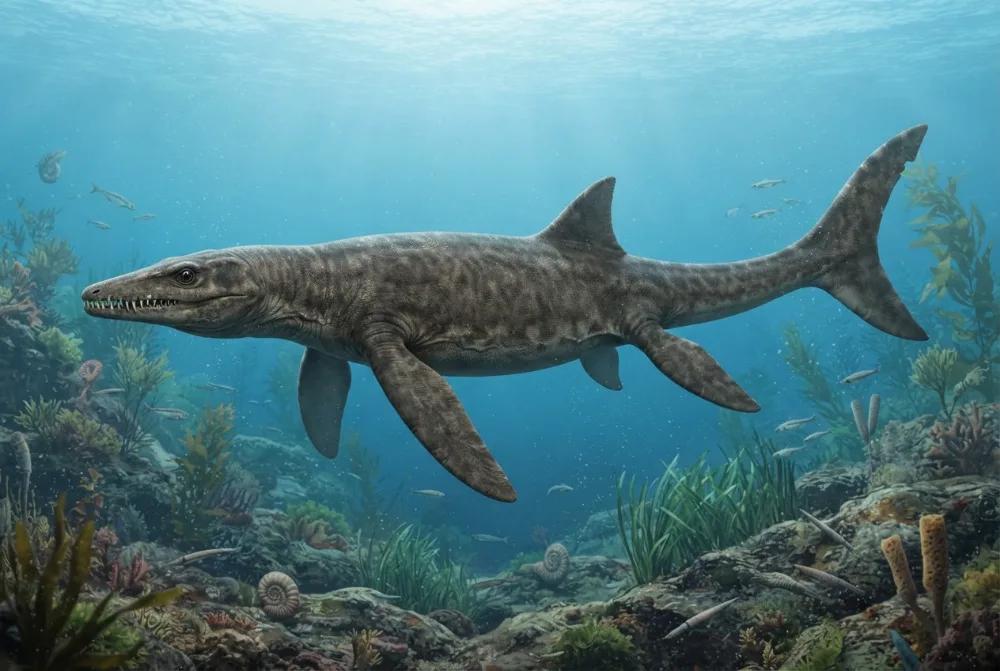
Megapterygius was a huge marine lizard that swam in the seas around Japan 72 million years ago. It had enormous flippers that were longer than its head, and scientists think it even had a dorsal fin like a shark!12
Azalaki na bomoi ntango nini?
Azalaki monene boni?
Azalaki molai boni?
Azalaki kilo boni?
 molai lokola bambwa 6 zolo kino mokila🍌molai lokola matoko 33 oyo balandani🍉kilo lokola bapasteke 90🧸kilo lokola bana 24 ya eteyelo ya bana mike🎒kilo lokola bana 14 ya kelasi🏊akokaki kobeta mai bolai ya pisine monene (50 m) na sekonde 4,7
Megapterygius azalaki monene boni soki tokokanisi na YO?
Kaka matematiki na navigatere na yo. Eloko moko te ebombami to etindami esika moko.
Azalaki na mbangu boni?


Makambo ya kosepelisa
Megapterygius had rear flippers that were even longer than its front flippers, a feature only seen in one other mosasaur, Tylosaurus.1
Its flippers were longer than its skull, which is unique among mosasaurs with paddle-like limbs.1
The shape of its backbone suggests it had a dorsal fin, like a dolphin or shark, which would have helped it turn quickly in the water.12
Its skull was slightly wide around the eye sockets, giving it binocular vision that helped it hunt prey. This is only the second mosasaur known to have this ability.1
The fossil was found in 2006 by Akihiro Misaki, who was actually looking for ammonite fossils when he spotted a vertebra.12
More than 100 shark teeth were found around the Megapterygius skeleton, suggesting that sharks scavenged its body after it died.1
Megapterygius is the most complete mosasaur skeleton ever found in Japan or the northwestern Pacific.2
Mituna oyo batunaka mingi na ntina na Megapterygius
?How big was Megapterygius?
Megapterygius was about 6 metres long, with a skull about 0.8 metres long. That is roughly the size of a large great white shark.12
?Did Megapterygius have a dorsal fin?
Scientists think it did. The shape of its backbone is like that of dolphins and porpoises, which have dorsal fins, and this would have helped it turn quickly in the water. It's the first mosasaur with evidence of a dorsal fin.12
?What did Megapterygius eat?
Scientists think it hunted large groups of small prey, like schools of fish. Its binocular vision and big flippers would have helped it catch them.1
Mpo na bayebi ya badino
- Nkombo ya siansi
- Megapterygius
- Nkombo epesamaki na
- Konishi et al. 20234
- Lisanga
- Bamozazore
- Libota / klade
- Mosasauridae4
- Klasifikasio
- Mosasauroidea4
- Mbula ya mabanga
- mbula milio 84 kino 66 (Campanian / Maastrichtian)4
- Milongo ya mabanga
- Toyajo4
- Bikolo
- Zapo4
- Bafosile oyo ekomami
- 1 na The Paleobiology Database4
- Ntango bamonaki yango
- The fossil was discovered in 2006 by Akihiro Misaki in Wakayama Prefecture, Japan. It was named Megapterygius wakayamaensis by Takuya Konishi and colleagues in 2023.12
- Naino bazali kowelana
- Scientists are still debating how Megapterygius used its four large flippers and tail fin together for swimming, since no modern animal has a similar body shape.2
Esika makambo euti
- Megapterygius (en.wikipedia.org)
- UC paleontologist describes Wakayama 'blue dragon' that ruled prehistoric waters off Japan - University of Cincinnati: Founder of Co-op, Leader in Co-op | University of Cincinnati (uc.edu)
- Megapterygius | Dino Encyclopedia (dinosaurmuseum.jp)
- Megapterygius in The Paleobiology Database (CC BY 4.0): mbula, bisika, milongo ya mabanga, klasifikasio.
Likambo nyonso na lokasa oyo ezali na nimero oyo elakisi liziba na yango. Soki tosali libunga, limbisa biso, tozali bato balingaka badino, zulunalo ya siansi te. Yebisa biso na [email protected] mpe tokobongisa yango.
 Rex azali na nzala! Dino Wiki ezali mosala ya tata moko mpo na mwana na ye ya mobali oyo alingaka badino, ofele, piblisite te mpe batrakere te. Bato bakolo bakoki kopesa Rex biskwi mpo na kosalisa ete etikala na internet.Leisa Rex
 Mosasaurus
 Prognathodon
 Tylosaurus
 Platecarpus
 Clidastes
 Globidens
 Tyrannosaurus
 Triceratops
 Velociraptor
 Spinosaurus
 Ankylosaurus
 Parasaurolophus