 Kwizi ya Ndiwe dino uti?
 Nkhondo ya madino
 Mpikisano wa madino
 Masewera ang'onoang'ono a madino
 Chimbale cha zomata
 Mindandanda ya TOP ya madino
 Ndidabwitse!
Alanqa
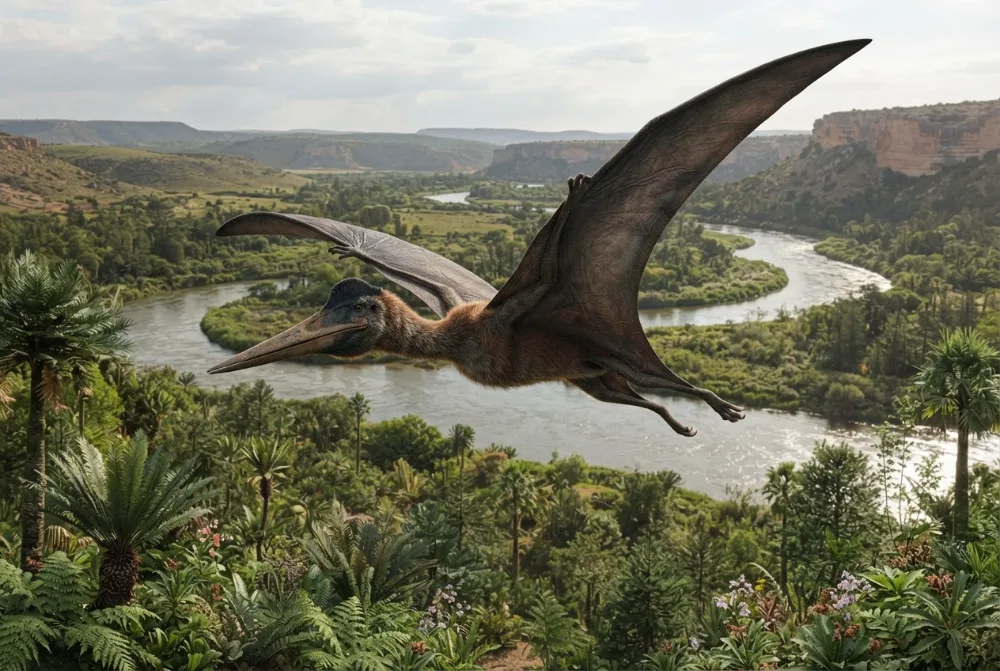
Alanqa was a giant flying reptile that soared over ancient rivers in what is now Morocco. It had a long, straight, pointed beak with no teeth, perfect for scooping up fish and other small animals.2
Ankakhala liti?
Anali wamkulu bwanji?
Mapiko ake anali otambalala bwanji?
Ankalemera bwanji?

 mapiko otambalala ngati njinga 3 pamzere🍉wolemera ngati mavwende 7⚽akanatha kuuluka kudutsa bwalo lonse la mpira m'masekondi 5.1
Alanqa anali wamkulu bwanji poyerekeza ndi IWEYO?
Ndi masamu chabe mu msakatuli wako. Palibe chimene chimasungidwa kapena kutumizidwa kwina kulikonse.
Anali ndi liwiro lotani?


Mfundo zosangalatsa
Alanqa is known from only five jaw fragments and possibly one neck vertebra, so scientists have not found a full skeleton yet.1
Its beak was straight and pointed, like a spear, and it had a raised bump on the top of its lower jaw near the back.2
The largest Alanqa individuals may have had a wingspan as wide as a small airplane, about 6 meters (20 feet).21
Alanqa lived alongside huge meat-eating dinosaurs like Spinosaurus and Carcharodontosaurus, which might have hunted it.1
The Kem Kem Beds where Alanqa was found were once a freshwater delta, full of rivers and swamps.1
Two of the jaw fragments were first described in 1999 but were not named until 2010, when scientists realized they belonged to a new species.1
Mafunso ofunsidwa kwambiri okhudza Alanqa
?How big was Alanqa?
Most Alanqa individuals had a wingspan of about 4 meters (13 feet), but a larger neck vertebra suggests some reached 6 meters (20 feet). An individual of that size would have weighed 16 to 37 kilograms (35 to 82 pounds).1
?What did Alanqa eat?
Alanqa probably ate small animals like crustaceans, mollusks, amphibians, small reptiles, and even small or juvenile dinosaurs. Grooves in its jaw suggest it also crushed hard foods like mollusks and seeds.1
?Is Alanqa a dinosaur?
No, Alanqa is a pterosaur, a flying reptile that is not a dinosaur.1
?Where was Alanqa found?
Alanqa was found in the Kem Kem Group of southeastern Morocco, in a place called Aferdou N'Chaft near the village of Begaa.1
?When did Alanqa live?
Alanqa lived during the Late Cretaceous period, specifically the Cenomanian stage, about 100 to 93 million years ago.1
?Did Alanqa have teeth?
No, Alanqa had no teeth. Its jaws were straight and pointed, like a spear, perfect for scooping up food.1
Kwa akatswiri a madino
- Dzina la sayansi
- Alanqa
- Anapatsidwa dzina ndi
- Ibrahim et al. 20104
- Gulu
- Zokwawa zouluka
- Banja / kladi
- Azhdarchidae4
- Magawidwe a sayansi
- Pterosauria > Pterodactyloidea > Azhdarchidae4
- Zaka za miyala
- zaka 100 mpaka 94 miliyoni (Cenomanian)4
- Mapangidwe a miyala
- Ifezouane4
- Mayiko
- Moroko4
- Zolemba za mafosili
- 4 mu The Paleobiology Database4
- Kupezeka
- Alanqa was named in 2010 by Ibrahim and colleagues based on a nearly complete lower jaw found at Aferdou N'Chaft, Morocco, in 2008.21
- Akukambiranabe
- Scientists are not sure if the large neck vertebra really belongs to Alanqa or to a different, even bigger pterosaur.21
Kumene mfundo zimachokera
- Alanqa (en.wikipedia.org)
- A New Pterosaur (Pterodactyloidea: Azhdarchidae) from the Upper Cretaceous of Morocco - PMC (pmc.ncbi.nlm.nih.gov)
- PBDB Taxon (paleobiodb.org)
- Alanqa in The Paleobiology Database (CC BY 4.0): zaka, malo, mapangidwe a miyala, magawidwe a sayansi.
Mfundo iliyonse patsamba lino ili ndi nambala yosonyeza kumene yachokera. Ngati talakwitsa kanthu, pepa, ndife okonda madino, osati magazini ya sayansi. Tiuze pa [email protected] ndipo tikonza.
 Rex ali ndi njala! Dino Wiki ndi ntchito ya bambo kwa mwana wawo wamwamuna wokonda madainoso, yaulere popanda zotsatsa ndi zokazonda. Akuluakulu angadyetse Rex zokhwasula-khwasula kuti tsambali lipitirize kupezeka pa intaneti.Dyetsa Rex
 Pteranodon
 Quetzalcoatlus
 Dorygnathus
 Rhamphorhynchus
 Anhanguera
 Pterodactylus
 Tyrannosaurus
 Triceratops
 Velociraptor
 Spinosaurus
 Ankylosaurus
 Parasaurolophus