 Kwizi ya Ndiwe dino uti?
 Nkhondo ya madino
 Mpikisano wa madino
 Masewera ang'onoang'ono a madino
 Chimbale cha zomata
 Mindandanda ya TOP ya madino
 Ndidabwitse!
Apatornis
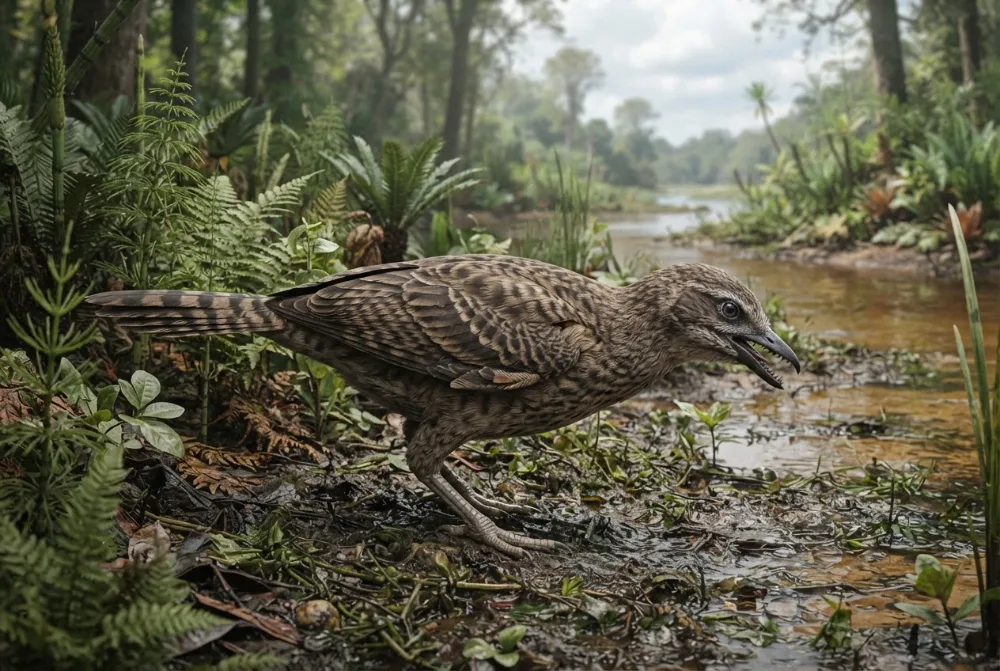
Apatornis was a small, toothed bird that lived in the Late Cretaceous period, about 83.5 million years ago. It was a fast, ground-dwelling hunter that probably chased after small prey. Even though it could fly, it spent much of its time on the ground.12
Ankakhala liti?
Anali wamkulu bwanji?
Anali wautali bwanji?
Msinkhu wake unali wautali bwanji?
kuyerekeza
Apatornis anali wamkulu bwanji poyerekeza ndi IWEYO?
Ndi masamu chabe mu msakatuli wako. Palibe chimene chimasungidwa kapena kutumizidwa kwina kulikonse.
Anali ndi liwiro lotani?


Mfundo zosangalatsa
Apatornis had at least one more rib attached to its hip vertebrae than its close relative Ichthyornis, and maybe more, because the whole hip bone wasn't preserved.1
Unlike Ichthyornis, Apatornis did not have ossified tendons covering the top of its sacral region, which is a unique feature.1
The only known fossil of Apatornis is a synsacrum, which is the fused vertebrae over the hips, and it was found in the Smoky Hill Chalk of Kansas.1
Apatornis was originally classified as a species of Ichthyornis, but scientists now think it's more closely related to modern birds.1
The type specimen of Apatornis was discovered by Othniel Charles Marsh in October 1872 at Butte Creek in Kansas.1
Apatornis lived during the Coniacian to Santonian stages, about 89.8 to 83.6 million years ago.2
Mafunso ofunsidwa kwambiri okhudza Apatornis
?How big was Apatornis?
It was very small, about 18 to 20 centimetres long, which is roughly the size of a modern sparrow.1
?What did Apatornis eat?
It was a ground-dwelling carnivore that probably chased after small prey like insects or tiny vertebrates.2
?Could Apatornis fly?
Yes, it could fly, but it spent much of its time on the ground hunting for food.1
?Is Apatornis a dinosaur?
Yes, Apatornis is a genus of ornithuran dinosaurs, specifically a small, toothed bird from the Late Cretaceous.1
Wothetsa nthano zabodza
Nthano: Apatornis was a close relative of Ichthyornis.
Zoona: Scientists used to think so, but in 2004, Julia Clarke showed that Apatornis is actually more closely related to modern birds than to Ichthyornis.1
Kwa akatswiri a madino
- Dzina la sayansi
- Apatornis
- Anapatsidwa dzina ndi
- Marsh 18732
- Gulu
- Mbalame zoyambirira
- Banja / kladi
- Ornithurae2
- Magawidwe a sayansi
- Theropoda > Avialae2
- Zaka za miyala
- zaka 90 mpaka 84 miliyoni (Coniacian / Santonian)2
- Mapangidwe a miyala
- Niobrara2
- Mayiko
- Amereka2
- Zolemba za mafosili
- 1 mu The Paleobiology Database2
- Kupezeka
- Apatornis was named by Othniel Charles Marsh in 1873. He found the first fossil, a synsacrum, in October 1872 at Butte Creek in Kansas, USA.1
- Akukambiranabe
- Scientists are still debating whether Apatornis is a valid genus or just a variation of Ichthyornis, because the only fossil is so incomplete.1
Kumene mfundo zimachokera
- Apatornis (en.wikipedia.org)
- Apatornis in The Paleobiology Database (CC BY 4.0): zaka, malo, mapangidwe a miyala, magawidwe a sayansi.
Mfundo iliyonse patsamba lino ili ndi nambala yosonyeza kumene yachokera. Ngati talakwitsa kanthu, pepa, ndife okonda madino, osati magazini ya sayansi. Tiuze pa [email protected] ndipo tikonza.
 Rex ali ndi njala! Dino Wiki ndi ntchito ya bambo kwa mwana wawo wamwamuna wokonda madainoso, yaulere popanda zotsatsa ndi zokazonda. Akuluakulu angadyetse Rex zokhwasula-khwasula kuti tsambali lipitirize kupezeka pa intaneti.Dyetsa Rex
 Archaeopteryx
 Hesperornis
 Ichthyornis
 Baptornis
 Jurapteryx
 Gobipteryx
 Tyrannosaurus
 Triceratops
 Velociraptor
 Spinosaurus
 Ankylosaurus
 Parasaurolophus