 Kwizi ya Ndiwe dino uti?
 Nkhondo ya madino
 Mpikisano wa madino
 Masewera ang'onoang'ono a madino
 Chimbale cha zomata
 Mindandanda ya TOP ya madino
 Ndidabwitse!
Archaeornithoides
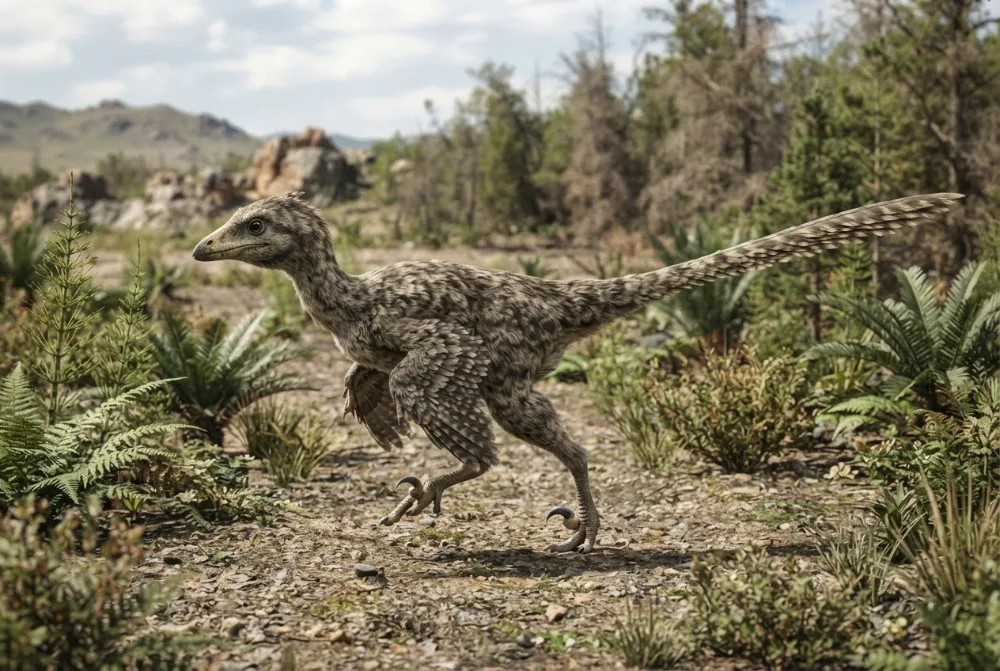
Archaeornithoides was a tiny, bird-like dinosaur that lived in what is now Mongolia. It was one of the smallest non-avian dinosaurs ever found, about the size of a chicken. Scientists think it may have been a close relative of birds.1
Ankakhala liti?
Anali wamkulu bwanji?
Anali wautali bwanji?
Archaeornithoides anali wamkulu bwanji poyerekeza ndi IWEYO?
Ndi masamu chabe mu msakatuli wako. Palibe chimene chimasungidwa kapena kutumizidwa kwina kulikonse.
Anali ndi liwiro lotani?


Mfundo zosangalatsa
The only known fossil of Archaeornithoides is a tiny skull and jaw fragment, just 27 millimetres long.1
The fossil has bite marks on it, and scientists think a weasel-sized mammal called Deltatheridium may have bitten off the dinosaur's head.1
This dinosaur lived about 83 to 72 million years ago, during the Late Cretaceous period.2
Its name means 'shaped like an ancient bird' because it had many bird-like features in its skull.1
Some scientists think Archaeornithoides might be a baby of another troodontid dinosaur, but others believe it is a distinct species.1
The fossil was found in 1965 by a Polish-Mongolian expedition, but it wasn't named until 1992.1
Mafunso ofunsidwa kwambiri okhudza Archaeornithoides
?How big was Archaeornithoides?
About 50 to 60 centimetres long, based on the only known fossil, which was a juvenile. Adult size is not known for sure.1
?What did Archaeornithoides eat?
It was a carnivore, meaning it ate meat. Its small, smooth teeth were good for catching tiny prey.31
?Did Archaeornithoides have feathers?
No fossil feathers have been found with Archaeornithoides, but because it was a close relative of birds and troodontids, many scientists think it probably had feathers.1
?Is Archaeornithoides a bird?
No, it is a non-avian dinosaur, not a bird. But its skull had many bird-like features, which is why its name means 'shaped like an ancient bird'.1
Wothetsa nthano zabodza
Nthano: Archaeornithoides was a bird.
Zoona: It was a non-avian dinosaur, though it had many bird-like features and was once thought to be the closest relative of birds.1
Kwa akatswiri a madino
- Dzina la sayansi
- Archaeornithoides
- Anapatsidwa dzina ndi
- Elzanowski and Wellnhofer 19924
- Gulu
- Maraputala
- Banja / kladi
- Troodontidae4
- Magawidwe a sayansi
- Theropoda > Troodontidae4
- Zaka za miyala
- zaka 84 mpaka 72 miliyoni (Campanian)4
- Mapangidwe a miyala
- Djadokhta4
- Mayiko
- Mongoliya4
- Zolemba za mafosili
- 1 mu The Paleobiology Database4
- Kupezeka
- The fossil was found in 1965 at Bayn Dzak, Mongolia, by a Polish-Mongolian expedition. It was named Archaeornithoides deinosauriscus by Andrzej Elzanowski and Peter Wellnhofer in 1992.1
- Akukambiranabe
- Scientists are not sure if Archaeornithoides is a distinct species or a juvenile of another troodontid dinosaur like Saurornithoides or Byronosaurus.1
Kumene mfundo zimachokera
- Archaeornithoides (en.wikipedia.org)
- PBDB Taxon (paleobiodb.org)
- Archaeornithoides — Facts, Size, Diet & Pronunciation | Types of Dinosaurs (typesofdinosaurs.com)
- Archaeornithoides in The Paleobiology Database (CC BY 4.0): zaka, malo, mapangidwe a miyala, magawidwe a sayansi.
Mfundo iliyonse patsamba lino ili ndi nambala yosonyeza kumene yachokera. Ngati talakwitsa kanthu, pepa, ndife okonda madino, osati magazini ya sayansi. Tiuze pa [email protected] ndipo tikonza.
 Rex ali ndi njala! Dino Wiki ndi ntchito ya bambo kwa mwana wawo wamwamuna wokonda madainoso, yaulere popanda zotsatsa ndi zokazonda. Akuluakulu angadyetse Rex zokhwasula-khwasula kuti tsambali lipitirize kupezeka pa intaneti.Dyetsa Rex
 Velociraptor
 Microraptor
 Deinonychus
 Asiamericana
 Richardoestesia
 Saurornitholestes
 Tyrannosaurus
 Triceratops
 Spinosaurus
 Ankylosaurus
 Parasaurolophus
 Pteranodon