 Kwizi ya Ndiwe dino uti?
 Nkhondo ya madino
 Mpikisano wa madino
 Masewera ang'onoang'ono a madino
 Chimbale cha zomata
 Mindandanda ya TOP ya madino
 Ndidabwitse!
Ankakhala liti?

Anali wamkulu bwanji?
Anali wautali bwanji?
Msinkhu wake unali wautali bwanji?
Ankalemera bwanji?
 wautali ngati amphaka a pakhomo 4 otsatizana mphuno ndi mchira🍌wautali ngati nthochi 11 zotsatizana🍉wolemera ngati mavwende 4🏃akanatha kuthamanga mamita 100 m'masekondi 10 (munthu waliwiro kwambiri amafunika 9.6)
Byronosaurus anali wamkulu bwanji poyerekeza ndi IWEYO?
Ndi masamu chabe mu msakatuli wako. Palibe chimene chimasungidwa kapena kutumizidwa kwina kulikonse.
Anali ndi liwiro lotani?


Mfundo zosangalatsa
Byronosaurus had a large brain for its size, making it one of the smartest non-bird dinosaurs.1
Its eyes faced forward, so it could judge distances well, which helped it hunt.2
Two baby Byronosaurus skulls were found inside a nest of oviraptorid eggs, probably as leftovers from a predator.1
Unlike other troodontids, Byronosaurus had smooth teeth without serrations, like its close relative Xixiasaurus.1
The first Byronosaurus fossils were discovered in 1993 by an American Museum of Natural History expedition to the Gobi Desert.1
Byronosaurus lived during the Late Cretaceous, about 80 to 71 million years ago.1
Its bones were mixed with bones of other animals when found, and scientists had to carefully sort them out.2
Mafunso ofunsidwa kwambiri okhudza Byronosaurus
?How big was Byronosaurus?
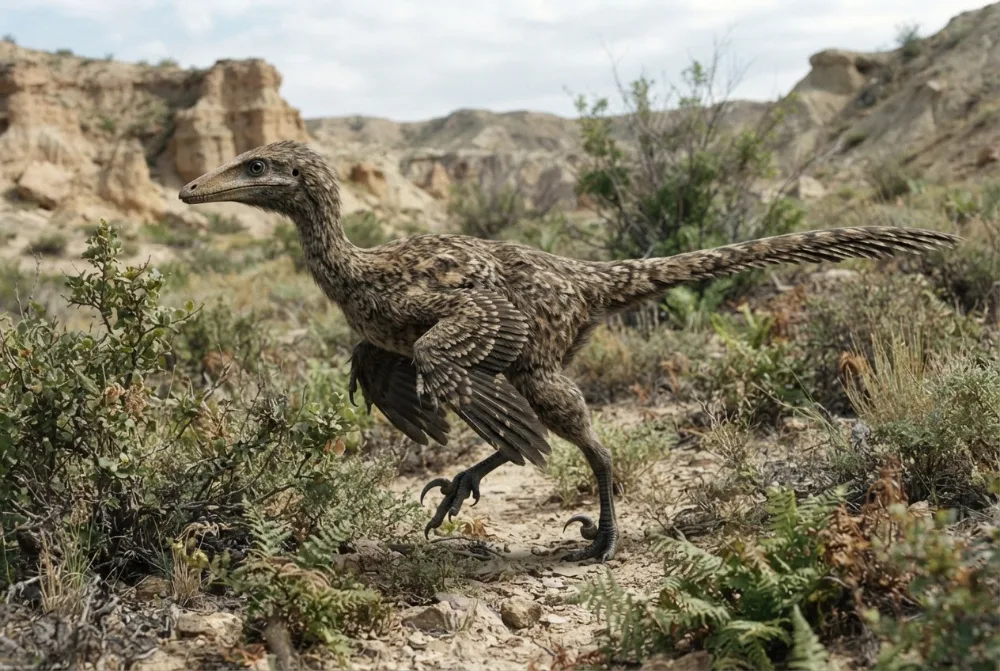
Byronosaurus was a small dinosaur, about 1.5 to 2 metres (5 to 6.6 feet) long and 50 cm (20 inches) tall. It weighed only about 4 to 20 kg (9 to 44 pounds), about the size of a large bird.12
?What did Byronosaurus eat?
Scientists are not sure. Some think it ate meat, others think it may have eaten plants or both. Its smooth teeth without serrations suggest it may have had a different diet from other troodontids.1
?When did Byronosaurus live?
Byronosaurus lived during the Late Cretaceous Period, about 80 to 71 million years ago. Its fossils were found in Mongolia.12
?Was Byronosaurus a dinosaur?
Yes, Byronosaurus was a small theropod dinosaur, specifically a troodontid. It was not a bird, but it was closely related to birds.1
Wothetsa nthano zabodza
Nthano: Some people think all troodontids were meat-eaters with serrated teeth.
Zoona: Byronosaurus had smooth teeth without serrations, so it may have been an omnivore or herbivore, not a pure carnivore.1
Kwa akatswiri a madino
- Dzina la sayansi
- Byronosaurus
- Anapatsidwa dzina ndi
- Norell et al. 20003
- Gulu
- Maraputala
- Banja / kladi
- Troodontidae3
- Magawidwe a sayansi
- Theropoda > Troodontidae3
- Zaka za miyala
- zaka 84 mpaka 72 miliyoni (Campanian)3
- Mapangidwe a miyala
- Djadokhta3
- Mayiko
- Mongoliya3
- Zolemba za mafosili
- 3 mu The Paleobiology Database3
- Kupezeka
- Byronosaurus was named in 2000 by Mark Norell, Peter Makovicky, and James Clark. The first skeleton was found in 1993 at Ukhaa Tolgod, Mongolia, and a second skull was found in 1996 at Bolor's Hill.1
- Akukambiranabe
- Scientists are not sure what Byronosaurus ate. Its smooth teeth suggest it might have been an omnivore or herbivore, but some experts think it was still a carnivore.1
Kumene mfundo zimachokera
- Byronosaurus (en.wikipedia.org)
- Byronosaurus jaffei | AMNH (amnh.org)
- Byronosaurus in The Paleobiology Database (CC BY 4.0): zaka, malo, mapangidwe a miyala, magawidwe a sayansi.
Mfundo iliyonse patsamba lino ili ndi nambala yosonyeza kumene yachokera. Ngati talakwitsa kanthu, pepa, ndife okonda madino, osati magazini ya sayansi. Tiuze pa [email protected] ndipo tikonza.
 Rex ali ndi njala! Dino Wiki ndi ntchito ya bambo kwa mwana wawo wamwamuna wokonda madainoso, yaulere popanda zotsatsa ndi zokazonda. Akuluakulu angadyetse Rex zokhwasula-khwasula kuti tsambali lipitirize kupezeka pa intaneti.Dyetsa Rex
 Velociraptor
 Microraptor
 Deinonychus
 Asiamericana
 Richardoestesia
 Saurornitholestes
 Tyrannosaurus
 Triceratops
 Spinosaurus
 Ankylosaurus
 Parasaurolophus
 Pteranodon