 Kwizi ya Ndiwe dino uti?
 Nkhondo ya madino
 Mpikisano wa madino
 Masewera ang'onoang'ono a madino
 Chimbale cha zomata
 Mindandanda ya TOP ya madino
 Ndidabwitse!
Carinodens
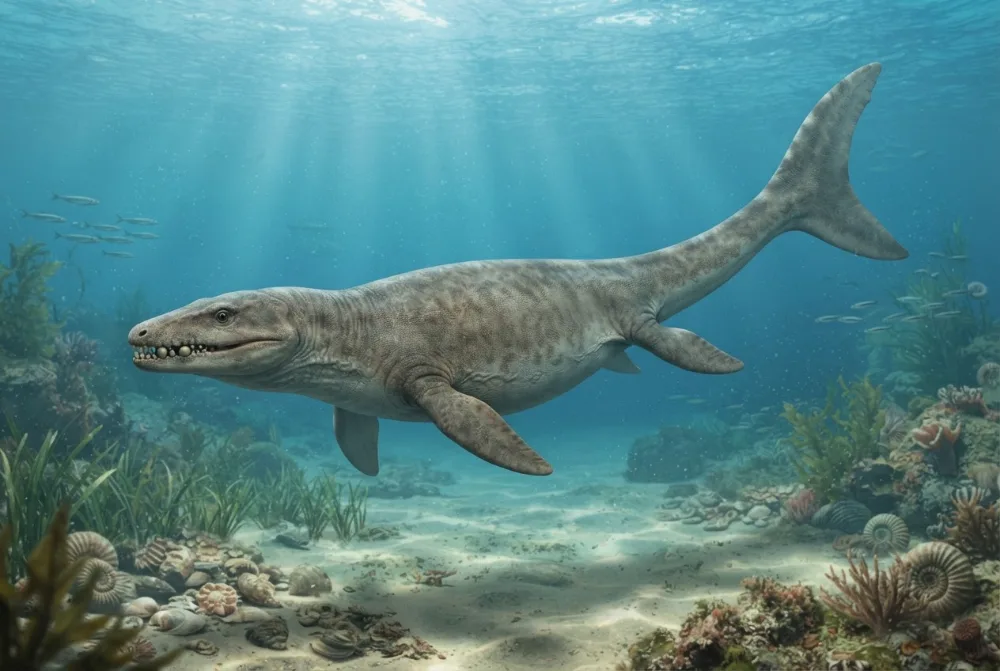
Carinodens was a small mosasaur, a marine lizard that lived in the late Cretaceous seas. It had round, blunt teeth like a set of nutcrackers for crushing hard-shelled animals. At only about 2 to 2.6 metres long, it was one of the tiniest mosasaurs ever.1
Ankakhala liti?
Anali wamkulu bwanji?
Anali wautali bwanji?
 wautali ngati agalu 2.5 otsatizana mphuno ndi mchira🍌wautali ngati nthochi 14 zotsatizana🏊akanatha kusambira utali wa dziwe lalikulu losambira (50 m) m'masekondi 6
Carinodens anali wamkulu bwanji poyerekeza ndi IWEYO?
Ndi masamu chabe mu msakatuli wako. Palibe chimene chimasungidwa kapena kutumizidwa kwina kulikonse.
Anali ndi liwiro lotani?


Mfundo zosangalatsa
Carinodens was first thought to be a crocodile! A fossil jaw was originally named Bottosaurus belgicus and considered a crocodilian before being recognized as a mosasaur.1
Its teeth were very different from each other. The front teeth were round and curved, while the back teeth were flat and blade-like with a keel on each side.1
Scientists can tell what Carinodens ate by looking at tiny scratches on its teeth. The wear patterns show it munched on hard-shelled animals that lived on the seafloor.1
Carinodens is closely related to Globidens, another mosasaur with crushing teeth. Together they belong to a group called Globidensini.1
The name Carinodens means 'keel teeth' because its teeth have a ridge like the keel of a boat. It replaced the older name Compressidens, which was already used for a different animal.1
Mafunso ofunsidwa kwambiri okhudza Carinodens
?What did Carinodens eat?
Carinodens ate hard-shelled animals like clams, oysters, and sea urchins. Its blunt teeth were perfect for crushing them, and scratches on the teeth show it munched on creatures that lived on the seafloor.12
?How big was Carinodens?
Carinodens was about 2 to 2.6 metres (6.6 to 8.5 feet) long. That makes it one of the smallest mosasaurs ever.1
?Where did Carinodens live?
Carinodens lived in the late Cretaceous seas, and its fossils have been found in Europe, North America, South America, and North Africa. Most skull fossils come from the Netherlands and Belgium.1
?Is Carinodens a dinosaur?
No, Carinodens is not a dinosaur. It is a marine lizard called a mosasaur that lived in the sea during the time of the dinosaurs.1
Kwa akatswiri a madino
- Dzina la sayansi
- Carinodens
- Anapatsidwa dzina ndi
- Thurmond 19693
- Gulu
- Mamosasauri
- Banja / kladi
- Mosasauridae3
- Magawidwe a sayansi
- Mosasauroidea3
- Zaka za miyala
- zaka 72 mpaka 66 miliyoni (Maastrichtian)3
- Mapangidwe a miyala
- Maastricht, Gramame, Bereza Beds3
- Mayiko
- Netherlands, Moroko, Brazil, Ukraine, Rasha, Belgium3
- Zolemba za mafosili
- 16 mu The Paleobiology Database3
- Kupezeka
- The first fossils were found in Belgium and described by Louis Dollo in 1913 as Globidens fraasi. In 1969, J.T. Thurmond gave it the new name Carinodens because the old name was already taken.1
- Akukambiranabe
- Scientists are not sure how many species of Carinodens existed. Some think C. belgicus and C. fraasi might be the same species, while others believe they are different based on tooth shape.1
Kumene mfundo zimachokera
- Carinodens (en.wikipedia.org)
- Feeding the Mechanical Mosasaur: what did Carinodens eat? | Netherlands Journal of Geosciences | Cambridge Core (cambridge.org)
- Carinodens in The Paleobiology Database (CC BY 4.0): zaka, malo, mapangidwe a miyala, magawidwe a sayansi.
Mfundo iliyonse patsamba lino ili ndi nambala yosonyeza kumene yachokera. Ngati talakwitsa kanthu, pepa, ndife okonda madino, osati magazini ya sayansi. Tiuze pa [email protected] ndipo tikonza.
 Rex ali ndi njala! Dino Wiki ndi ntchito ya bambo kwa mwana wawo wamwamuna wokonda madainoso, yaulere popanda zotsatsa ndi zokazonda. Akuluakulu angadyetse Rex zokhwasula-khwasula kuti tsambali lipitirize kupezeka pa intaneti.Dyetsa Rex
 Mosasaurus
 Prognathodon
 Tylosaurus
 Platecarpus
 Clidastes
 Globidens
 Tyrannosaurus
 Triceratops
 Velociraptor
 Spinosaurus
 Ankylosaurus
 Parasaurolophus