 Kwizi ya Ndiwe dino uti?
 Nkhondo ya madino
 Mpikisano wa madino
 Masewera ang'onoang'ono a madino
 Chimbale cha zomata
 Mindandanda ya TOP ya madino
 Ndidabwitse!
Ankakhala liti?

Anali wamkulu bwanji?
Anali wautali bwanji?
Msinkhu wake unali wautali bwanji?
kuyerekeza
Ankalemera bwanji?
 wautali ngati amphaka a pakhomo 2 otsatizana mphuno ndi mchira🍌wautali ngati nthochi 6 zotsatizanawolemera pafupifupi ngati mphaka wa pakhomo🍌wolemera ngati nthochi 42🪑wamng'ono moti angayende pansi pa mpando🏃akanatha kuthamanga mamita 100 m'masekondi 14 (munthu waliwiro kwambiri amafunika 9.6)
Caudipteryx anali wamkulu bwanji poyerekeza ndi IWEYO?
Ndi masamu chabe mu msakatuli wako. Palibe chimene chimasungidwa kapena kutumizidwa kwina kulikonse.
Anali ndi liwiro lotani?


Mfundo zosangalatsa
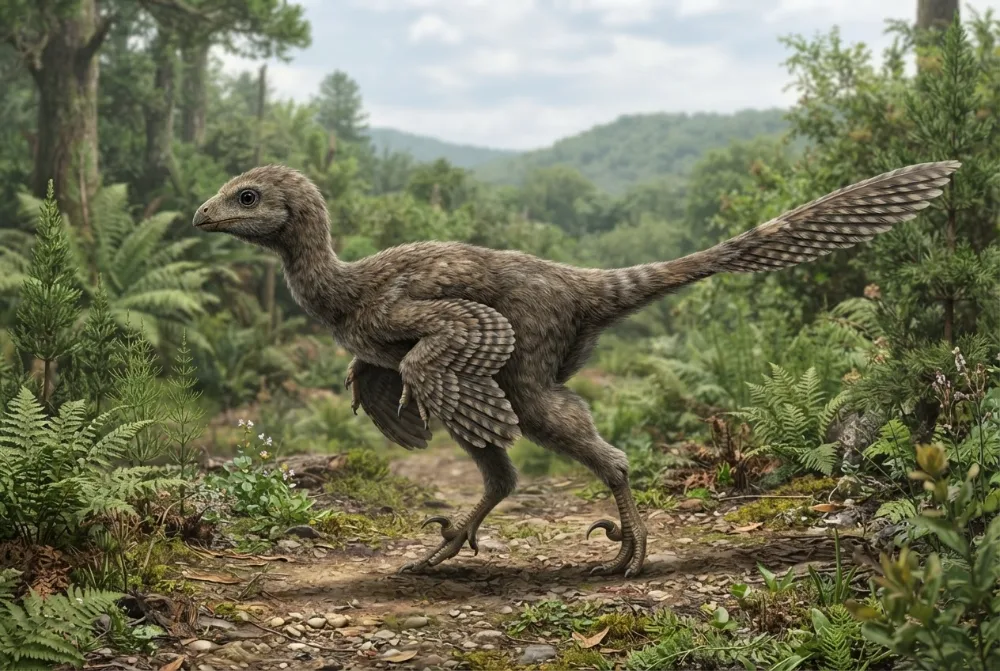
Caudipteryx had long, symmetrical feathers on its hands and tail, measuring 15 to 20 centimetres (5.9 to 7.9 inches) long. These feathers were black with a banded pattern on the tail.1
Its discovery in 1998 helped prove that birds evolved from dinosaurs, because it had clear feathers but was not a bird.1
Caudipteryx had a short, boxy skull with a beak-like snout and only a few teeth in the front of its upper jaw.1
Scientists think Caudipteryx was secondarily flightless, meaning its ancestors could fly but it lost that ability.1
Fossils of Caudipteryx have been found with gizzard stones in the place where its stomach would have been, just like in some plant-eating dinosaurs and modern birds.1
Mafunso ofunsidwa kwambiri okhudza Caudipteryx
?How big was Caudipteryx?
About 72.5 to 89 centimetres (2 feet 4.5 inches to 2 feet 11 inches) long and weighed around 5 kilograms (11 pounds). It was about the size of a peacock.14
?What did Caudipteryx eat?
It was an omnivore. It probably ate insects and maybe plants, and it swallowed small stones called gastroliths to help digest its food.12
?Could Caudipteryx fly?
No, it could not fly. Its arms were too short to work as wings, and scientists think it was secondarily flightless, meaning its ancestors could fly but it lost that ability.14
?When did Caudipteryx live?
It lived during the Early Cretaceous period, about 124 to 122 million years ago.12
?Where was Caudipteryx found?
All Caudipteryx fossils have been found in the Yixian Formation in Liaoning, China.14
?Is Caudipteryx a bird?
Most scientists say it is a non-avian dinosaur, but a few think it might be a flightless bird. The debate helped prove that birds evolved from dinosaurs.1
Wothetsa nthano zabodza
Nthano: Caudipteryx was a bird because it had feathers.
Zoona: Caudipteryx was a non-avian dinosaur, not a bird. It belongs to a group called oviraptorosaurs, which are dinosaurs closely related to birds.1
Kwa akatswiri a madino
- Dzina la sayansi
- Caudipteryx
- Anapatsidwa dzina ndi
- Ji et al. 19985
- Gulu
- Madino a nthenga achilendo
- Banja / kladi
- Oviraptorosauria5
- Magawidwe a sayansi
- Theropoda > Oviraptorosauria5
- Zaka za miyala
- zaka 126 mpaka 120 miliyoni (Barremian / Aptian)5
- Mapangidwe a miyala
- Yixian5
- Mayiko
- China5
- Zolemba za mafosili
- 2 mu The Paleobiology Database5
- Kupezeka
- Caudipteryx was named in 1998 by Ji and colleagues based on two nearly complete skeletons found in Liaoning, China. The name honors Zou Jiahua, a Chinese vice premier.1
- Akukambiranabe
- Scientists still debate whether Caudipteryx was a bird or a non-avian dinosaur, though most now agree it is a non-avian oviraptorosaur.1
Kumene mfundo zimachokera
- Caudipteryx (en.wikipedia.org)
- Caudipteryx | Natural History Museum (nhm.ac.uk)
- PBDB Taxon (paleobiodb.org)
- Caudipteryx | Size, Habitat, & Facts | Britannica (britannica.com)
- Caudipteryx in The Paleobiology Database (CC BY 4.0): zaka, malo, mapangidwe a miyala, magawidwe a sayansi.
Mfundo iliyonse patsamba lino ili ndi nambala yosonyeza kumene yachokera. Ngati talakwitsa kanthu, pepa, ndife okonda madino, osati magazini ya sayansi. Tiuze pa [email protected] ndipo tikonza.
 Rex ali ndi njala! Dino Wiki ndi ntchito ya bambo kwa mwana wawo wamwamuna wokonda madainoso, yaulere popanda zotsatsa ndi zokazonda. Akuluakulu angadyetse Rex zokhwasula-khwasula kuti tsambali lipitirize kupezeka pa intaneti.Dyetsa Rex
 Therizinosaurus
 Oviraptor
 Chirostenotes
 Citipes
 Leptorhynchos
 Avimimus
 Stegosaurus
 Iguanodon
 Archaeopteryx
 Giganotosaurus
 Microraptor
 Deinonychus