 Kwizi ya Ndiwe dino uti?
 Nkhondo ya madino
 Mpikisano wa madino
 Masewera ang'onoang'ono a madino
 Chimbale cha zomata
 Mindandanda ya TOP ya madino
 Ndidabwitse!
Ankakhala liti?

Anali wamkulu bwanji?
Anali wautali bwanji?
Msinkhu wake unali wautali bwanji?
kuyerekeza
Ankalemera bwanji?

 wautali ngati amphaka a pakhomo 4 otsatizana mphuno ndi mchira🍌wautali ngati nthochi 11 zotsatizanawolemera ngati amphaka a pakhomo 10🍉wolemera ngati mavwende 8🧸wolemera ngati ana a sukulu ya mkaka 2🎒wolemera ngati ana a sukulu 1🏃akanatha kuthamanga mamita 100 m'masekondi 8.2 (munthu waliwiro kwambiri amafunika 9.6)
Oviraptor anali wamkulu bwanji poyerekeza ndi IWEYO?
Ndi masamu chabe mu msakatuli wako. Palibe chimene chimasungidwa kapena kutumizidwa kwina kulikonse.
Anali ndi liwiro lotani?


Mfundo zosangalatsa
Oviraptor had no teeth. Instead it used a horny beak to crush its food.2
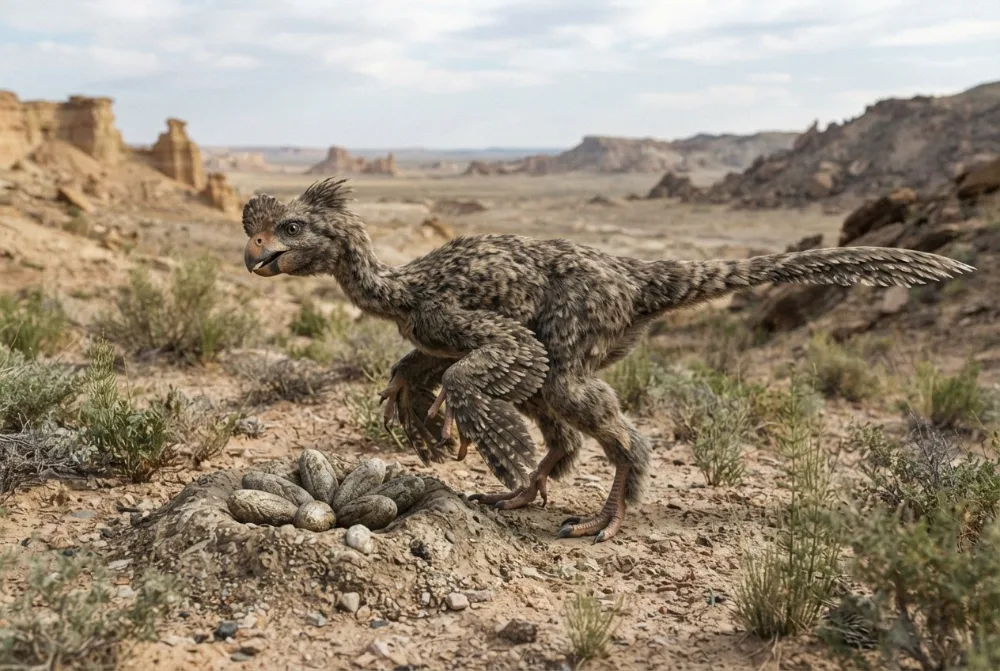
The first Oviraptor fossil was found lying on top of a nest of eggs. Scientists thought it was stealing them, but later they realized it was probably protecting its own eggs.1
Oviraptor was covered in feathers. Its tail ended in a pygostyle, a bone that supported a fan of feathers.1
Oviraptor lived about 75 to 71 million years ago, during the Late Cretaceous period.1
Its arms were long and ended in three fingers with curved claws.1
The name Oviraptor means 'egg thief' because the first fossil was found with eggs. But scientists now think it was a good parent, not a thief.1
Mafunso ofunsidwa kwambiri okhudza Oviraptor
?How big was Oviraptor?
Oviraptor was about 1.6 to 2 metres (5.2 to 6.6 feet) long and weighed between 33 and 40 kilograms (73 to 88 pounds).1
?Did Oviraptor have teeth?
No, Oviraptor had no teeth. It had a horny beak like a parrot that could crush hard food.12
?What did Oviraptor eat?
Oviraptor was an omnivore. It ate hard fruits, eggs, and possibly shellfish, using its strong beak to crush them.2
?Did Oviraptor steal eggs?
No, that was a mistake. Scientists once thought Oviraptor stole eggs, but now we know it was actually a caring parent that brooded its own eggs.1
?Did Oviraptor have feathers?
Yes, Oviraptor was covered in feathers. Its tail ended in a pygostyle that supported a fan of feathers.1
?When did Oviraptor live?
Oviraptor lived during the Late Cretaceous period, about 85 to 75 million years ago.2
?Where was Oviraptor found?
Oviraptor fossils were found in the Gobi Desert of Mongolia, at a place called the Flaming Cliffs.1
?What does the name Oviraptor mean?
Oviraptor means 'egg thief' in Latin, because the first fossil was found lying on a nest of eggs. But we now know it was a good parent, not a thief.1
Wothetsa nthano zabodza
Nthano: Oviraptor stole and ate the eggs of other dinosaurs.
Zoona: The Oviraptor fossil was found on a nest, but it was probably sitting on its own eggs to keep them warm, like a bird. It likely ate plants, fruits, and small animals, not eggs.1
Kwa akatswiri a madino
- Dzina la sayansi
- Oviraptor
- Anapatsidwa dzina ndi
- Osborn 19243
- Gulu
- Madino a nthenga achilendo
- Banja / kladi
- Oviraptoridae3
- Magawidwe a sayansi
- Theropoda > Oviraptorosauria3
- Zaka za miyala
- zaka 90 mpaka 72 miliyoni (Coniacian / Campanian)3
- Mapangidwe a miyala
- Djadokhta, Dabrazhin3
- Mayiko
- Mongoliya, Kazakhstan3
- Zolemba za mafosili
- 3 mu The Paleobiology Database3
- Kupezeka
- Oviraptor was discovered in 1923 in the Gobi Desert of Mongolia during an expedition led by Roy Chapman Andrews. It was named by Henry Fairfield Osborn in 1924.1
- Akukambiranabe
- Scientists are not sure exactly what Oviraptor ate. Its strong beak could crush hard objects, but whether it mainly ate plants, eggs, or shellfish is still debated.21
Kumene mfundo zimachokera
- Oviraptor (en.wikipedia.org)
- Oviraptor | Natural History Museum (nhm.ac.uk)
- Oviraptor in The Paleobiology Database (CC BY 4.0): zaka, malo, mapangidwe a miyala, magawidwe a sayansi.
Mfundo iliyonse patsamba lino ili ndi nambala yosonyeza kumene yachokera. Ngati talakwitsa kanthu, pepa, ndife okonda madino, osati magazini ya sayansi. Tiuze pa [email protected] ndipo tikonza.
 Rex ali ndi njala! Dino Wiki ndi ntchito ya bambo kwa mwana wawo wamwamuna wokonda madainoso, yaulere popanda zotsatsa ndi zokazonda. Akuluakulu angadyetse Rex zokhwasula-khwasula kuti tsambali lipitirize kupezeka pa intaneti.Dyetsa Rex
 Therizinosaurus
 Chirostenotes
 Citipes
 Leptorhynchos
 Avimimus
 Caenagnathus
 Tyrannosaurus
 Triceratops
 Velociraptor
 Spinosaurus
 Ankylosaurus
 Parasaurolophus