 Kwizi ya Ndiwe dino uti?
 Nkhondo ya madino
 Mpikisano wa madino
 Masewera ang'onoang'ono a madino
 Chimbale cha zomata
 Mindandanda ya TOP ya madino
 Ndidabwitse!
Ankakhala liti?

Anali wamkulu bwanji?
Anali wautali bwanji?
 wautali ngati amphaka a pakhomo 5 otsatizana mphuno ndi mchira🍌wautali ngati nthochi 13 zotsatizana🏃akanatha kuthamanga mamita 100 m'masekondi 8.8 (munthu waliwiro kwambiri amafunika 9.6)
Diluvicursor anali wamkulu bwanji poyerekeza ndi IWEYO?
Ndi masamu chabe mu msakatuli wako. Palibe chimene chimasungidwa kapena kutumizidwa kwina kulikonse.
Anali ndi liwiro lotani?


Mfundo zosangalatsa
Diluvicursor's name means 'flood runner' because its body was found in a deep, fast-moving river deposit.1
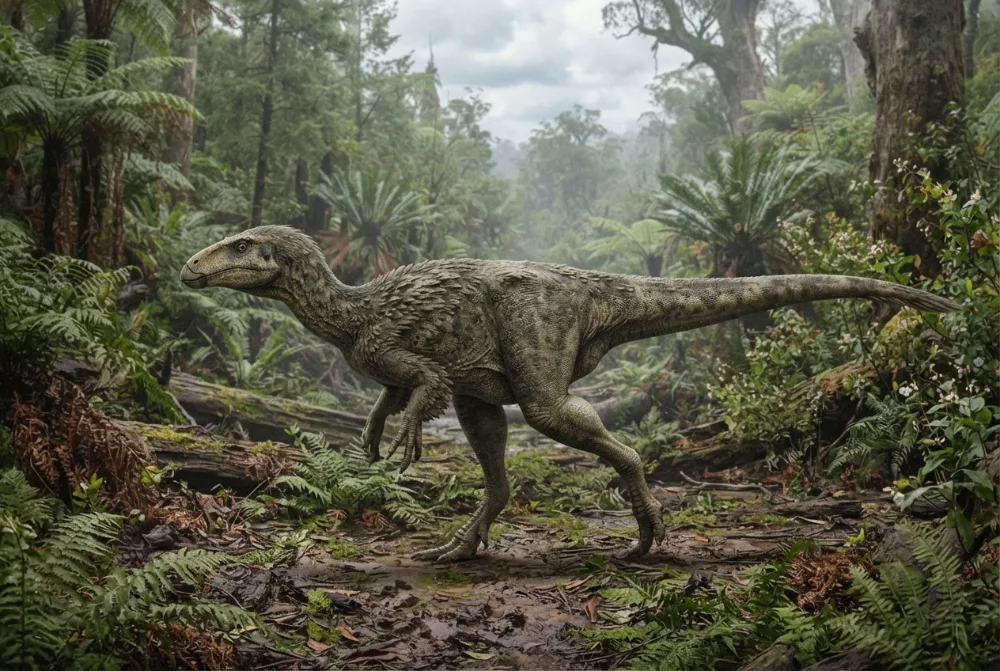
The only known skeleton is a juvenile that was about 1.2 metres long, about the size of a wild turkey.1
An adult Diluvicursor probably grew to at least 2.3 metres long, similar in size to a rhea.1
Its tail was short but very strong, with wide bones that suggest powerful muscles for running.2
Diluvicursor lived about 113 to 112 million years ago, during the Early Cretaceous period.1
The fossil was found in a log-filled scour in an ancient river, possibly caught on a tree stump.1
Scientists think Diluvicursor was closely related to other small ornithopods from South America and Antarctica.2
Mafunso ofunsidwa kwambiri okhudza Diluvicursor
?How big was Diluvicursor?
A young Diluvicursor was about 1.2 metres (3.9 ft) long, about the size of a wild turkey. An adult probably grew to at least 2.3 metres (7.5 ft) long, similar in size to a rhea.12
?What did Diluvicursor eat?
Diluvicursor was a plant-eater. Its diet probably included flowers, seeds, fruit, pine nuts, mosses, and lichens.1
?Could Diluvicursor run fast?
Yes, scientists think Diluvicursor was a good runner. Its short, strong tail had powerful muscles that helped it run quickly.13
?When did Diluvicursor live?
Diluvicursor lived about 113 to 112 million years ago, during the Early Cretaceous period.1
Kwa akatswiri a madino
- Dzina la sayansi
- Diluvicursor
- Anapatsidwa dzina ndi
- Herne et al. 20184
- Gulu
- Odya zomera a milomo
- Banja / kladi
- Elasmaria4
- Magawidwe a sayansi
- Ornithischia > Ornithopoda > Iguanodontia4
- Zaka za miyala
- zaka 113 mpaka 110 miliyoni (Albian)4
- Mapangidwe a miyala
- Eumeralla4
- Mayiko
- Australia4
- Zolemba za mafosili
- 1 mu The Paleobiology Database4
- Kupezeka
- The fossils were discovered in 2005 at a beach near Cape Otway, Victoria, Australia. Scientists named it Diluvicursor pickeringi in 2018, honoring David A. Pickering.1
- Akukambiranabe
- Scientists are not sure if Diluvicursor is the same as other small ornithopods from the same area, like Atlascopcosaurus or Leaellynasaura, because their fossils don't overlap.1
Kumene mfundo zimachokera
- Diluvicursor (en.wikipedia.org)
- A new small-bodied ornithopod (Dinosauria, Ornithischia) from a deep, high-energy Early Cretaceous river of the Australian, Antarctic rift system (pmc.ncbi.nlm.nih.gov)
- Turkey-sized dinosaur discovered in ancient log-jam - News - The University of Queensland (news.uq.edu.au)
- Diluvicursor in The Paleobiology Database (CC BY 4.0): zaka, malo, mapangidwe a miyala, magawidwe a sayansi.
Mfundo iliyonse patsamba lino ili ndi nambala yosonyeza kumene yachokera. Ngati talakwitsa kanthu, pepa, ndife okonda madino, osati magazini ya sayansi. Tiuze pa [email protected] ndipo tikonza.
 Rex ali ndi njala! Dino Wiki ndi ntchito ya bambo kwa mwana wawo wamwamuna wokonda madainoso, yaulere popanda zotsatsa ndi zokazonda. Akuluakulu angadyetse Rex zokhwasula-khwasula kuti tsambali lipitirize kupezeka pa intaneti.Dyetsa Rex
 Iguanodon
 Tenontosaurus
 Thescelosaurus
 Zalmoxes
 Camptosaurus
 Rhabdodon
 Stegosaurus
 Archaeopteryx
 Giganotosaurus
 Microraptor
 Deinonychus
 Baryonyx