 Kwizi ya Ndiwe dino uti?
 Nkhondo ya madino
 Mpikisano wa madino
 Masewera ang'onoang'ono a madino
 Chimbale cha zomata
 Mindandanda ya TOP ya madino
 Ndidabwitse!
Ankakhala liti?

Anali wamkulu bwanji?
Anali wautali bwanji?
Msinkhu wake unali wautali bwanji?
Ankalemera bwanji?
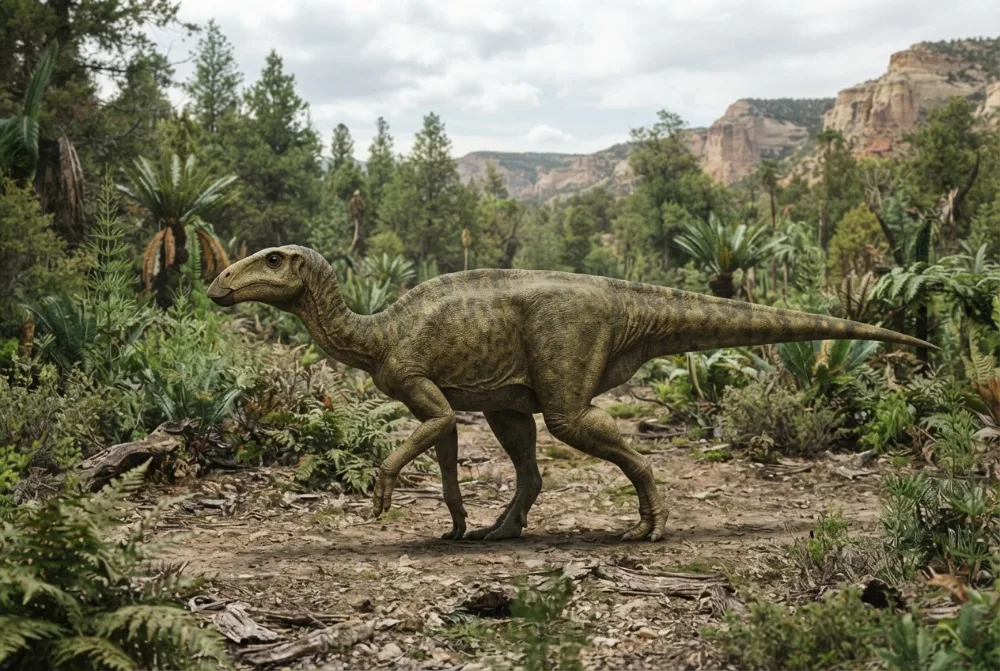
 wautali ngati agalu 7 otsatizana mphuno ndi mchira🍌wautali ngati nthochi 37 zotsatizana🍉wolemera ngati mavwende 260🧸wolemera ngati ana a sukulu ya mkaka 68🎒wolemera ngati ana a sukulu 41🐻❄️wolemera ngati zimbalangondo zoyera 3🏃akanatha kuthamanga mamita 100 m'masekondi 11 (munthu waliwiro kwambiri amafunika 9.6)
Eolambia anali wamkulu bwanji poyerekeza ndi IWEYO?
Ndi masamu chabe mu msakatuli wako. Palibe chimene chimasungidwa kapena kutumizidwa kwina kulikonse.
Anali ndi liwiro lotani?


Mfundo zosangalatsa
Eolambia is known from hundreds of bones, including both adults and babies, so scientists have a good picture of its skeleton.1
The first Eolambia fossil was found by Carole and Ramal Jones in 1993, and the species name honors Carole.1
Young Eolambia were hunted by big crocodile-like reptiles that lived in the lakes, but adults were too big for them.1
Grown-up Eolambia, at least eight or nine years old, were hunted by large meat-eating dinosaurs like Siats.1
Eolambia lived in a floodplain with lakes that changed water levels over about 21,000-year cycles.1
The name Eolambia was suggested by paleoartist Michael Skrepnick, replacing an earlier informal name.1
Mafunso ofunsidwa kwambiri okhudza Eolambia
?How big was Eolambia?
About 6 metres (20 feet) long. That is about as long as a large van.1
?What does the name Eolambia mean?
It means 'dawn lambeosaurine', because scientists first thought it was an early member of the lambeosaurine group.1
?Was Eolambia a hadrosaur?
No, it is a hadrosauroid, an early cousin of the true duck-billed dinosaurs (hadrosaurs).1
?How old could Eolambia get?
Scientists estimate it lived at least 8 to 9 years, based on a subadult specimen.4
Wothetsa nthano zabodza
Nthano: Eolambia was a duck-billed dinosaur like later hadrosaurs.
Zoona: Eolambia was an early relative of hadrosaurs, but it was not a true hadrosaurid. Scientists place it outside the hadrosaurid family.2
Kwa akatswiri a madino
- Dzina la sayansi
- Eolambia
- Anapatsidwa dzina ndi
- Kirkland 19985
- Gulu
- Odya zomera a milomo
- Banja / kladi
- Hadrosauroidea5
- Magawidwe a sayansi
- Ornithischia > Ornithopoda > Iguanodontia5
- Zaka za miyala
- zaka 121 mpaka 94 miliyoni (Aptian / Cenomanian)5
- Mapangidwe a miyala
- Cedar Mountain5
- Mayiko
- Amereka5
- Zolemba za mafosili
- 12 mu The Paleobiology Database5
- Kupezeka
- The first Eolambia fossils were found in 1993 by Carole and Ramal Jones in Utah. Paleontologist James Kirkland named it Eolambia caroljonesa in 1998.1
- Akukambiranabe
- Scientists debate exactly where Eolambia sits on the family tree, with some originally thinking it was a lambeosaurine hadrosaurid, but later studies place it as a more basal hadrosauroid.2
Kumene mfundo zimachokera
- Eolambia (en.wikipedia.org)
- Osteology of the Basal Hadrosauroid Eolambia caroljonesa (Dinosauria: Ornithopoda) from the Cedar Mountain Formation of Utah | PLOS One (journals.plos.org)
- Eolambia caroljonesa | Dinosaur Database by DinoAnimals.com (dinoanimals.com)
- Anatomy, taphonomy, and phylogenetic implications of a new specimen of Eolambia caroljonesa (Dinosauria: Ornithopoda) from the Cedar Mountain Formation, Utah, USA (pmc.ncbi.nlm.nih.gov)
- Eolambia in The Paleobiology Database (CC BY 4.0): zaka, malo, mapangidwe a miyala, magawidwe a sayansi.
Mfundo iliyonse patsamba lino ili ndi nambala yosonyeza kumene yachokera. Ngati talakwitsa kanthu, pepa, ndife okonda madino, osati magazini ya sayansi. Tiuze pa [email protected] ndipo tikonza.
 Rex ali ndi njala! Dino Wiki ndi ntchito ya bambo kwa mwana wawo wamwamuna wokonda madainoso, yaulere popanda zotsatsa ndi zokazonda. Akuluakulu angadyetse Rex zokhwasula-khwasula kuti tsambali lipitirize kupezeka pa intaneti.Dyetsa Rex
 Iguanodon
 Tenontosaurus
 Thescelosaurus
 Zalmoxes
 Camptosaurus
 Rhabdodon
 Stegosaurus
 Archaeopteryx
 Giganotosaurus
 Microraptor
 Deinonychus
 Baryonyx