 Kwizi ya Ndiwe dino uti?
 Nkhondo ya madino
 Mpikisano wa madino
 Masewera ang'onoang'ono a madino
 Chimbale cha zomata
 Mindandanda ya TOP ya madino
 Ndidabwitse!
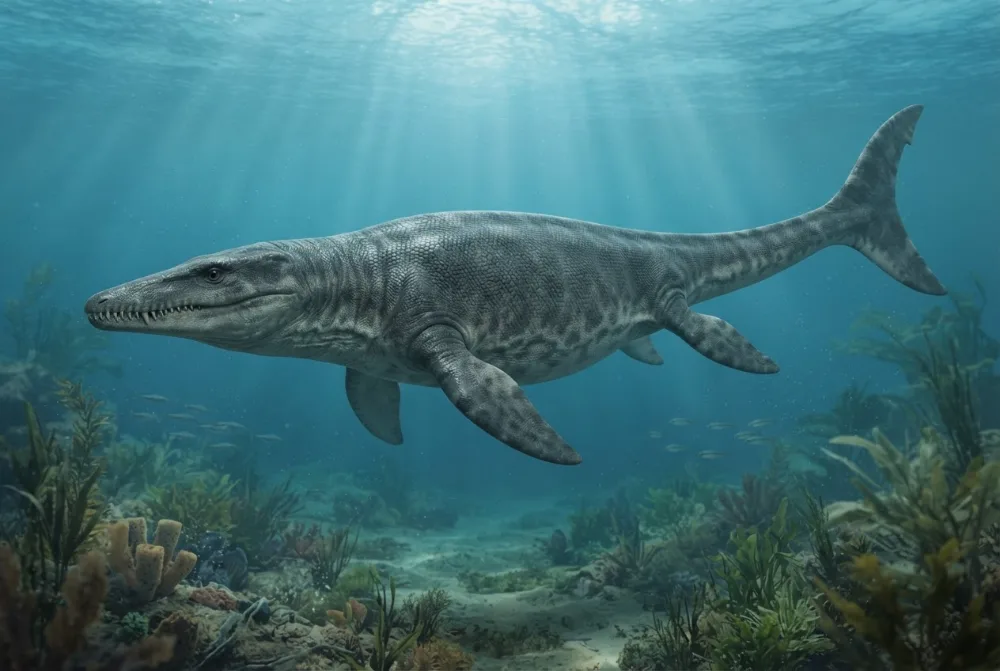
Eremiasaurus
Eremiasaurus was a marine reptile that swam in warm seas during the time of the dinosaurs. It was a mosasaur, not a dinosaur, and it lived about 70 to 66 million years ago. This predator had a streamlined body and a long tail to help it zoom through the water.1
Ankakhala liti?
Anali wamkulu bwanji?
Anali wautali bwanji?
 wautali ngati agalu 5 otsatizana mphuno ndi mchira🍌wautali ngati nthochi 28 zotsatizana🏊akanatha kusambira utali wa dziwe lalikulu losambira (50 m) m'masekondi 4.7
Eremiasaurus anali wamkulu bwanji poyerekeza ndi IWEYO?
Ndi masamu chabe mu msakatuli wako. Palibe chimene chimasungidwa kapena kutumizidwa kwina kulikonse.
Anali ndi liwiro lotani?


Mfundo zosangalatsa
Eremiasaurus had very different-shaped teeth in its jaws, a rare trait for mosasaurs. Its species name heterodontus means 'different teeth'.1
The first fossils of Eremiasaurus were teeth found in Morocco in 1952. Scientists at first thought they belonged to another mosasaur called Mosasaurus.1
Eremiasaurus was named in 2012 from two nearly complete skeletons. One skeleton was found by a scientist, and the other came from a commercial fossil collector.1
This mosasaur had a tail that bent downward and a fan of bones in its tail, which helped it swim fast. Its tail was similar to the fast-swimming mosasaur Plotosaurus.1
Eremiasaurus lived in a warm, shallow sea called the Mediterranean Tethys. Many other mosasaurs and fish lived there too.1
Scientists think Eremiasaurus ate different food than its larger mosasaur neighbors, like Thalassotitan and Prognathodon. This helped them avoid competing for the same prey.1
Mafunso ofunsidwa kwambiri okhudza Eremiasaurus
?How big was Eremiasaurus?
About 5 metres (16 feet) long, which is a bit shorter than a minibus.1
?What did Eremiasaurus eat?
Nobody knows for sure. Its different-shaped teeth make it unclear what prey it ate.1
?Could Eremiasaurus swim fast?
Yes. Its tail bones suggest it was a high-speed pursuit predator, built for fast swimming.1
?Where did Eremiasaurus live?
It lived in a warm, shallow sea called the Mediterranean Tethys, near what is now Morocco.1
Kwa akatswiri a madino
- Dzina la sayansi
- Eremiasaurus
- Anapatsidwa dzina ndi
- LeBlanc et al. 20122
- Gulu
- Mamosasauri
- Banja / kladi
- Mosasauridae2
- Magawidwe a sayansi
- Mosasauroidea2
- Zaka za miyala
- zaka 72 mpaka 66 miliyoni (Maastrichtian)2
- Mapangidwe a miyala
- Phosphates, Couche III2
- Mayiko
- Moroko2
- Zolemba za mafosili
- 7 mu The Paleobiology Database2
- Kupezeka
- Eremiasaurus was named in 2012 by paleontologists Aaron LeBlanc, Michael Caldwell, and Nathalie Bardet. They described it from two skeletons found in the phosphate mines of the Ouled Abdoun Basin in Morocco.1
- Akukambiranabe
- Scientists are not sure exactly what Eremiasaurus ate. Its unusual teeth make it hard to guess its favorite prey.1
Kumene mfundo zimachokera
- Eremiasaurus (en.wikipedia.org)
- Eremiasaurus in The Paleobiology Database (CC BY 4.0): zaka, malo, mapangidwe a miyala, magawidwe a sayansi.
Mfundo iliyonse patsamba lino ili ndi nambala yosonyeza kumene yachokera. Ngati talakwitsa kanthu, pepa, ndife okonda madino, osati magazini ya sayansi. Tiuze pa [email protected] ndipo tikonza.
 Rex ali ndi njala! Dino Wiki ndi ntchito ya bambo kwa mwana wawo wamwamuna wokonda madainoso, yaulere popanda zotsatsa ndi zokazonda. Akuluakulu angadyetse Rex zokhwasula-khwasula kuti tsambali lipitirize kupezeka pa intaneti.Dyetsa Rex
 Mosasaurus
 Prognathodon
 Tylosaurus
 Platecarpus
 Clidastes
 Globidens
 Tyrannosaurus
 Triceratops
 Velociraptor
 Spinosaurus
 Ankylosaurus
 Parasaurolophus