 Kwizi ya Ndiwe dino uti?
 Nkhondo ya madino
 Mpikisano wa madino
 Masewera ang'onoang'ono a madino
 Chimbale cha zomata
 Mindandanda ya TOP ya madino
 Ndidabwitse!
Falcarius
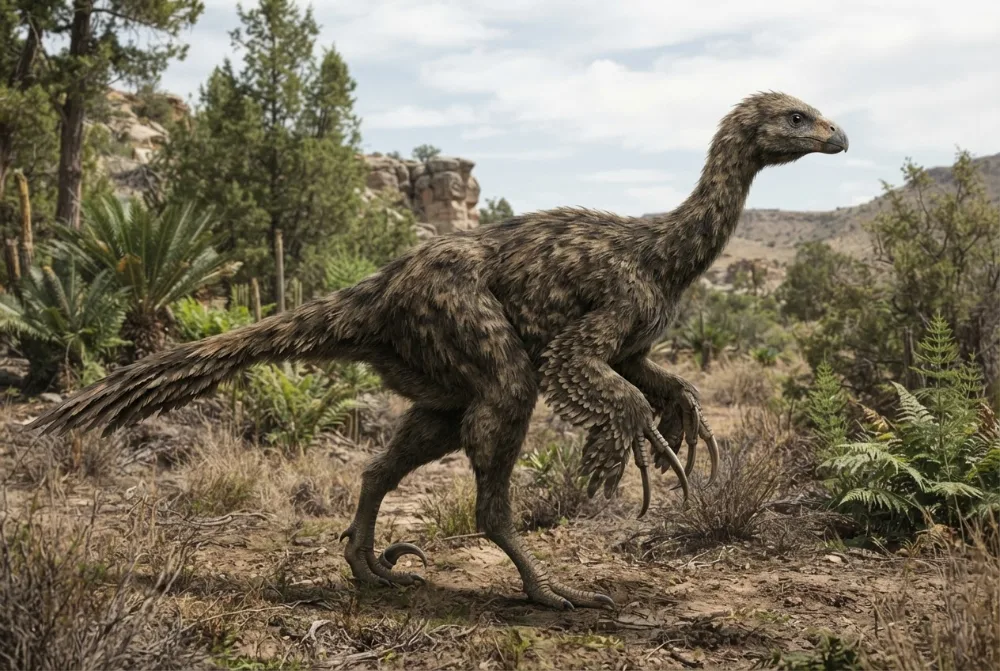
Falcarius was a strange dinosaur that looked like a mix between an ostrich, a gorilla, and Edward Scissorhands! It had a small head, a long neck, and huge curved claws on its hands. This dinosaur lived in what is now Utah, USA, about 139 to 134 million years ago.1
Ankakhala liti?
Anali wamkulu bwanji?
Anali wautali bwanji?
Msinkhu wake unali wautali bwanji?
Ankalemera bwanji?
 wautali ngati agalu 5 otsatizana mphuno ndi mchira🍌wautali ngati nthochi 28 zotsatizana🍉wolemera ngati mavwende 20🧸wolemera ngati ana a sukulu ya mkaka 5🎒wolemera ngati ana a sukulu 3🏃akanatha kuthamanga mamita 100 m'masekondi 12 (munthu waliwiro kwambiri amafunika 9.6)
Falcarius anali wamkulu bwanji poyerekeza ndi IWEYO?
Ndi masamu chabe mu msakatuli wako. Palibe chimene chimasungidwa kapena kutumizidwa kwina kulikonse.
Anali ndi liwiro lotani?


Mfundo zosangalatsa
Falcarius is one of the most primitive therizinosaurs ever found. It helps scientists understand how meat-eating dinosaurs turned into plant-eaters.2
Over 3,000 bones of Falcarius have been dug up from a single quarry in Utah. That's a lot of fossils!1
Falcarius had a long neck that let it reach leaves about 1.5 metres (5 feet) off the ground.1
Its hand claws were huge and curved, like sickles. That's how it got its name, which means 'sickle cutter'.1
Falcarius probably had feathers, like its close relatives from Asia.1
The smallest Falcarius was less than 1 metre (3.3 feet) long, but adults grew to about 4 to 5 metres (13 to 16 feet).1
Mafunso ofunsidwa kwambiri okhudza Falcarius
?How big was Falcarius?
About 4 metres (13 feet) long and about 1.4 metres (4.5 feet) tall at the hip, weighing around 100 kilograms (220 pounds). The smallest known individual was less than 1 metre (3.3 feet) long.14
?What did Falcarius eat?
Mostly plants. Its leaf-shaped, serrated teeth were good for shredding leaves, but the pointed front teeth suggest it might have also eaten small animals like lizards sometimes.1
?Did Falcarius have feathers?
Scientists think yes. No feathers were found with its fossils, but its close feathered relatives from China make it very likely Falcarius had shaggy, hair-like proto-feathers.4
?How fast could Falcarius run?
Probably not very fast. Its lower legs were stubby, which suggests it no longer needed to run after prey like its meat-eating relatives did.4
Kwa akatswiri a madino
- Dzina la sayansi
- Falcarius
- Anapatsidwa dzina ndi
- Kirkland et al. 20055
- Gulu
- Madino a nthenga achilendo
- Banja / kladi
- Therizinosauria5
- Magawidwe a sayansi
- Theropoda > Therizinosauria5
- Zaka za miyala
- zaka 143 mpaka 133 miliyoni (Berriasian / Valanginian)5
- Mapangidwe a miyala
- Cedar Mountain5
- Mayiko
- Amereka5
- Zolemba za mafosili
- 2 mu The Paleobiology Database5
- Kupezeka
- Falcarius was discovered in 1999 by fossil collector Lawrence Walker in Utah. Scientists named it in 2005.1
- Akukambiranabe
- Scientists are not sure if Falcarius was a pure plant-eater or if it also ate meat. Its front teeth are sharp and pointed, which might mean it ate small animals too.1
Kumene mfundo zimachokera
- Falcarius (en.wikipedia.org)
- A primitive therizinosauroid dinosaur from the Early Cretaceous of Utah | Nature (nature.com)
- A Primitive Therizinosauroid Dinosaur from the Early Cretaceous of Utah - DocsLib (docslib.org)
- Falcarius Utahensis - Utah Geological Survey (geology.utah.gov)
- Falcarius in The Paleobiology Database (CC BY 4.0): zaka, malo, mapangidwe a miyala, magawidwe a sayansi.
Mfundo iliyonse patsamba lino ili ndi nambala yosonyeza kumene yachokera. Ngati talakwitsa kanthu, pepa, ndife okonda madino, osati magazini ya sayansi. Tiuze pa [email protected] ndipo tikonza.
 Rex ali ndi njala! Dino Wiki ndi ntchito ya bambo kwa mwana wawo wamwamuna wokonda madainoso, yaulere popanda zotsatsa ndi zokazonda. Akuluakulu angadyetse Rex zokhwasula-khwasula kuti tsambali lipitirize kupezeka pa intaneti.Dyetsa Rex
 Therizinosaurus
 Oviraptor
 Chirostenotes
 Citipes
 Leptorhynchos
 Avimimus
 Stegosaurus
 Iguanodon
 Archaeopteryx
 Giganotosaurus
 Microraptor
 Deinonychus