 Kwizi ya Ndiwe dino uti?
 Nkhondo ya madino
 Mpikisano wa madino
 Masewera ang'onoang'ono a madino
 Chimbale cha zomata
 Mindandanda ya TOP ya madino
 Ndidabwitse!
Ankakhala liti?

Anali ndi liwiro lotani?


Mfundo zosangalatsa
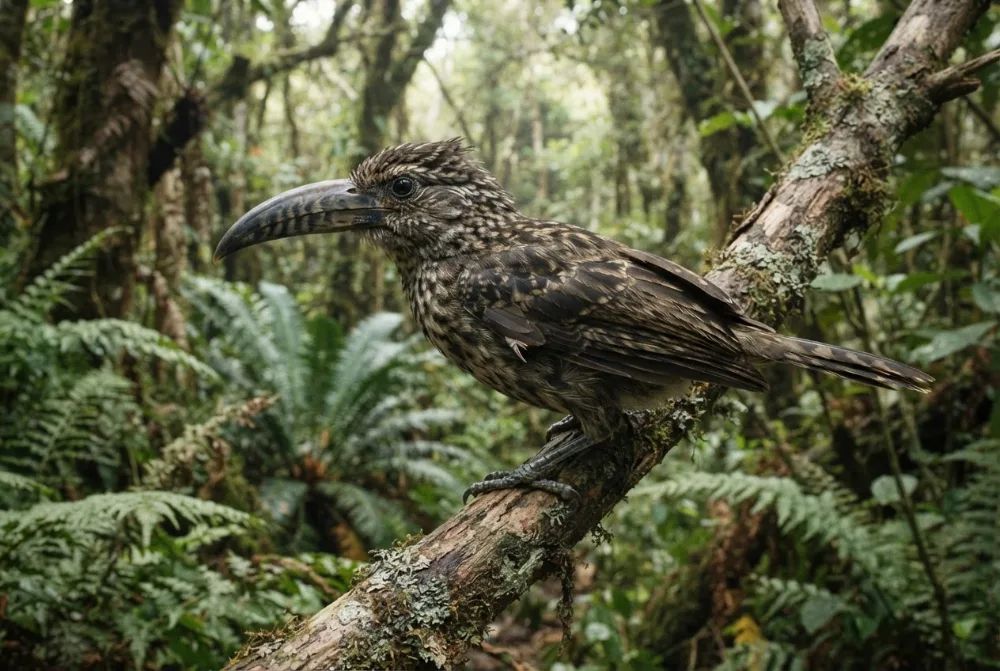
Falcatakely had a beak that looked like a toucan's, but it was not a close relative of toucans. Its beak shape evolved separately.1
The upper jaw of Falcatakely was made mostly of a large, toothless maxilla bone, with a small premaxilla that held teeth.1
Falcatakely is one of the few Mesozoic birds known to have a deep, long beak. Most early birds had simple, short snouts.1
This bird belonged to a group called Enantiornithes, which were the most common birds during the Cretaceous period.3
The only known fossil of Falcatakely was found in the Maevarano Formation in Madagascar, a site famous for other unusual animals like the giant frog Beelzebufo.3
Falcatakely shows that some ancient birds evolved large beaks before modern birds appeared, challenging old ideas about beak evolution.1
Mafunso ofunsidwa kwambiri okhudza Falcatakely
?How big was Falcatakely?
About the size of a crow. Its beak was about 9 centimetres (3.5 inches) long.2
?Did Falcatakely have teeth?
Yes, it had teeth in the tip of its upper jaw, which is unusual for a bird.2
?Is Falcatakely a dinosaur?
Yes, it is a bird, and birds are a type of dinosaur called avialan dinosaurs.2
?When did Falcatakely live?
It lived about 68 to 70 million years ago, during the Late Cretaceous period.2
Kwa akatswiri a madino
- Dzina la sayansi
- Falcatakely
- Anapatsidwa dzina ndi
- O'Connor et al. 20203
- Gulu
- Mbalame zoyambirira
- Banja / kladi
- Enantiornithes3
- Magawidwe a sayansi
- Theropoda > Avialae3
- Zaka za miyala
- zaka 72 mpaka 66 miliyoni (Maastrichtian)3
- Mapangidwe a miyala
- Maevarano3
- Mayiko
- Madagasikara3
- Zolemba za mafosili
- 1 mu The Paleobiology Database3
- Kupezeka
- Falcatakely was named in 2020 by Patrick O'Connor and colleagues based on a fossil skull found in Madagascar.31
- Akukambiranabe
- Scientists are still debating exactly how Falcatakely used its unusual beak, since it had teeth in the front but a large toothless beak behind.1
Kumene mfundo zimachokera
- Late Cretaceous bird from Madagascar reveals unique development of beaks | Nature (nature.com)
- Falcatakely (en.wikipedia.org)
- Falcatakely in The Paleobiology Database (CC BY 4.0): zaka, malo, mapangidwe a miyala, magawidwe a sayansi.
Mfundo iliyonse patsamba lino ili ndi nambala yosonyeza kumene yachokera. Ngati talakwitsa kanthu, pepa, ndife okonda madino, osati magazini ya sayansi. Tiuze pa [email protected] ndipo tikonza.
 Rex ali ndi njala! Dino Wiki ndi ntchito ya bambo kwa mwana wawo wamwamuna wokonda madainoso, yaulere popanda zotsatsa ndi zokazonda. Akuluakulu angadyetse Rex zokhwasula-khwasula kuti tsambali lipitirize kupezeka pa intaneti.Dyetsa Rex
 Archaeopteryx
 Hesperornis
 Ichthyornis
 Baptornis
 Jurapteryx
 Gobipteryx
 Tyrannosaurus
 Triceratops
 Velociraptor
 Spinosaurus
 Ankylosaurus
 Parasaurolophus