 Kwizi ya Ndiwe dino uti?
 Nkhondo ya madino
 Mpikisano wa madino
 Masewera ang'onoang'ono a madino
 Chimbale cha zomata
 Mindandanda ya TOP ya madino
 Ndidabwitse!
Geosternbergia
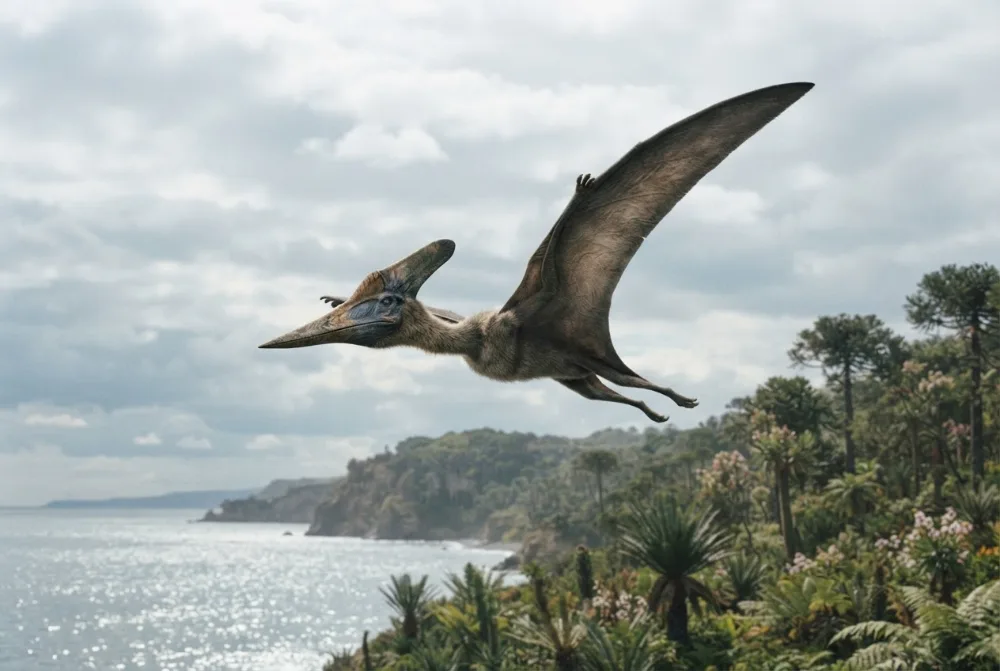
Geosternbergia was a flying reptile that soared over the ancient seas of North America. It had a long, toothless beak and a big crest on its head. It was a pterosaur, not a dinosaur.3
Ankakhala liti?
Anali wamkulu bwanji?
Mapiko ake anali otambalala bwanji?
 mapiko otambalala ngati njinga 3 pamzere⚽akanatha kuuluka kudutsa bwalo lonse la mpira m'masekondi 5.1
Geosternbergia anali wamkulu bwanji poyerekeza ndi IWEYO?
Ndi masamu chabe mu msakatuli wako. Palibe chimene chimasungidwa kapena kutumizidwa kwina kulikonse.
Anali ndi liwiro lotani?


Mfundo zosangalatsa
Geosternbergia lived during the Campanian age, about 83 to 72 million years ago.3
Its fossils were found in the Pierre Shale Formation, which was once the bottom of a shallow sea.3
The name Geosternbergia honors Charles Sternberg, a famous fossil hunter.3
Geosternbergia belonged to the family Pteranodontidae, which includes large, toothless pterosaurs.3
Only one species of Geosternbergia is known: Geosternbergia maiseyi.1
The type specimen of Geosternbergia maiseyi is a partial skull, stored at the University of Kansas.1
Mafunso ofunsidwa kwambiri okhudza Geosternbergia
?How big was Geosternbergia?
Geosternbergia was among the largest pterosaurs, with a wingspan of up to 6 metres (20 ft) in males. Most adults had wingspans between 3 and 6 metres (9.8 and 19.7 ft).2
?Did Geosternbergia have teeth?
No, Geosternbergia had a toothless beak made of solid, bony margins, similar to modern birds. Its beak was long, slender, and ended in a sharp point.2
?What did Geosternbergia eat?
Scientists think Geosternbergia ate fish and other sea creatures, because it lived over shallow seas and had a long, toothless beak like a bird that catches fish. The sources do not give a direct answer, but its habitat and beak shape suggest a fish-eating diet.2
?Is Geosternbergia a dinosaur?
No, Geosternbergia is a pterosaur, a flying reptile that lived at the same time as dinosaurs but is not a dinosaur.2
?When did Geosternbergia live?
Geosternbergia lived during the Late Cretaceous period, about 88 to 80.5 million years ago. The species G. maiseyi lived between 81.5 and 80.5 million years ago.23
?Why did Geosternbergia have a crest?
The crest on Geosternbergia's head was probably used for display, like to attract mates or show off to other pterosaurs. It may have also had other functions, but scientists are not sure.2
Kwa akatswiri a madino
- Dzina la sayansi
- Geosternbergia
- Anapatsidwa dzina ndi
- Miller 19783
- Gulu
- Zokwawa zouluka
- Banja / kladi
- Pteranodontidae3
- Magawidwe a sayansi
- Pterosauria > Pterodactyloidea > Pteranodontidae3
- Zaka za miyala
- zaka 84 mpaka 72 miliyoni (Campanian)3
- Mapangidwe a miyala
- Pierre Shale3
- Mayiko
- Amereka3
- Zolemba za mafosili
- 1 mu The Paleobiology Database3
- Kupezeka
- Geosternbergia was named by Halszka Osmólska in 1978, based on fossils found in South Dakota. The species G. maiseyi was named by Alexander Kellner in 2010.31
Kumene mfundo zimachokera
- PBDB Taxon (paleobiodb.org)
- Pteranodon sternbergi (en.wikipedia.org)
- Geosternbergia in The Paleobiology Database (CC BY 4.0): zaka, malo, mapangidwe a miyala, magawidwe a sayansi.
Mfundo iliyonse patsamba lino ili ndi nambala yosonyeza kumene yachokera. Ngati talakwitsa kanthu, pepa, ndife okonda madino, osati magazini ya sayansi. Tiuze pa [email protected] ndipo tikonza.
 Rex ali ndi njala! Dino Wiki ndi ntchito ya bambo kwa mwana wawo wamwamuna wokonda madainoso, yaulere popanda zotsatsa ndi zokazonda. Akuluakulu angadyetse Rex zokhwasula-khwasula kuti tsambali lipitirize kupezeka pa intaneti.Dyetsa Rex
 Pteranodon
 Quetzalcoatlus
 Dorygnathus
 Rhamphorhynchus
 Anhanguera
 Pterodactylus
 Tyrannosaurus
 Triceratops
 Velociraptor
 Spinosaurus
 Ankylosaurus
 Parasaurolophus