 Kwizi ya Ndiwe dino uti?
 Nkhondo ya madino
 Mpikisano wa madino
 Masewera ang'onoang'ono a madino
 Chimbale cha zomata
 Mindandanda ya TOP ya madino
 Ndidabwitse!
Ankakhala liti?

Anali wamkulu bwanji?
Msinkhu wake unali wautali bwanji?
Ankalemera bwanji?
Mirarce anali wamkulu bwanji poyerekeza ndi IWEYO?
Ndi masamu chabe mu msakatuli wako. Palibe chimene chimasungidwa kapena kutumizidwa kwina kulikonse.
Anali ndi liwiro lotani?


Mfundo zosangalatsa
Its fossil was discovered in 1992 but was not officially named until 2018.1
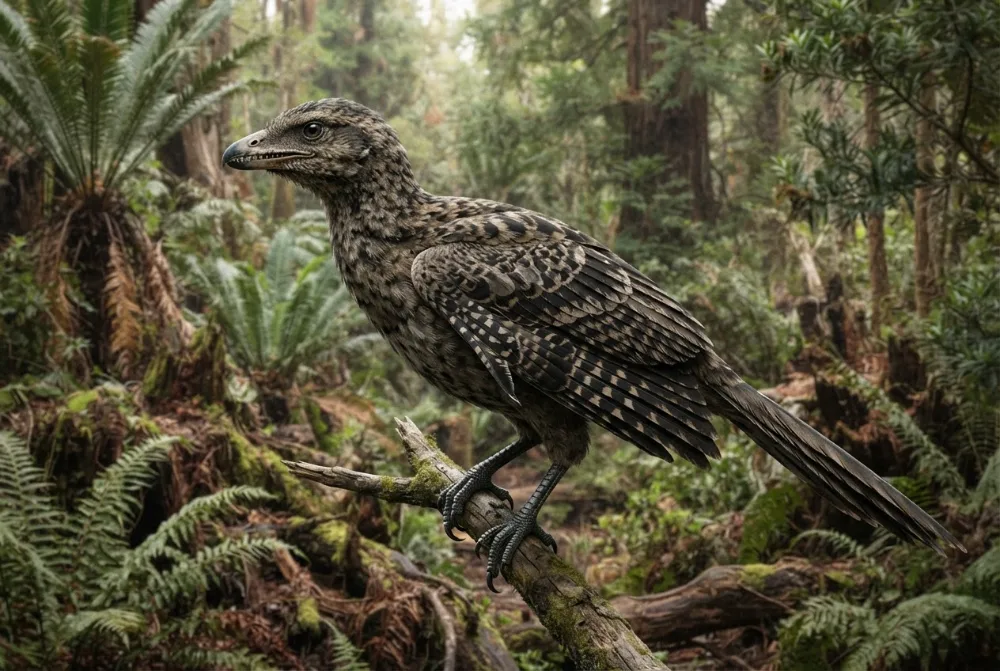
Mirarce had quill knobs on its ulna bone, which are bumps that help anchor flight feathers. This is the first time such knobs have been found in enantiornithine birds.21
It had a deeply keeled sternum (breastbone) and a narrow furcula (wishbone), features that improved its flight abilities.2
Mirarce lived during the Campanian age of the Late Cretaceous, about 76 to 74 million years ago.1
Its name combines Latin 'mirus' (wonderful) and the Greek messenger Arke, referring to its well-preserved flight-related features.1
Mafunso ofunsidwa kwambiri okhudza Mirarce
?Was Mirarce a dinosaur?
Yes, Mirarce was a bird, and birds are a type of dinosaur called avialan theropods. So it was a dinosaur, but not a non-avian dinosaur like T. rex.1
?How big was Mirarce?
Mirarce was about the size of a turkey vulture, growing to around 60 cm tall. It weighed about 0.45 kg.13
?What did Mirarce eat?
Mirarce was a raptorial predator, meaning it hunted and ate other animals. It had powerful talons and leg tendons, similar to modern birds of prey.1
?When did Mirarce live?
Mirarce lived during the Campanian age of the Late Cretaceous, about 76 to 74 million years ago.1
Kwa akatswiri a madino
- Dzina la sayansi
- Mirarce
- Anapatsidwa dzina ndi
- Atterholt et al. 20184
- Gulu
- Mbalame zoyambirira
- Banja / kladi
- Avisauridae4
- Magawidwe a sayansi
- Theropoda > Avialae4
- Zaka za miyala
- zaka 84 mpaka 72 miliyoni (Campanian)4
- Mapangidwe a miyala
- Kaiparowits4
- Mayiko
- Amereka4
- Zolemba za mafosili
- 1 mu The Paleobiology Database4
- Kupezeka
- The fossil was collected in 1992 by Howard Hutchison in Utah. It was studied and named by Jesse Atterholt and colleagues in 2018, who called it Mirarce eatoni in honor of paleontologist Jeffrey Eaton.1
- Akukambiranabe
- Scientists are still debating how enantiornithine birds like Mirarce compare to modern birds in terms of flight abilities and evolutionary relationships.2
Kumene mfundo zimachokera
- Mirarce (en.wikipedia.org)
- The most complete enantiornithine from North America and a phylogenetic analysis of the Avisauridae (pmc.ncbi.nlm.nih.gov)
- Rare fossil bird deepens mystery of avian extinctions (vcresearch.berkeley.edu)
- Mirarce in The Paleobiology Database (CC BY 4.0): zaka, malo, mapangidwe a miyala, magawidwe a sayansi.
Mfundo iliyonse patsamba lino ili ndi nambala yosonyeza kumene yachokera. Ngati talakwitsa kanthu, pepa, ndife okonda madino, osati magazini ya sayansi. Tiuze pa [email protected] ndipo tikonza.
 Rex ali ndi njala! Dino Wiki ndi ntchito ya bambo kwa mwana wawo wamwamuna wokonda madainoso, yaulere popanda zotsatsa ndi zokazonda. Akuluakulu angadyetse Rex zokhwasula-khwasula kuti tsambali lipitirize kupezeka pa intaneti.Dyetsa Rex
 Archaeopteryx
 Hesperornis
 Ichthyornis
 Baptornis
 Jurapteryx
 Gobipteryx
 Tyrannosaurus
 Triceratops
 Velociraptor
 Spinosaurus
 Ankylosaurus
 Parasaurolophus