 Kwizi ya Ndiwe dino uti?
 Nkhondo ya madino
 Mpikisano wa madino
 Masewera ang'onoang'ono a madino
 Chimbale cha zomata
 Mindandanda ya TOP ya madino
 Ndidabwitse!
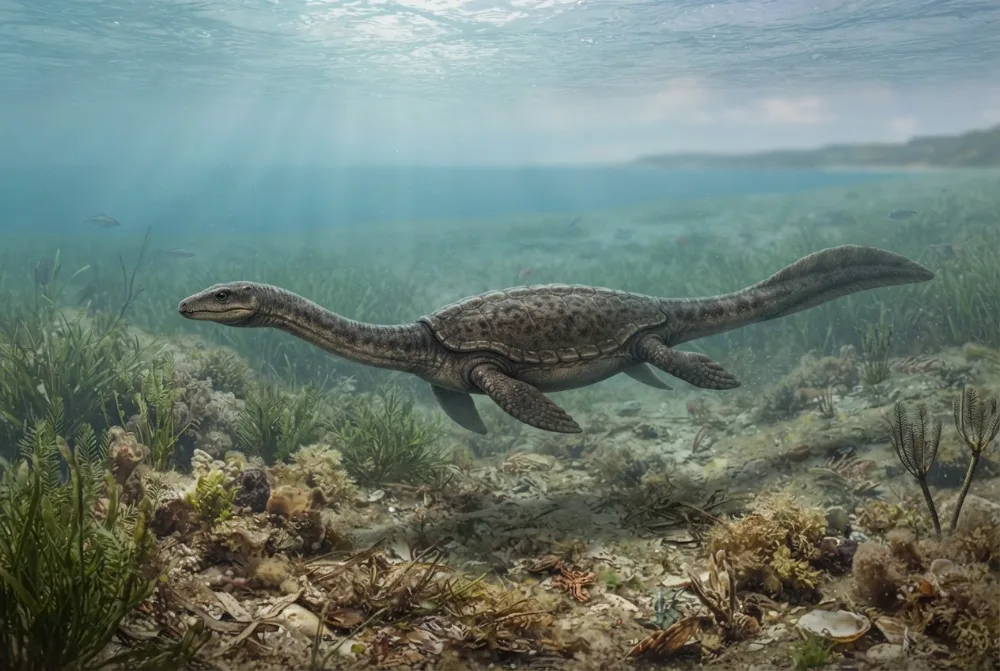
Paludidraco
Paludidraco was a strange marine reptile that lived in shallow seas over 200 million years ago. It had a very heavy, dense skeleton that helped it stay underwater without swimming much, like a manatee. Its jaws were weak and filled with many tiny teeth, so it probably sucked up soft plants or small animals from the seafloor.2
Ankakhala liti?
Anali wamkulu bwanji?
Anali wautali bwanji?
 wautali ngati agalu 2.5 otsatizana mphuno ndi mchira🍌wautali ngati nthochi 14 zotsatizana🏊akanatha kusambira utali wa dziwe lalikulu losambira (50 m) m'masekondi 8.6
Paludidraco anali wamkulu bwanji poyerekeza ndi IWEYO?
Ndi masamu chabe mu msakatuli wako. Palibe chimene chimasungidwa kapena kutumizidwa kwina kulikonse.
Anali ndi liwiro lotani?


Mfundo zosangalatsa
Paludidraco had an extremely heavy, pachyostotic skeleton, meaning its bones were very thick and dense. This helped it float at shallow depths without using much energy, just like modern manatees.2
Its jaws were very slender and weak, and its teeth were small, curved, and set in a groove (pleurodont implantation). This is very different from most other marine reptiles of its time.1
Paludidraco had more than 15 teeth in its premaxilla (the front part of the upper jaw), which is a unique feature among its family, Simosauridae.1
Scientists think Paludidraco was not an active predator. Its weak jaws could not catch struggling prey, and its heavy body made it slow and not very maneuverable.1
The name Paludidraco comes from Latin words meaning 'marshy dragon', because its fossils were found near a reservoir called El Atance in Spain.1
Paludidraco lived during the Late Triassic period, about 237 to 205 million years ago, in what is now central Spain.4
Kwa akatswiri a madino
- Dzina la sayansi
- Paludidraco
- Anapatsidwa dzina ndi
- de Miguel Chaves et al. 20184
- Gulu
- Zokwawa za m'nyanja
- Banja / kladi
- Simosauridae4
- Magawidwe a sayansi
- Nothosauria > Sauropterygia4
- Zaka za miyala
- zaka 237 mpaka 206 miliyoni (Carnian / Norian)4
- Mapangidwe a miyala
- Keuper4
- Mayiko
- Sipeyini4
- Zolemba za mafosili
- 1 mu The Paleobiology Database4
- Kupezeka
- Paludidraco multidentatus was named in 2018 by scientists de Miguel Chaves, Ortega, and Pérez-García. They described it from two well-preserved skeletons found at the El Atance site in central Spain.41
- Akukambiranabe
- Scientists are not sure whether Paludidraco was a true filter feeder like some whales, or if it used its comb-like teeth to scrape soft plants from the seafloor. Its skull lacks some features seen in modern filter feeders.1
Kumene mfundo zimachokera
- New highly pachyostotic nothosauroid interpreted as a filter ... (pmc.ncbi.nlm.nih.gov)
- New highly pachyostotic nothosauroid interpreted as a filter-feeding Triassic (royalsocietypublishing.org)
- Paludidraco (en.wikipedia.org)
- Paludidraco in The Paleobiology Database (CC BY 4.0): zaka, malo, mapangidwe a miyala, magawidwe a sayansi.
Mfundo iliyonse patsamba lino ili ndi nambala yosonyeza kumene yachokera. Ngati talakwitsa kanthu, pepa, ndife okonda madino, osati magazini ya sayansi. Tiuze pa [email protected] ndipo tikonza.
 Rex ali ndi njala! Dino Wiki ndi ntchito ya bambo kwa mwana wawo wamwamuna wokonda madainoso, yaulere popanda zotsatsa ndi zokazonda. Akuluakulu angadyetse Rex zokhwasula-khwasula kuti tsambali lipitirize kupezeka pa intaneti.Dyetsa Rex
 Nothosaurus
 Placodus
 Lariosaurus
 Cyamodus
 Cymatosaurus
 Proneusticosaurus
 Massospondylus
 Plateosaurus
 Coelophysis
 Podokesaurus
 Thecodontosaurus
 Eudimorphodon