 Kwizi ya Ndiwe dino uti?
 Nkhondo ya madino
 Mpikisano wa madino
 Masewera ang'onoang'ono a madino
 Chimbale cha zomata
 Mindandanda ya TOP ya madino
 Ndidabwitse!
Ankakhala liti?

Anali wamkulu bwanji?
Anali wautali bwanji?
Msinkhu wake unali wautali bwanji?
kuyerekeza
 wautali ngati amphaka a pakhomo 2 otsatizana mphuno ndi mchira🍌wautali ngati nthochi 6 zotsatizana🪑wamng'ono moti angayende pansi pa mpando🏃akanatha kuthamanga mamita 100 m'masekondi 15 (munthu waliwiro kwambiri amafunika 9.6)
Papiliovenator anali wamkulu bwanji poyerekeza ndi IWEYO?
Ndi masamu chabe mu msakatuli wako. Palibe chimene chimasungidwa kapena kutumizidwa kwina kulikonse.
Anali ndi liwiro lotani?


Mfundo zosangalatsa
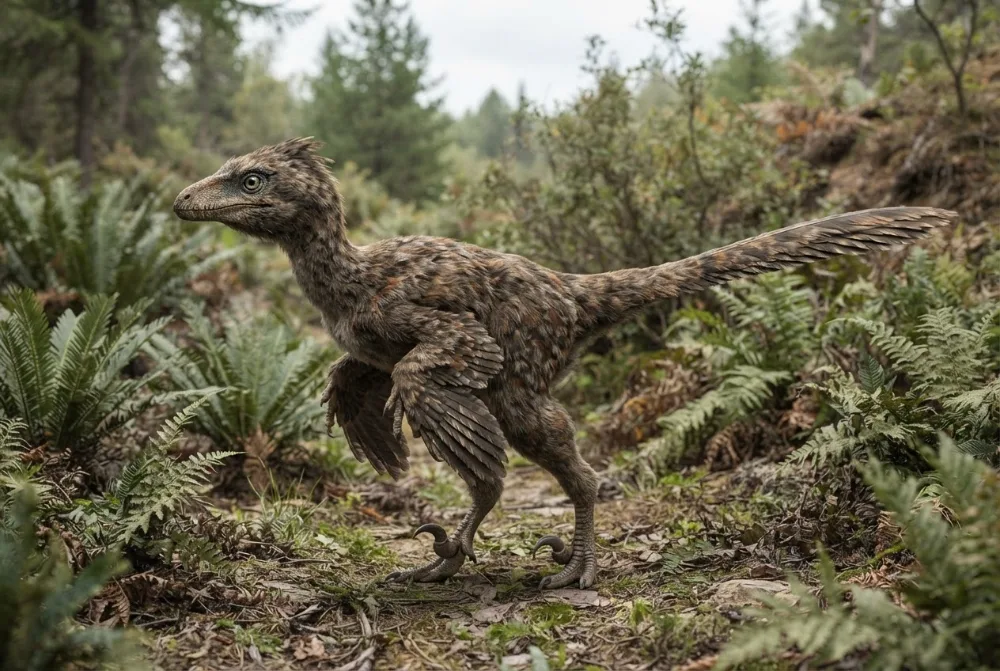
Papiliovenator gets its name from a butterfly-shaped bone in its back. The first two vertebrae of its spine had wide, wing-like parts that looked like a butterfly.1
Its snout was short and triangular, more like older troodontids from the Early Cretaceous. Most Late Cretaceous troodontids had long, low snouts.1
This dinosaur lived about 83 to 72 million years ago, during the Campanian age of the Late Cretaceous.12
Scientists think Papiliovenator was one of the earliest Late Cretaceous troodontids. Only one other troodontid, Almas, was more primitive.1
The only known fossil is a partial skeleton of a subadult, including a nearly complete skull and many other bones.1
Mafunso ofunsidwa kwambiri okhudza Papiliovenator
?How big was Papiliovenator?
It was a small dinosaur. Scientists have not given an exact length or weight, but troodontids were usually about the size of a turkey or a small dog.14
?What did Papiliovenator eat?
It probably hunted small animals and maybe ate plants too. Its teeth had no serrations, which is unusual for a meat-eater, so it may have eaten softer food.1
?Did Papiliovenator have feathers?
Yes, it was a troodontid, a type of bird-like raptor, and scientists think it had feathers.1
Kwa akatswiri a madino
- Dzina la sayansi
- Papiliovenator
- Anapatsidwa dzina ndi
- Pei et al. 20225
- Gulu
- Maraputala
- Banja / kladi
- Troodontidae5
- Magawidwe a sayansi
- Theropoda > Troodontidae5
- Zaka za miyala
- zaka 84 mpaka 72 miliyoni (Campanian)5
- Mapangidwe a miyala
- Wulansuhai5
- Mayiko
- China5
- Zolemba za mafosili
- 1 mu The Paleobiology Database5
- Kupezeka
- Papiliovenator was named in 2022 by a team of scientists led by R. Pei. The fossils were found at the Bayan Mandahu Fossil Preserve in Inner Mongolia, China.15
- Akukambiranabe
- Scientists are not sure exactly what Papiliovenator ate. Its teeth lack serrations, which is rare for a carnivore, so its diet may have included plants or soft-bodied prey.12
Kumene mfundo zimachokera
- Papiliovenator (en.wikipedia.org)
- PBDB Taxon (paleobiodb.org)
- Papiliovenator neimengguensis a Short-snouted Troodontid (blog.everythingdinosaur.com)
- 【中国科学报】内蒙古发现小型伤齿龙科恐龙新属种----中国科学院古脊椎动物与古人类研究所 (ivpp.cas.cn)
- Papiliovenator in The Paleobiology Database (CC BY 4.0): zaka, malo, mapangidwe a miyala, magawidwe a sayansi.
Mfundo iliyonse patsamba lino ili ndi nambala yosonyeza kumene yachokera. Ngati talakwitsa kanthu, pepa, ndife okonda madino, osati magazini ya sayansi. Tiuze pa [email protected] ndipo tikonza.
 Rex ali ndi njala! Dino Wiki ndi ntchito ya bambo kwa mwana wawo wamwamuna wokonda madainoso, yaulere popanda zotsatsa ndi zokazonda. Akuluakulu angadyetse Rex zokhwasula-khwasula kuti tsambali lipitirize kupezeka pa intaneti.Dyetsa Rex
 Velociraptor
 Microraptor
 Deinonychus
 Asiamericana
 Richardoestesia
 Saurornitholestes
 Tyrannosaurus
 Triceratops
 Spinosaurus
 Ankylosaurus
 Parasaurolophus
 Pteranodon