 Kwizi ya Ndiwe dino uti?
 Nkhondo ya madino
 Mpikisano wa madino
 Masewera ang'onoang'ono a madino
 Chimbale cha zomata
 Mindandanda ya TOP ya madino
 Ndidabwitse!
Ankakhala liti?

Anali wamkulu bwanji?
Mapiko ake anali otambalala bwanji?
Parvavis anali wamkulu bwanji poyerekeza ndi IWEYO?
Ndi masamu chabe mu msakatuli wako. Palibe chimene chimasungidwa kapena kutumizidwa kwina kulikonse.
Anali ndi liwiro lotani?


Mfundo zosangalatsa
When Parvavis was discovered, it was the smallest known enantiornithine bird, even smaller than Iberomesornis.1
The fossil of Parvavis includes parts of the skull, spine, tail, and even impressions of its feathers in the rock.1
Scientists studied the bone structure and found that Parvavis was nearly full-grown when it died, but it was still surprisingly tiny.12
Parvavis had a special feature: the bottom joint of its second metatarsal (a foot bone) was wider than the joints of its other metatarsals.1
The claw on the fourth toe of Parvavis was reduced, meaning it was smaller than the other toe claws.1
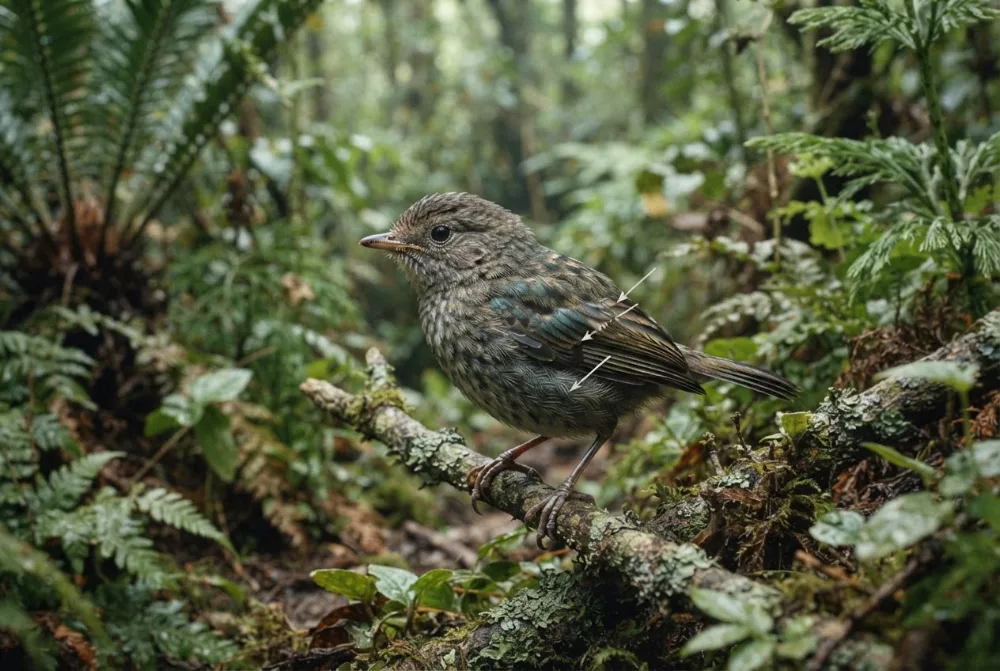
Kwa akatswiri a madino
- Dzina la sayansi
- Parvavis
- Anapatsidwa dzina ndi
- Wang et al. 20143
- Gulu
- Mbalame zoyambirira
- Banja / kladi
- Enantiornithes3
- Magawidwe a sayansi
- Theropoda > Avialae3
- Zaka za miyala
- zaka 94 mpaka 84 miliyoni (Turonian / Santonian)3
- Mapangidwe a miyala
- Jiangdihe3
- Mayiko
- China3
- Zolemba za mafosili
- 1 mu The Paleobiology Database3
- Kupezeka
- The skeleton of Parvavis was found in 2010 near Luojumei Village in Yunnan, China. It was named and described in 2014 by Wang Min, Zhou Zhonghe, and Xu Guanghui.1
- Akukambiranabe
- Scientists are still debating exactly where Parvavis fits on the enantiornithine family tree. Some analyses place it in a relatively basal position, meaning it may have been an early branch of this group.1
Kumene mfundo zimachokera
- Parvavis (en.wikipedia.org)
- The first enantiornithine bird from the Upper Cretaceous of China (tandfonline.com)
- Parvavis in The Paleobiology Database (CC BY 4.0): zaka, malo, mapangidwe a miyala, magawidwe a sayansi.
Mfundo iliyonse patsamba lino ili ndi nambala yosonyeza kumene yachokera. Ngati talakwitsa kanthu, pepa, ndife okonda madino, osati magazini ya sayansi. Tiuze pa [email protected] ndipo tikonza.
 Rex ali ndi njala! Dino Wiki ndi ntchito ya bambo kwa mwana wawo wamwamuna wokonda madainoso, yaulere popanda zotsatsa ndi zokazonda. Akuluakulu angadyetse Rex zokhwasula-khwasula kuti tsambali lipitirize kupezeka pa intaneti.Dyetsa Rex
 Archaeopteryx
 Hesperornis
 Ichthyornis
 Baptornis
 Jurapteryx
 Gobipteryx
 Tyrannosaurus
 Triceratops
 Velociraptor
 Spinosaurus
 Ankylosaurus
 Parasaurolophus