 Kwizi ya Ndiwe dino uti?
 Nkhondo ya madino
 Mpikisano wa madino
 Masewera ang'onoang'ono a madino
 Chimbale cha zomata
 Mindandanda ya TOP ya madino
 Ndidabwitse!
Psephoderma
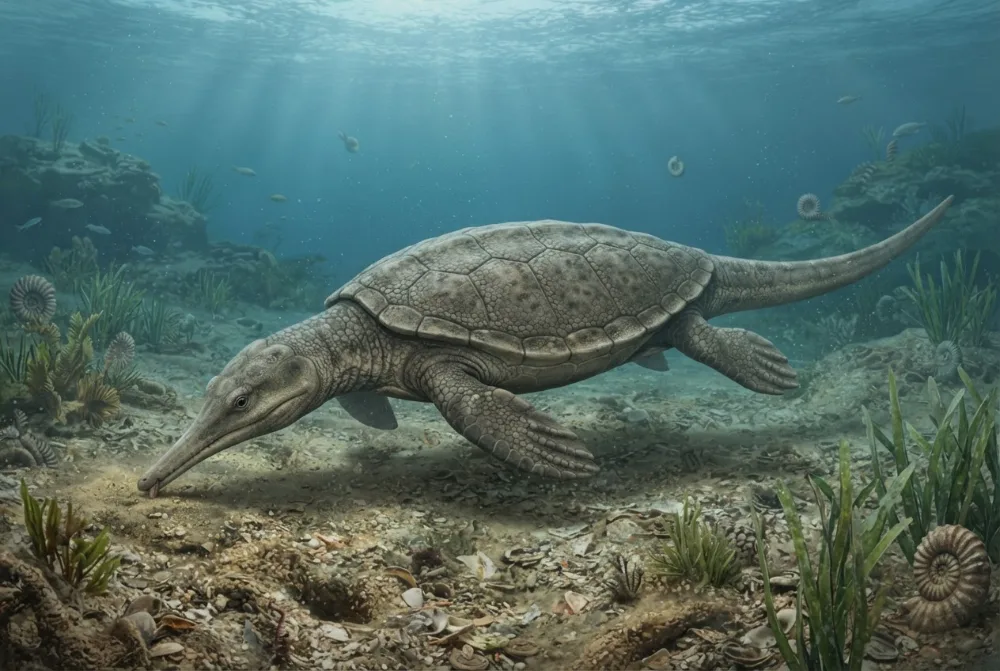
Psephoderma was a marine reptile that lived in the Late Triassic, about 210 million years ago. It had a flat skull and a shell made of two parts, like a turtle, and used its long snout to dig up shellfish from the seafloor.1
Ankakhala liti?
Anali wamkulu bwanji?
Anali wautali bwanji?
 wautali ngati amphaka a pakhomo 4 otsatizana mphuno ndi mchira🍌wautali ngati nthochi 10 zotsatizana🏊akanatha kusambira utali wa dziwe lalikulu losambira (50 m) m'masekondi 16
Psephoderma anali wamkulu bwanji poyerekeza ndi IWEYO?
Ndi masamu chabe mu msakatuli wako. Palibe chimene chimasungidwa kapena kutumizidwa kwina kulikonse.
Anali ndi liwiro lotani?


Mfundo zosangalatsa
Psephoderma had a long tail, up to about 80 cm (31 inches), covered in bony scutes.1
Its shell was split into two pieces: one over the ribs and another over the pelvis.1
The largest known Psephoderma fossil is 180 cm (5.9 feet) long.3
Its skull had a narrow, straight snout with grooves that led to the nostrils.1
Psephoderma had no teeth at the front of its mouth, only four large crushing teeth on each side of the palate.1
It lived in shallow, oxygen-rich waters near tidal channels, where it fed on shellfish like Modiolus and Isognomon.3
Mafunso ofunsidwa kwambiri okhudza Psephoderma
?Was Psephoderma a dinosaur?
No, Psephoderma was not a dinosaur. It was a marine reptile called a placodont, which is a type of sauropterygian.1
?How big was Psephoderma?
Psephoderma grew up to 180 centimetres (5.9 feet) long, which is about as long as a bathtub.1
?What did Psephoderma eat?
Psephoderma ate shellfish like Modiolus and Isognomon. It used its long snout to dig them up and crushed them with its large, flat teeth.3
?Could Psephoderma swim?
Yes, Psephoderma could swim. Its shell was streamlined for swimming, and it used its paddle-like limbs to move through the water.3
Kwa akatswiri a madino
- Dzina la sayansi
- Psephoderma
- Anapatsidwa dzina ndi
- von Meyer 18584
- Gulu
- Zokwawa za m'nyanja
- Banja / kladi
- Placochelyida4
- Magawidwe a sayansi
- Placodontia > Sauropterygia4
- Zaka za miyala
- zaka 243 mpaka 201 miliyoni ()4
- Mapangidwe a miyala
- Calcare di Zu, Kössener Schichten, Zorzino Limestone4
- Mayiko
- Italiya, Austria, Israeli, United Kingdom4
- Zolemba za mafosili
- 10 mu The Paleobiology Database4
- Amadziwikanso kuti
- Placochelyanus (mayina akale tsopano amawerengedwa ngati nyama yomweyi)4
- Kupezeka
- Psephoderma was named by German paleontologist Hermann von Meyer in 1858. Fossils have been found in the Alps and England.12
- Akukambiranabe
- Scientists are not sure if Psephoderma used its shell mainly for defense or for swimming, but some think it was shaped to help it glide through water.3
Kumene mfundo zimachokera
- Psephoderma (en.wikipedia.org)
- PBDB Taxon (paleobiodb.org)
- FUNCTIONAL MORPHOLOGY AND MODE OF LIFE OF THE LATE TRIASSIC PLACODONT PSEPHODERMA ALPINUM MEYER FROM THE CALCARE DI ZORZINO (LOMBARDY, N ITALY) | RIVISTA ITALIANA DI PALEONTOLOGIA E STRATIGRAFIA (riviste.unimi.it)
- Psephoderma in The Paleobiology Database (CC BY 4.0): zaka, malo, mapangidwe a miyala, magawidwe a sayansi.
Mfundo iliyonse patsamba lino ili ndi nambala yosonyeza kumene yachokera. Ngati talakwitsa kanthu, pepa, ndife okonda madino, osati magazini ya sayansi. Tiuze pa [email protected] ndipo tikonza.
 Rex ali ndi njala! Dino Wiki ndi ntchito ya bambo kwa mwana wawo wamwamuna wokonda madainoso, yaulere popanda zotsatsa ndi zokazonda. Akuluakulu angadyetse Rex zokhwasula-khwasula kuti tsambali lipitirize kupezeka pa intaneti.Dyetsa Rex
 Nothosaurus
 Placodus
 Lariosaurus
 Cyamodus
 Cymatosaurus
 Proneusticosaurus
 Massospondylus
 Plateosaurus
 Coelophysis
 Podokesaurus
 Thecodontosaurus
 Eudimorphodon