 Kwizi ya Ndiwe dino uti?
 Nkhondo ya madino
 Mpikisano wa madino
 Masewera ang'onoang'ono a madino
 Chimbale cha zomata
 Mindandanda ya TOP ya madino
 Ndidabwitse!
Saurornithoides
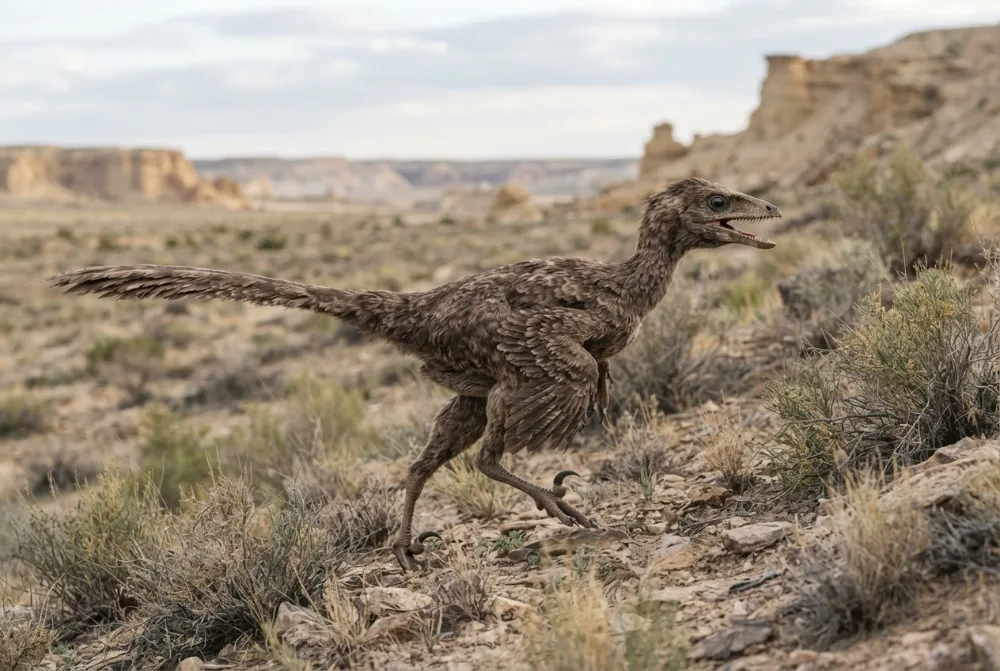
Saurornithoides was a small, fast, bird-like dinosaur that lived in the Late Cretaceous period. It had big eyes for seeing in the dark and a sharp claw on each foot to catch its prey. This smart hunter probably scoured the Gobi Desert for small mammals and reptiles.1
Ankakhala liti?
Anali wamkulu bwanji?
Anali wautali bwanji?
Msinkhu wake unali wautali bwanji?
kuyerekeza
 wautali ngati amphaka a pakhomo 5 otsatizana mphuno ndi mchira🍌wautali ngati nthochi 13 zotsatizana🏃akanatha kuthamanga mamita 100 m'masekondi 8.2 (munthu waliwiro kwambiri amafunika 9.6)
Saurornithoides anali wamkulu bwanji poyerekeza ndi IWEYO?
Ndi masamu chabe mu msakatuli wako. Palibe chimene chimasungidwa kapena kutumizidwa kwina kulikonse.
Anali ndi liwiro lotani?


Mfundo zosangalatsa
Saurornithoides had a large brain for its size, making it one of the smartest non-bird dinosaurs.1
Its eyes were huge and gave it excellent stereoscopic vision, which helped it judge distances when hunting at night.1
The first Saurornithoides fossil was found on July 9, 1923, by a Chinese employee of an American Museum of Natural History expedition named Chih.1
A baby Saurornithoides had very strong leg bones, suggesting that troodontid babies could walk soon after hatching and needed little parental care.1
It had a retractable sickle claw on the second toe of each foot, like its cousin Troodon.1
The name was originally going to be 'Ornithoides' (bird-like), but Henry Fairfield Osborn changed it to Saurornithoides when he formally described it in 1924.1
Mafunso ofunsidwa kwambiri okhudza Saurornithoides
?How big was Saurornithoides?
About 2 metres (6.6 feet) long. That is roughly the length of a large sofa.3
?What does the name Saurornithoides mean?
It means 'bird-like lizard' in Greek, because its skull looked like a bird's.3
?Was Saurornithoides related to Velociraptor?
Yes, it resembled Velociraptor. Both are theropod dinosaurs.1
?Where was Saurornithoides found?
In Mongolia, in the Gobi Desert. Its fossils come from the Djadochta Formation.1
?When did Saurornithoides live?
It lived during the Late Cretaceous period, about 85 to 80 million years ago.3
?How many species of Saurornithoides were there?
Only one valid species is known: Saurornithoides mongoliensis. Other named species have been moved to different dinosaurs or are no longer considered valid.1
Kwa akatswiri a madino
- Dzina la sayansi
- Saurornithoides
- Anapatsidwa dzina ndi
- Osborn 19244
- Gulu
- Maraputala
- Banja / kladi
- Troodontidae4
- Magawidwe a sayansi
- Theropoda > Theropoda > Troodontidae > Compsognathidae4
- Zaka za miyala
- zaka 100 mpaka 66 miliyoni (Cenomanian / Maastrichtian)4
- Mapangidwe a miyala
- Djadokhta, Hell Creek, Bayan Mandahu4
- Mayiko
- Mongoliya, Amereka, China, Uzbekistan4
- Zolemba za mafosili
- 8 mu The Paleobiology Database4
- Kupezeka
- Saurornithoides was named by Henry Fairfield Osborn in 1924 based on a skull and other bones found in Mongolia by a Chinese collector named Chih in 1923.1
- Akukambiranabe
- Scientists are not sure whether Saurornithoides is more closely related to North American troodontids like Troodon or to other Asian troodontids.2
Kumene mfundo zimachokera
- Saurornithoides (en.wikipedia.org)
- A review of the Mongolian Cretaceous dinosaur Saurornithoides (Troodontidae, Theropoda). (American Museum novitates, no. 3654) (digitallibrary.amnh.org)
- Saurornithoides | Natural History Museum (nhm.ac.uk)
- Saurornithoides in The Paleobiology Database (CC BY 4.0): zaka, malo, mapangidwe a miyala, magawidwe a sayansi.
Mfundo iliyonse patsamba lino ili ndi nambala yosonyeza kumene yachokera. Ngati talakwitsa kanthu, pepa, ndife okonda madino, osati magazini ya sayansi. Tiuze pa [email protected] ndipo tikonza.
 Rex ali ndi njala! Dino Wiki ndi ntchito ya bambo kwa mwana wawo wamwamuna wokonda madainoso, yaulere popanda zotsatsa ndi zokazonda. Akuluakulu angadyetse Rex zokhwasula-khwasula kuti tsambali lipitirize kupezeka pa intaneti.Dyetsa Rex
 Velociraptor
 Microraptor
 Deinonychus
 Asiamericana
 Richardoestesia
 Saurornitholestes
 Tyrannosaurus
 Triceratops
 Spinosaurus
 Ankylosaurus
 Parasaurolophus
 Pteranodon