 Kwizi ya Ndiwe dino uti?
 Nkhondo ya madino
 Mpikisano wa madino
 Masewera ang'onoang'ono a madino
 Chimbale cha zomata
 Mindandanda ya TOP ya madino
 Ndidabwitse!
Ankakhala liti?

Anali wamkulu bwanji?
Anali wautali bwanji?
Msinkhu wake unali wautali bwanji?
kuyerekeza
Ankalemera bwanji?
 wautali ngati agalu 4 otsatizana mphuno ndi mchira🍌wautali ngati nthochi 19 zotsatizana🍉wolemera ngati mavwende 30🧸wolemera ngati ana a sukulu ya mkaka 8🎒wolemera ngati ana a sukulu 5🏃akanatha kuthamanga mamita 100 m'masekondi 8 (munthu waliwiro kwambiri amafunika 9.6)
Tietasaura anali wamkulu bwanji poyerekeza ndi IWEYO?
Ndi masamu chabe mu msakatuli wako. Palibe chimene chimasungidwa kapena kutumizidwa kwina kulikonse.
Anali ndi liwiro lotani?


Mfundo zosangalatsa
Tietasaura is known from just one fossil: the lower end of a left thigh bone (femur).1
The fossil was discovered in 1906 during expeditions by London's Natural History Museum to South America.1
For many years, scientists thought the bone belonged to a crocodile-like reptile called Hyposaurus or Sarcosuchus.1
Tietasaura lived between about 137 and 126 million years ago, during the Valanginian to Hauterivian ages of the Early Cretaceous.4
It was named in 2024, making it a very recently discovered dinosaur.1
The name Tietasaura comes from 'Tieta', the main character of a Brazilian novel, and 'saura', meaning lizard.1
Mafunso ofunsidwa kwambiri okhudza Tietasaura
?How big was Tietasaura?
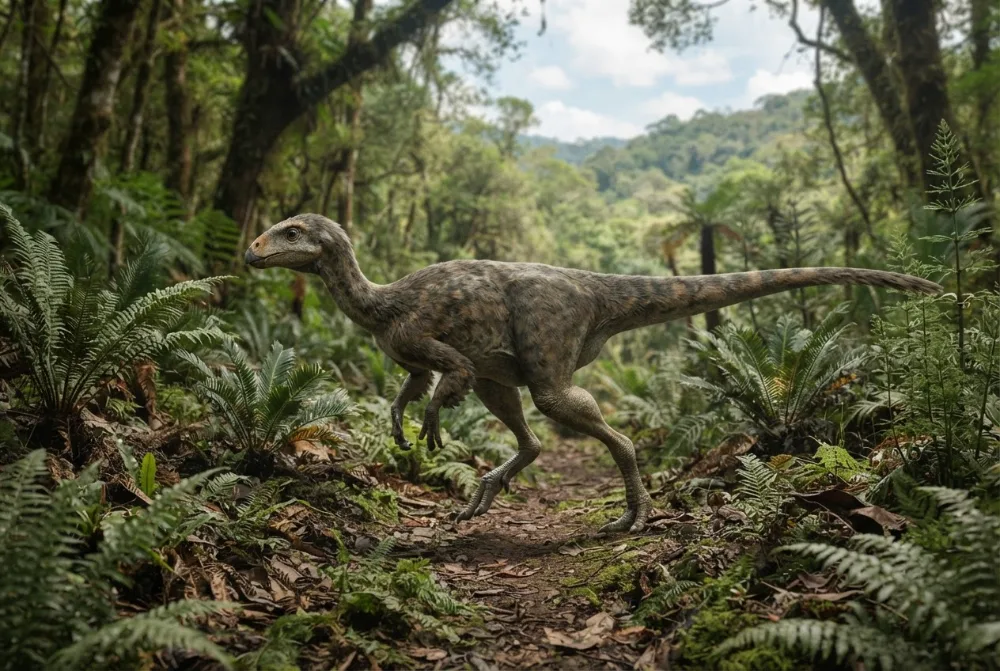
About 2 metres (6.6 feet) long. It was a small dinosaur, about the size of a bicycle.2
?What did Tietasaura eat?
Plants. It was an herbivore, meaning it ate leaves and other vegetation.4
?When was Tietasaura discovered?
The fossil was found in 2019, but it was not named as a new dinosaur until 2024.1
Kwa akatswiri a madino
- Dzina la sayansi
- Tietasaura
- Anapatsidwa dzina ndi
- Bandeira et al. 20244
- Gulu
- Odya zomera a milomo
- Banja / kladi
- Elasmaria4
- Magawidwe a sayansi
- Ornithischia > Ornithopoda > Iguanodontia4
- Zaka za miyala
- zaka 137 mpaka 126 miliyoni (Valanginian / Hauterivian)4
- Mapangidwe a miyala
- Marfim4
- Mayiko
- Brazil4
- Zolemba za mafosili
- 1 mu The Paleobiology Database4
- Kupezeka
- The only known fossil of Tietasaura was found in 1906 near Salvador, Bahia, Brazil, but it was misidentified as a crocodile for over a century. It was finally named and described as a new dinosaur by Bandeira and colleagues in 2024.1
- Akukambiranabe
- Scientists are not sure exactly how big Tietasaura was, because only a piece of its thigh bone has been found.1
Kumene mfundo zimachokera
- Tietasaura (en.wikipedia.org)
- ‘Tietasaura’: pesquisadoras da Uerj identificam nova espécie de dinossauro encontrada no Recôncavo Baiano - UERJ - Universidade do Estado do Rio de Janeiro (uerj.br)
- Tietasaura derbyiana | Dinosaur Database by DinoAnimals.com (dinoanimals.com)
- Tietasaura in The Paleobiology Database (CC BY 4.0): zaka, malo, mapangidwe a miyala, magawidwe a sayansi.
Mfundo iliyonse patsamba lino ili ndi nambala yosonyeza kumene yachokera. Ngati talakwitsa kanthu, pepa, ndife okonda madino, osati magazini ya sayansi. Tiuze pa [email protected] ndipo tikonza.
 Rex ali ndi njala! Dino Wiki ndi ntchito ya bambo kwa mwana wawo wamwamuna wokonda madainoso, yaulere popanda zotsatsa ndi zokazonda. Akuluakulu angadyetse Rex zokhwasula-khwasula kuti tsambali lipitirize kupezeka pa intaneti.Dyetsa Rex
 Iguanodon
 Tenontosaurus
 Thescelosaurus
 Zalmoxes
 Camptosaurus
 Rhabdodon
 Stegosaurus
 Archaeopteryx
 Giganotosaurus
 Microraptor
 Deinonychus
 Baryonyx