 Kwizi ya Ndiwe dino uti?
 Nkhondo ya madino
 Mpikisano wa madino
 Masewera ang'onoang'ono a madino
 Chimbale cha zomata
 Mindandanda ya TOP ya madino
 Ndidabwitse!
Ankakhala liti?

Anali wamkulu bwanji?
Anali wautali bwanji?
Msinkhu wake unali wautali bwanji?
kuyerekeza
Ankalemera bwanji?
 wautali ngati amphaka a pakhomo 4 otsatizana mphuno ndi mchira🍌wautali ngati nthochi 11 zotsatizana🍌wolemera ngati nthochi 120🏃akanatha kuthamanga mamita 100 m'masekondi 10 (munthu waliwiro kwambiri amafunika 9.6)
Yuanyanglong anali wamkulu bwanji poyerekeza ndi IWEYO?
Ndi masamu chabe mu msakatuli wako. Palibe chimene chimasungidwa kapena kutumizidwa kwina kulikonse.
Anali ndi liwiro lotani?


Mfundo zosangalatsa
Yuanyanglong is the first Early Cretaceous oviraptorosaur named from the Gobi Desert region, while other Gobi relatives come from later rocks.1
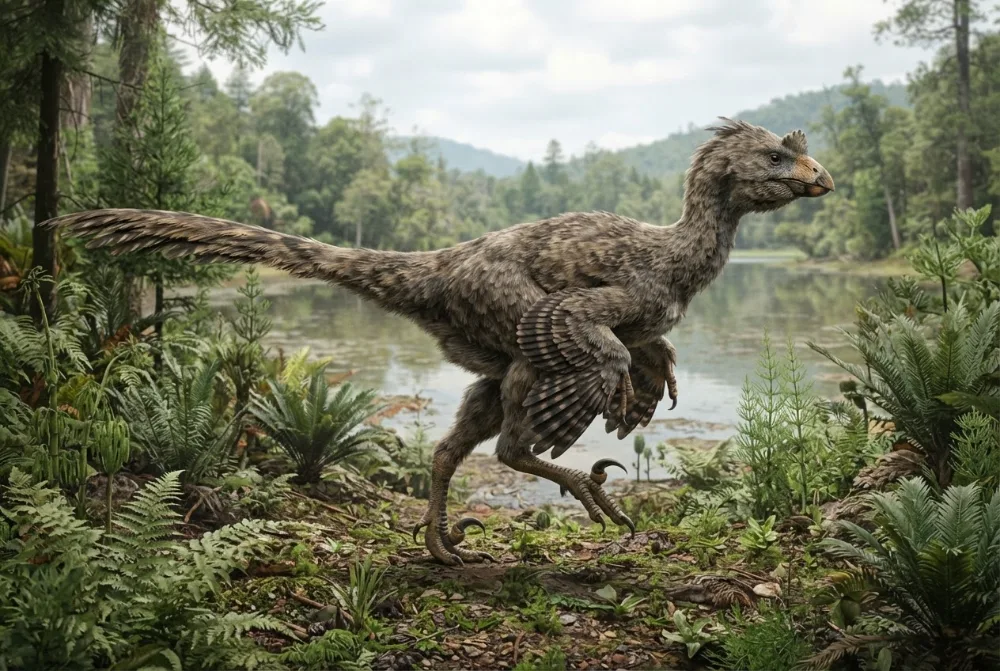
The name Yuanyanglong comes from the Mandarin word for lovebirds, because the two fossil skeletons were found together on the same block.1
The species name bainian means 'a hundred years' in Chinese, celebrating 100 years since the first oviraptorosaurs were named in 1924.1
Scientists found two partial skeletons, one with a poorly preserved skull and the other with parts of the hips, legs, and arms.1
Yuanyanglong is a basal oviraptorosaur, meaning it branched off early in the group's family tree, before many other oviraptorosaurs.1
Mafunso ofunsidwa kwambiri okhudza Yuanyanglong
?How big was Yuanyanglong?
It was a relatively small dinosaur, though its exact size is not given in the sources. It is described as a 'smaller' oviraptorosaur based on the two partial skeletons found.3
?What did Yuanyanglong eat?
It was an omnivore, meaning it ate both plants and small animals. Scientists found gastroliths (stomach stones) in its body cavity, which helped it grind up food.43
?Could Yuanyanglong run fast?
It had long legs and narrow feet, which usually help with running, but its hip bone had a very short area for leg muscles to attach. Scientists think it was probably not a fast runner and may have been better at wading in water like a modern wading bird.3
?Why was it called Yuanyanglong?
The name means 'lovebird dragon' in Chinese, because the two fossil skeletons were found lying together on the same rock block, like a pair of lovebirds.1
Kwa akatswiri a madino
- Dzina la sayansi
- Yuanyanglong
- Anapatsidwa dzina ndi
- Hao et al. 20254
- Gulu
- Madino a nthenga achilendo
- Banja / kladi
- Oviraptorosauria4
- Magawidwe a sayansi
- Theropoda > Oviraptorosauria4
- Zaka za miyala
- zaka 121 mpaka 100 miliyoni (Aptian / Albian)4
- Mapangidwe a miyala
- Miaogou4
- Mayiko
- China4
- Zolemba za mafosili
- 1 mu The Paleobiology Database4
- Kupezeka
- The fossils were discovered in 2021 in the Miaogou Formation in Inner Mongolia, China. In 2024, Hao and colleagues announced the new genus and species Yuanyanglong bainian, and the full description was published in 2025.1
- Akukambiranabe
- Scientists are still debating exactly where Yuanyanglong sits on the oviraptorosaur family tree, since its skeleton is incomplete.1
Kumene mfundo zimachokera
- Yuanyanglong (en.wikipedia.org)
- Yuanyanglong bainian | Dinosaur Database by DinoAnimals.com (dinoanimals.com)
- 内蒙古发现窃蛋龙类恐龙新属种——百年鸳鸯龙----中国科学院古脊椎动物与古人类研究所 (ivpp.ac.cn)
- Yuanyanglong in The Paleobiology Database (CC BY 4.0): zaka, malo, mapangidwe a miyala, magawidwe a sayansi.
Mfundo iliyonse patsamba lino ili ndi nambala yosonyeza kumene yachokera. Ngati talakwitsa kanthu, pepa, ndife okonda madino, osati magazini ya sayansi. Tiuze pa [email protected] ndipo tikonza.
 Rex ali ndi njala! Dino Wiki ndi ntchito ya bambo kwa mwana wawo wamwamuna wokonda madainoso, yaulere popanda zotsatsa ndi zokazonda. Akuluakulu angadyetse Rex zokhwasula-khwasula kuti tsambali lipitirize kupezeka pa intaneti.Dyetsa Rex
 Therizinosaurus
 Oviraptor
 Chirostenotes
 Citipes
 Leptorhynchos
 Avimimus
 Stegosaurus
 Iguanodon
 Archaeopteryx
 Giganotosaurus
 Microraptor
 Deinonychus