 Ati daayinoo kami? Qormaata
 Lola daayinoo
 Dorgommii daayinoo
 Taphoota daayinoo xixiqqoo
 Albamii istiikarii
 Tarreewwan TOP daayinoo
 Na dinqisiisi!
Yoom jiraate?

Hammam guddaa ture?
Hammam dheeraa ture?
Hammam ol-dheeraa ture?
tilmaama
Hammam ulfaataa ture?
 akka adurree manaa 2 funyaan hanga eegeetti dheeraa🍌akka muuzii 6 walitti hiriiran dheeraagara ulfaatina adurree manaa🍌akka muuzii 42 ulfaata🪑akka barcuma jala deemuu danda'utti xiqqaa🏃meetira 100 sekondii 14 keessatti fiiguu danda'a (namni hunda caalaa saffisaan 9.6 barbaada)
SI wajjin yoo wal bira qabamu, Caudipteryx hammam guddaa ture?
Herrega qofa barbaadduu kee keessatti. Wanti tokkollee hin olkaa'amu, eessayyuu hin ergamu.
Hammam saffisaa ture?


Odeeffannoowwan bashannansiisoo
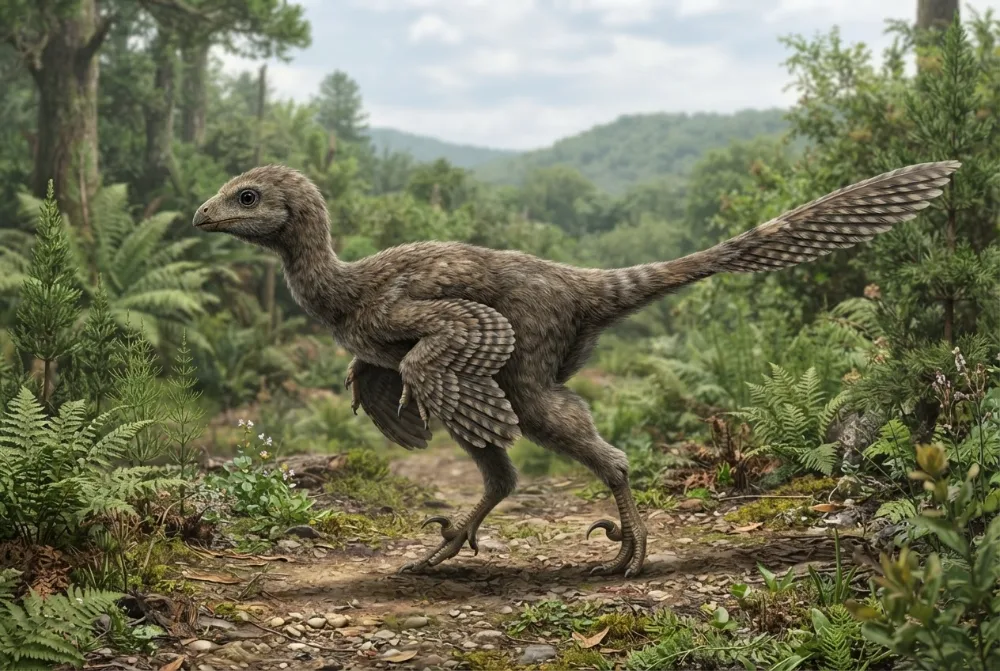
Caudipteryx had long, symmetrical feathers on its hands and tail, measuring 15 to 20 centimetres (5.9 to 7.9 inches) long. These feathers were black with a banded pattern on the tail.1
Its discovery in 1998 helped prove that birds evolved from dinosaurs, because it had clear feathers but was not a bird.1
Caudipteryx had a short, boxy skull with a beak-like snout and only a few teeth in the front of its upper jaw.1
Scientists think Caudipteryx was secondarily flightless, meaning its ancestors could fly but it lost that ability.1
Fossils of Caudipteryx have been found with gizzard stones in the place where its stomach would have been, just like in some plant-eating dinosaurs and modern birds.1
Gaaffiiwwan waa'ee Caudipteryx baay'ee gaafataman
?How big was Caudipteryx?
About 72.5 to 89 centimetres (2 feet 4.5 inches to 2 feet 11 inches) long and weighed around 5 kilograms (11 pounds). It was about the size of a peacock.14
?What did Caudipteryx eat?
It was an omnivore. It probably ate insects and maybe plants, and it swallowed small stones called gastroliths to help digest its food.12
?Could Caudipteryx fly?
No, it could not fly. Its arms were too short to work as wings, and scientists think it was secondarily flightless, meaning its ancestors could fly but it lost that ability.14
?When did Caudipteryx live?
It lived during the Early Cretaceous period, about 124 to 122 million years ago.12
?Where was Caudipteryx found?
All Caudipteryx fossils have been found in the Yixian Formation in Liaoning, China.14
?Is Caudipteryx a bird?
Most scientists say it is a non-avian dinosaur, but a few think it might be a flightless bird. The debate helped prove that birds evolved from dinosaurs.1
Seenaa sobaa diigaa
Seenaa sobaa: Caudipteryx was a bird because it had feathers.
Dhugaa: Caudipteryx was a non-avian dinosaur, not a bird. It belongs to a group called oviraptorosaurs, which are dinosaurs closely related to birds.1
Ogeeyyii daayinootiif
- Maqaa saayinsii
- Caudipteryx
- Kan maqaa baase
- Ji et al. 19985
- Garee
- Daayinoowwan rifeensa qaban kan addaa
- Maatii / kilaadii
- Oviraptorosauria5
- Ramaddii
- Theropoda > Oviraptorosauria5
- Umurii dhagaawwanii
- waggaa miliyoona 126 hanga 120 (Barremian / Aptian)5
- Caasaawwan dhagaa
- Yixian5
- Biyyoota
- Chaayinaa5
- Galmee fosilii
- 2 The Paleobiology Database keessa5
- Argannoo
- Caudipteryx was named in 1998 by Ji and colleagues based on two nearly complete skeletons found in Liaoning, China. The name honors Zou Jiahua, a Chinese vice premier.1
- Ammallee falmisiisaa
- Scientists still debate whether Caudipteryx was a bird or a non-avian dinosaur, though most now agree it is a non-avian oviraptorosaur.1
Odeeffannoon eessaa dhufa
- Caudipteryx (en.wikipedia.org)
- Caudipteryx | Natural History Museum (nhm.ac.uk)
- PBDB Taxon (paleobiodb.org)
- Caudipteryx | Size, Habitat, & Facts | Britannica (britannica.com)
- Caudipteryx in The Paleobiology Database (CC BY 4.0): umurii, bakkeewwan, caasaawwan dhagaa, ramaddii.
Odeeffannoon fuula kana irra jiru hundi lakkoofsa madda isaa agarsiisu qaba. Yoo waa dogoggorre, dhiifama, nuti jaallattoota daayinoo malee joornaalii saayinsii miti. [email protected] irratti nutti himi, nus ni sirreessina.
 Rex beela'eera! Dino Wiki pirojektii abbaa tokkoo kan ilma isaa daayinoo jaallatuuf hojjetame, bilisa, beeksisa malee fi hordoftuu malee. Ga'eessonni akka inni interneetii irra turuuf Rexiif nyaata xiqqoo kennuu danda'u.Rex soori
 Therizinosaurus
 Oviraptor
 Chirostenotes
 Citipes
 Leptorhynchos
 Avimimus
 Stegosaurus
 Iguanodon
 Archaeopteryx
 Giganotosaurus
 Microraptor
 Deinonychus