 Ati daayinoo kami? Qormaata
 Lola daayinoo
 Dorgommii daayinoo
 Taphoota daayinoo xixiqqoo
 Albamii istiikarii
 Tarreewwan TOP daayinoo
 Na dinqisiisi!
Clidastes
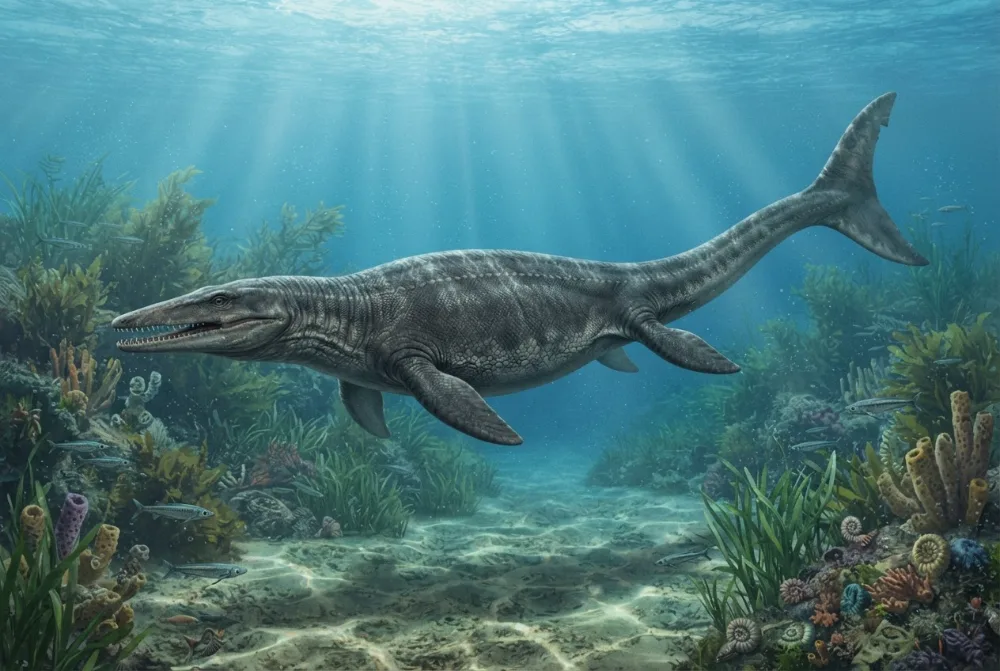
Clidastes was a small, speedy marine lizard that lived in the Late Cretaceous seas. It was one of the smallest mosasaurs, but it was a fast swimmer that chased down fish and squid in shallow waters.1
Yoom jiraate?
Hammam guddaa ture?
Hammam dheeraa ture?
Hammam ulfaataa ture?
 akka saree 6 funyaan hanga eegeetti dheeraa🍌akka muuzii 34 walitti hiriiran dheeraa
 akka adurree manaa 14 ulfaata🍉akka habxuu 11 ulfaata🧸akka ijoollee KG 3 ulfaata🎒akka ijoollee mana barumsaa 1.5 ulfaata🏊dheerina bishaan daakaa guddaa (50 m) sekondii 5.5 keessatti daakuu danda'a
SI wajjin yoo wal bira qabamu, Clidastes hammam guddaa ture?
Herrega qofa barbaadduu kee keessatti. Wanti tokkollee hin olkaa'amu, eessayyuu hin ergamu.
Hammam saffisaa ture?


Odeeffannoowwan bashannansiisoo
Clidastes had special vertebrae that locked together, making its spine strong and stable for fast swimming.1
It was one of the smallest mosasaurs, only 2 to 4 meters long on average, but some grew up to 6.2 meters.1
Isotope studies on its teeth suggest Clidastes sometimes entered freshwater, like modern sea snakes.1
The first Clidastes fossils were found in Alabama in 1869 by E. D. Cope, and they were beautifully preserved.1
Its tail had extra-strong bones and muscles, which helped it chase down the fastest prey.1
Some scientists think that only one species, Clidastes propython, is valid, but others recognize more.1
Gaaffiiwwan waa'ee Clidastes baay'ee gaafataman
?Was Clidastes a dinosaur?
No, Clidastes was a marine lizard, not a dinosaur. It belonged to a group called mosasaurs, which are reptiles that lived in the sea.13
?How big was Clidastes?
Clidastes was one of the smallest mosasaurs, averaging 2 to 4 metres (6.6 to 13.1 feet) long. The largest specimens reached about 6.2 metres (20 feet).13
?What did Clidastes eat?
Clidastes likely ate cephalopods (like squid), fish, and other small vertebrates. It hunted in shallow water.13
?Could Clidastes swim in freshwater?
Yes, isotope studies on its teeth suggest Clidastes sometimes entered freshwater, similar to modern sea snakes.1
Ogeeyyii daayinootiif
- Maqaa saayinsii
- Clidastes
- Kan maqaa baase
- Cope 18684
- Garee
- Moosaasaroota
- Maatii / kilaadii
- Mosasauridae4
- Ramaddii
- Mosasauroidea4
- Umurii dhagaawwanii
- waggaa miliyoona 94 hanga 66 (Turonian / Maastrichtian)4
- Caasaawwan dhagaa
- Mooreville Chalk, Niobrara, Pierre Shale4
- Biyyoota
- Ameerikaa, Iswiidin, Jarmanii, Meeksikoo, Raashiyaa, Jordaan4
- Galmee fosilii
- 34 The Paleobiology Database keessa4
- Argannoo
- E. D. Cope named Clidastes in 1868, and in 1869 he found the first good fossils in the Mooreville Chalk of Alabama.14
- Ammallee falmisiisaa
- Scientists debate whether fossils from Europe and Jordan really belong to Clidastes or to other mosasaurs.1
Odeeffannoon eessaa dhufa
- Clidastes (en.wikipedia.org)
- Clidastes - Justapedia (justapedia.org)
- Clidastes Facts for Kids (kids.kiddle.co)
- Clidastes in The Paleobiology Database (CC BY 4.0): umurii, bakkeewwan, caasaawwan dhagaa, ramaddii.
Odeeffannoon fuula kana irra jiru hundi lakkoofsa madda isaa agarsiisu qaba. Yoo waa dogoggorre, dhiifama, nuti jaallattoota daayinoo malee joornaalii saayinsii miti. [email protected] irratti nutti himi, nus ni sirreessina.
 Rex beela'eera! Dino Wiki pirojektii abbaa tokkoo kan ilma isaa daayinoo jaallatuuf hojjetame, bilisa, beeksisa malee fi hordoftuu malee. Ga'eessonni akka inni interneetii irra turuuf Rexiif nyaata xiqqoo kennuu danda'u.Rex soori
 Mosasaurus
 Prognathodon
 Tylosaurus
 Platecarpus
 Globidens
 Halisaurus
 Tyrannosaurus
 Triceratops
 Velociraptor
 Spinosaurus
 Ankylosaurus
 Parasaurolophus