 Ati daayinoo kami? Qormaata
 Lola daayinoo
 Dorgommii daayinoo
 Taphoota daayinoo xixiqqoo
 Albamii istiikarii
 Tarreewwan TOP daayinoo
 Na dinqisiisi!
Globidens
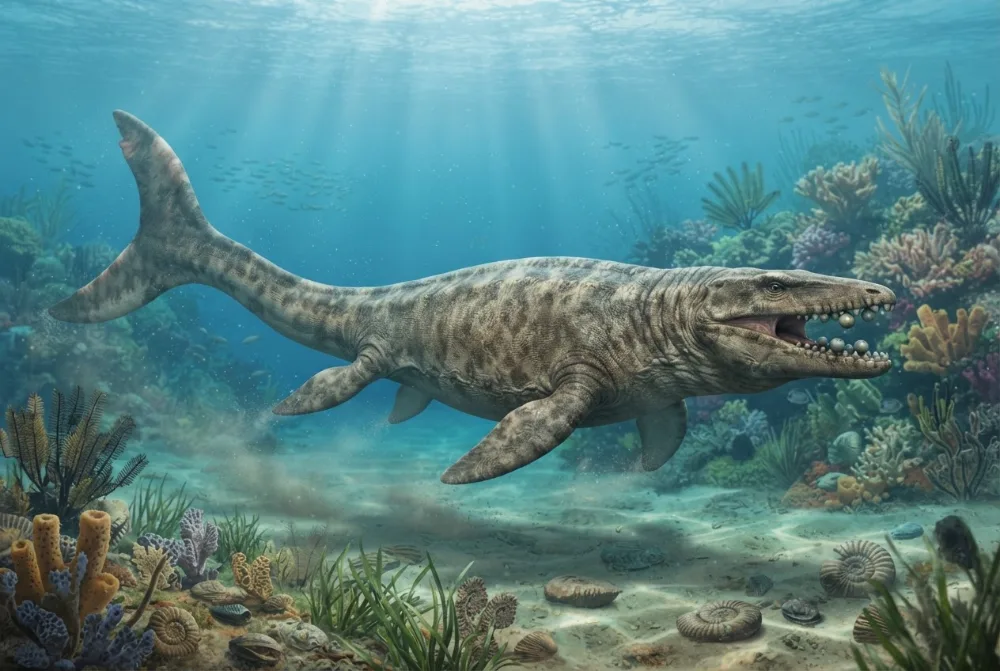
Globidens was a marine lizard that lived in the warm, shallow seas of the Late Cretaceous. It had strange, round teeth like little balls, perfect for crushing the hard shells of its prey. Unlike many other sea reptiles, Globidens was a shell-crushing specialist!1
Yoom jiraate?
Hammam guddaa ture?
Hammam dheeraa ture?
 akka saree 6 funyaan hanga eegeetti dheeraa🍌akka muuzii 33 walitti hiriiran dheeraa🏊dheerina bishaan daakaa guddaa (50 m) sekondii 4.7 keessatti daakuu danda'a
SI wajjin yoo wal bira qabamu, Globidens hammam guddaa ture?
Herrega qofa barbaadduu kee keessatti. Wanti tokkollee hin olkaa'amu, eessayyuu hin ergamu.
Hammam saffisaa ture?


Odeeffannoowwan bashannansiisoo
Globidens had round, globe-shaped teeth that were different from the sharp teeth of most other mosasaurs.1
Scientists found stomach contents inside a Globidens fossil from South Dakota, showing it ate clams called inoceramids.1
Globidens lived about 84 to 66 million years ago, during the Late Cretaceous period.3
The first Globidens fossil was a partial skull and a neck bone found in Alabama, USA, and named in 1912 by Charles W. Gilmore.1
Globidens had a strong, robust skull and a powerful bite to crush the shells of its prey.1
Gaaffiiwwan waa'ee Globidens baay'ee gaafataman
?How big was Globidens?
Globidens was a medium-sized mosasaur, measuring about 5 to 6 metres (16 to 20 feet) long.1
?What did Globidens eat?
Globidens ate hard-shelled prey like turtles, ammonites, nautili, and bivalves. Stomach contents from a fossil found in South Dakota showed it ate clams called inoceramids.12
?Why did Globidens have round teeth?
Globidens had round, globe-shaped teeth that were perfect for crushing tough shells. Unlike most mosasaurs with sharp teeth for grabbing slippery prey, Globidens was a shell-crushing specialist.1
?Was Globidens a dinosaur?
No, Globidens was not a dinosaur. It was a marine lizard, a type of mosasaur that lived in the sea during the Late Cretaceous.1
?When did Globidens live?
Globidens lived during the Late Cretaceous period, about 84 to 66 million years ago.1
?Where have Globidens fossils been found?
Globidens fossils have been found in Angola, Brazil, Colombia, Morocco, Syria, and the United States.1
Ogeeyyii daayinootiif
- Maqaa saayinsii
- Globidens
- Kan maqaa baase
- Gilmore 19123
- Garee
- Moosaasaroota
- Maatii / kilaadii
- Mosasauridae3
- Ramaddii
- Mosasauroidea3
- Umurii dhagaawwanii
- waggaa miliyoona 90 hanga 66 (Coniacian / Maastrichtian)3
- Caasaawwan dhagaa
- Pierre Shale, Wolfe City/Sprinkle, Phosphates3
- Biyyoota
- Ameerikaa, Morookoo, Sooriyaa, Jordaan, Gibxi, Angoolaa3
- Galmee fosilii
- 32 The Paleobiology Database keessa3
- Argannoo
- Globidens was first described in 1912 by Charles W. Gilmore, based on an incomplete skull and a neck bone from Alabama, USA. The name means 'globe tooth' because of its round teeth.1
- Ammallee falmisiisaa
- Scientists are still debating exactly how many species of Globidens existed, as some fossils have been moved to other groups like Prognathodon.1
Odeeffannoon eessaa dhufa
- Globidens (en.wikipedia.org)
- Stomach contents of Globidens, a shell-crushing mosasaur (Squamata), from the Late Cretaceous Pierre Shale Group, Big Bend area of the Missouri River, central South Dakota (exa.ai)
- Globidens in The Paleobiology Database (CC BY 4.0): umurii, bakkeewwan, caasaawwan dhagaa, ramaddii.
Odeeffannoon fuula kana irra jiru hundi lakkoofsa madda isaa agarsiisu qaba. Yoo waa dogoggorre, dhiifama, nuti jaallattoota daayinoo malee joornaalii saayinsii miti. [email protected] irratti nutti himi, nus ni sirreessina.
 Rex beela'eera! Dino Wiki pirojektii abbaa tokkoo kan ilma isaa daayinoo jaallatuuf hojjetame, bilisa, beeksisa malee fi hordoftuu malee. Ga'eessonni akka inni interneetii irra turuuf Rexiif nyaata xiqqoo kennuu danda'u.Rex soori
 Mosasaurus
 Prognathodon
 Tylosaurus
 Platecarpus
 Clidastes
 Halisaurus
 Tyrannosaurus
 Triceratops
 Velociraptor
 Spinosaurus
 Ankylosaurus
 Parasaurolophus