 Ati daayinoo kami? Qormaata
 Lola daayinoo
 Dorgommii daayinoo
 Taphoota daayinoo xixiqqoo
 Albamii istiikarii
 Tarreewwan TOP daayinoo
 Na dinqisiisi!
Platecarpus
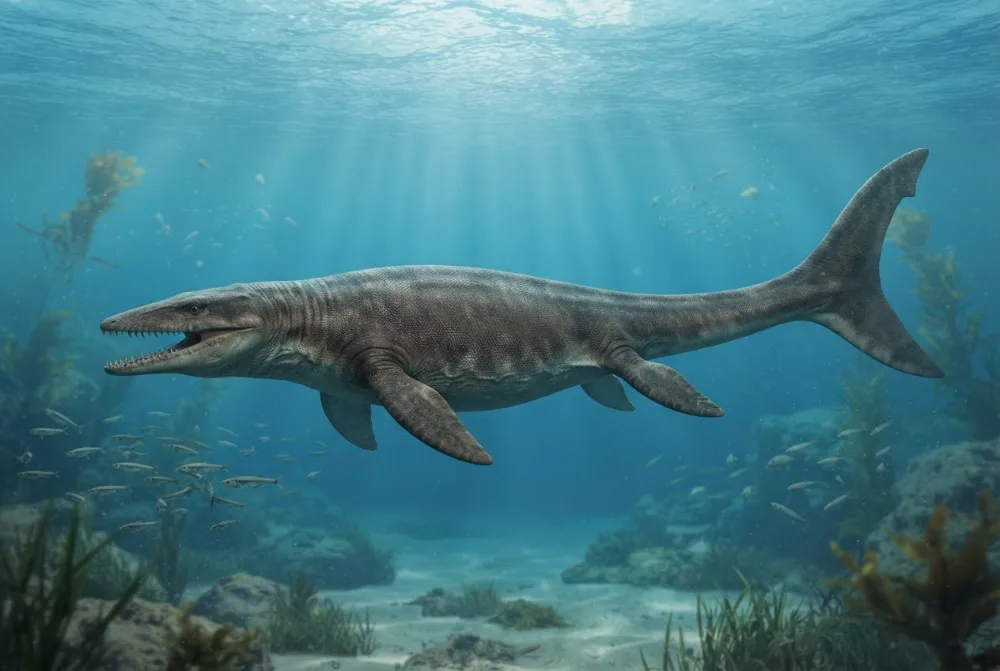
Platecarpus was a fast-swimming marine lizard that lived in the sea during the time of the dinosaurs. It had a long tail with a shark-like fin and ate fish and squid. Platecarpus was not a dinosaur, but a mosasaur, a kind of giant sea lizard.1
Yoom jiraate?
Hammam guddaa ture?
Hammam dheeraa ture?
 akka saree 6 funyaan hanga eegeetti dheeraa🍌akka muuzii 32 walitti hiriiran dheeraa🏊dheerina bishaan daakaa guddaa (50 m) sekondii 4.7 keessatti daakuu danda'a
SI wajjin yoo wal bira qabamu, Platecarpus hammam guddaa ture?
Herrega qofa barbaadduu kee keessatti. Wanti tokkollee hin olkaa'amu, eessayyuu hin ergamu.
Hammam saffisaa ture?


Odeeffannoowwan bashannansiisoo
Platecarpus had a short skull and fewer teeth than any other mosasaur, with only about 10 teeth in each lower jaw bone.1
A well-preserved fossil shows skin impressions, pigments near the nostrils, and even the shape of the tail fluke, which was like a shark's tail.1
Platecarpus swam by moving its tail side to side, but its deep tail fin made it a powerful, fast swimmer, not like an eel.1
Fossilized stomach contents show that Platecarpus ate fish and did not digest its food completely, passing bones and scales quickly.1
A 2026 study of tooth chemistry suggests that Platecarpus was warm-blooded, like modern sharks and whales.1
Platecarpus fossils are very common in the Smoky Hill Chalk of Kansas, which was once the bottom of a shallow sea.1
Gaaffiiwwan waa'ee Platecarpus baay'ee gaafataman
?How big was Platecarpus?
About 5.7 metres (18.7 feet) long, based on a complete fossil. That is roughly the length of a small bus.1
?What did Platecarpus eat?
It ate medium-sized fish, and probably also squid and ammonites. Fossil stomach contents show it swallowed fish whole and digested them quickly.1
?When did Platecarpus live?
It lived about 84 to 81 million years ago, during the Late Cretaceous period. That was the time of the dinosaurs.1
?Is Platecarpus a dinosaur?
No, it is not a dinosaur. It is a mosasaur, a kind of giant marine lizard that lived in the sea.1
?Where have Platecarpus fossils been found?
Mostly in the United States, especially in Kansas. Fossils have also been found in Belgium, Australia, and Africa.1
Seenaa sobaa diigaa
Seenaa sobaa: Many people think mosasaurs like Platecarpus swam like eels, wiggling their whole body.
Dhugaa: Platecarpus had a crescent-shaped tail fluke and swam more like a shark, using its tail for powerful thrusts.1
Ogeeyyii daayinootiif
- Maqaa saayinsii
- Platecarpus
- Kan maqaa baase
- Cope 18692
- Garee
- Moosaasaroota
- Maatii / kilaadii
- Mosasauridae2
- Ramaddii
- Mosasauroidea2
- Umurii dhagaawwanii
- waggaa miliyoona 100 hanga 66 (Cenomanian / Maastrichtian)2
- Caasaawwan dhagaa
- Pierre Shale, Niobrara, Molecap Greensand2
- Biyyoota
- Ameerikaa, Kanaadaa, Iswiidin, Biraazil, Awustiraaliyaa, Raashiyaa2
- Galmee fosilii
- 60 The Paleobiology Database keessa2
- Argannoo
- Platecarpus was named by the famous paleontologist Edward Drinker Cope in 1869, based on fossils found in Mississippi, USA.12
- Ammallee falmisiisaa
- Scientists still debate whether some fossils belong to Platecarpus or to other closely related mosasaurs, and some species have been moved to different genera.1
Odeeffannoon eessaa dhufa
- Platecarpus (en.wikipedia.org)
- Platecarpus in The Paleobiology Database (CC BY 4.0): umurii, bakkeewwan, caasaawwan dhagaa, ramaddii.
Odeeffannoon fuula kana irra jiru hundi lakkoofsa madda isaa agarsiisu qaba. Yoo waa dogoggorre, dhiifama, nuti jaallattoota daayinoo malee joornaalii saayinsii miti. [email protected] irratti nutti himi, nus ni sirreessina.
 Rex beela'eera! Dino Wiki pirojektii abbaa tokkoo kan ilma isaa daayinoo jaallatuuf hojjetame, bilisa, beeksisa malee fi hordoftuu malee. Ga'eessonni akka inni interneetii irra turuuf Rexiif nyaata xiqqoo kennuu danda'u.Rex soori
 Mosasaurus
 Prognathodon
 Tylosaurus
 Clidastes
 Globidens
 Halisaurus
 Tyrannosaurus
 Triceratops
 Velociraptor
 Spinosaurus
 Ankylosaurus
 Parasaurolophus