 Ati daayinoo kami? Qormaata
 Lola daayinoo
 Dorgommii daayinoo
 Taphoota daayinoo xixiqqoo
 Albamii istiikarii
 Tarreewwan TOP daayinoo
 Na dinqisiisi!
Similicaudipteryx
Similicaudipteryx was a small, feathered dinosaur that lived in what is now China. It looked a bit like a bird and had a special tail bone that helped support long tail feathers.1
Yoom jiraate?
Hammam guddaa ture?
Hammam dheeraa ture?
Hammam ol-dheeraa ture?
tilmaama
Hammam ulfaataa ture?
 akka adurree manaa 2 funyaan hanga eegeetti dheeraa🍌akka muuzii 6 walitti hiriiran dheeraagara ulfaatina adurree manaa🍌akka muuzii 58 ulfaata🪑akka barcuma jala deemuu danda'utti xiqqaa🏃meetira 100 sekondii 11 keessatti fiiguu danda'a (namni hunda caalaa saffisaan 9.6 barbaada)
SI wajjin yoo wal bira qabamu, Similicaudipteryx hammam guddaa ture?
Herrega qofa barbaadduu kee keessatti. Wanti tokkollee hin olkaa'amu, eessayyuu hin ergamu.
Hammam saffisaa ture?


Odeeffannoowwan bashannansiisoo
Similicaudipteryx had a dagger-shaped pygostyle, a bone at the end of its tail that helped anchor long tail feathers.1
It was bigger than its close relative Caudipteryx, but still only about 1 meter long.1
The first fossil of Similicaudipteryx was found in the Jiufotang Formation, which is about 120 million years old.1
Its pubic bone was very long compared to its ilium, which is a unique feature among its relatives.1
Scientists think Similicaudipteryx had feathers even though the first fossil didn't show them, because of its pygostyle.1
Two other fossils that were thought to be Similicaudipteryx might actually belong to a different dinosaur called Incisivosaurus.1
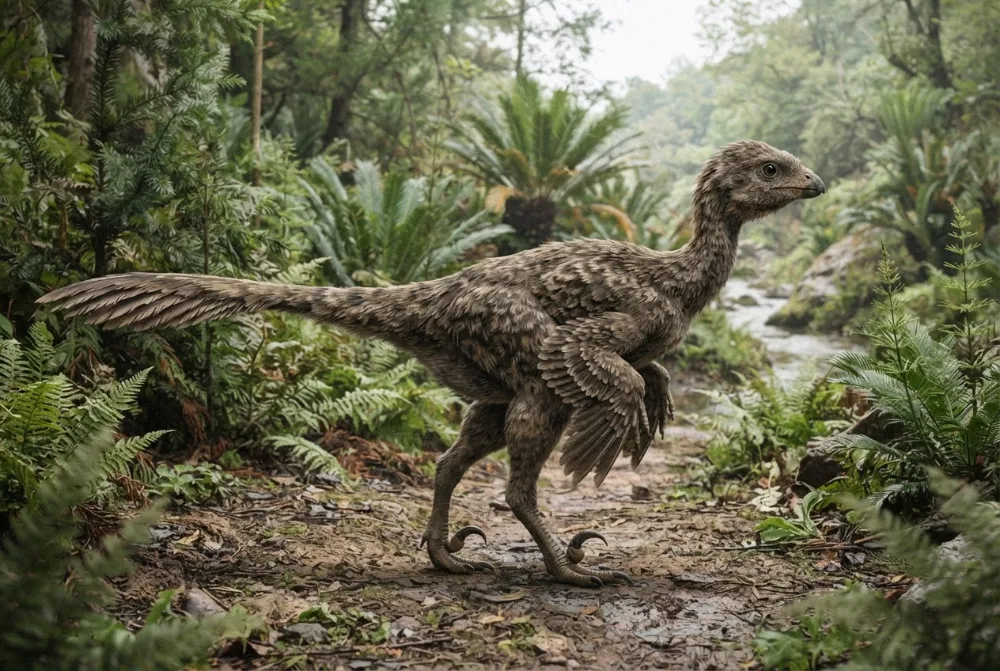
Gaaffiiwwan waa'ee Similicaudipteryx baay'ee gaafataman
?How big was Similicaudipteryx?
About 1 metre (3.3 feet) long and weighed about 7 kilograms (15 pounds).1
?Did Similicaudipteryx have feathers?
Yes, it had feathers. The first fossil didn't show them, but scientists think it had feathers because of its pygostyle, a bone that anchors tail feathers.1
?What did Similicaudipteryx eat?
The sources don't say exactly what it ate, but it was an oviraptorosaur, a group that likely ate plants or small animals.1
?When did Similicaudipteryx live?
It lived during the Early Cretaceous Period, about 120 million years ago.1
Ogeeyyii daayinootiif
- Maqaa saayinsii
- Similicaudipteryx
- Kan maqaa baase
- He et al. 20082
- Garee
- Daayinoowwan rifeensa qaban kan addaa
- Maatii / kilaadii
- Caudipterygidae2
- Ramaddii
- Theropoda > Oviraptorosauria2
- Umurii dhagaawwanii
- waggaa miliyoona 121 hanga 113 (Aptian)2
- Caasaawwan dhagaa
- Jiufotang2
- Biyyoota
- Chaayinaa2
- Galmee fosilii
- 1 The Paleobiology Database keessa2
- Argannoo
- Similicaudipteryx was named in 2008 by He Tao, Wang Xiaolin, and Zhou Zhonghe. The first fossil was found in Liaoning, China, in the Jiufotang Formation.12
- Ammallee falmisiisaa
- Scientists are not sure if two fossils with feathers belong to Similicaudipteryx or to another dinosaur called Incisivosaurus.1
Odeeffannoon eessaa dhufa
- Similicaudipteryx (en.wikipedia.org)
- Similicaudipteryx in The Paleobiology Database (CC BY 4.0): umurii, bakkeewwan, caasaawwan dhagaa, ramaddii.
Odeeffannoon fuula kana irra jiru hundi lakkoofsa madda isaa agarsiisu qaba. Yoo waa dogoggorre, dhiifama, nuti jaallattoota daayinoo malee joornaalii saayinsii miti. [email protected] irratti nutti himi, nus ni sirreessina.
 Rex beela'eera! Dino Wiki pirojektii abbaa tokkoo kan ilma isaa daayinoo jaallatuuf hojjetame, bilisa, beeksisa malee fi hordoftuu malee. Ga'eessonni akka inni interneetii irra turuuf Rexiif nyaata xiqqoo kennuu danda'u.Rex soori
 Therizinosaurus
 Oviraptor
 Chirostenotes
 Citipes
 Leptorhynchos
 Avimimus
 Stegosaurus
 Iguanodon
 Archaeopteryx
 Giganotosaurus
 Microraptor
 Deinonychus