 Ati daayinoo kami? Qormaata
 Lola daayinoo
 Dorgommii daayinoo
 Taphoota daayinoo xixiqqoo
 Albamii istiikarii
 Tarreewwan TOP daayinoo
 Na dinqisiisi!
Suzhousaurus
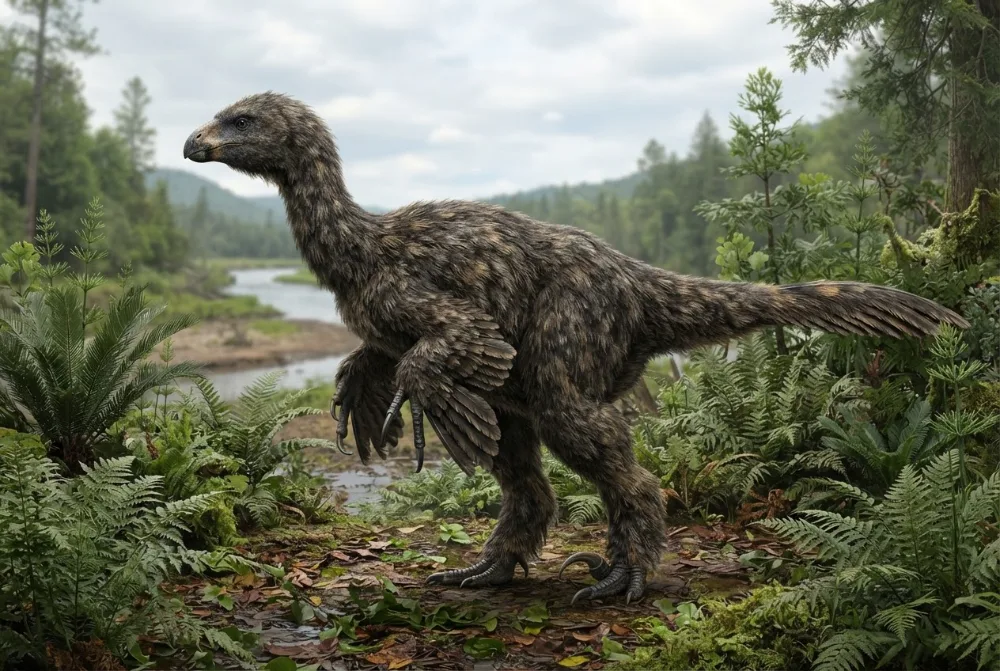
Suzhousaurus was a huge, plant-eating dinosaur with a big belly, strong legs, and long claws. It lived in China during the Early Cretaceous, about 124 to 113 million years ago. It probably had feathers, just like its close relatives!1
Yoom jiraate?
Hammam guddaa ture?
Hammam dheeraa ture?
Hammam ol-dheeraa ture?
tilmaama
Hammam ulfaataa ture?

 akka saree 6 funyaan hanga eegeetti dheeraa🍌akka muuzii 33 walitti hiriiran dheeraaakka saree 160 ulfaata🍉akka habxuu 620 ulfaata🎒akka kutaalee mana barumsaa guutuu 4 ulfaata🐻❄️akka beeraa adii 7 ulfaata🏃meetira 100 sekondii 22 keessatti fiiguu danda'a (namni hunda caalaa saffisaan 9.6 barbaada)
SI wajjin yoo wal bira qabamu, Suzhousaurus hammam guddaa ture?
Herrega qofa barbaadduu kee keessatti. Wanti tokkollee hin olkaa'amu, eessayyuu hin ergamu.
Hammam saffisaa ture?


Odeeffannoowwan bashannansiisoo
Suzhousaurus was one of the largest Early Cretaceous therizinosauroids, reaching about 6 metres (20 feet) long and weighing around 3.1 tonnes (3,100 kilograms).1
Its upper arm bone (humerus) had very expanded ends and a big entepicondyle, which helped scientists identify it as a therizinosauroid.3
Unlike more advanced therizinosaurids, Suzhousaurus's backbone was not highly pneumatized, meaning it had fewer air spaces in its vertebrae.1
Its pelvis was opisthopubic, a feature that is typical of therizinosaurids, even though Suzhousaurus was a more basal member of the group.1
Suzhousaurus had a large belly and a reduced tail, which helped it balance its heavy body.1
Feather impressions from the related Beipiaosaurus suggest that Suzhousaurus was probably at least partially feathered.1
The first specimen, FRDC-GSJB-99, was found in 1999 and includes a right humerus, shoulder bones, ten back vertebrae, and part of the pelvis, but no skull.1
A second, more complete skeleton found in 2004 includes the sacrum, tail vertebrae, a nearly complete pelvis, and both thigh bones.1
Gaaffiiwwan waa'ee Suzhousaurus baay'ee gaafataman
?How big was Suzhousaurus?
Suzhousaurus was about 6 metres (20 feet) long and weighed around 3.1 tonnes (3,100 kilograms). That makes it one of the largest Early Cretaceous therizinosauroids.1
?What did Suzhousaurus eat?
It was a plant-eater. It had a big belly, strong legs, and long claws for browsing on plants.1
?Did Suzhousaurus have feathers?
Probably yes. Feather impressions from its close relative Beipiaosaurus suggest that Suzhousaurus was at least partially feathered.1
?When did Suzhousaurus live?
It lived during the Early Cretaceous, about 124 to 113 million years ago, in what is now China.1
?Was Suzhousaurus a dinosaur?
Yes, it was a theropod dinosaur, specifically a therizinosauroid.1
?Why did Suzhousaurus have long claws?
Its long claws were probably used for pulling down branches and leaves to eat, like other therizinosauroids.1
Ogeeyyii daayinootiif
- Maqaa saayinsii
- Suzhousaurus
- Kan maqaa baase
- Li et al. 20074
- Garee
- Daayinoowwan rifeensa qaban kan addaa
- Maatii / kilaadii
- Therizinosauridae4
- Ramaddii
- Theropoda > Therizinosauria4
- Umurii dhagaawwanii
- waggaa miliyoona 121 hanga 110 (Aptian / Albian)4
- Caasaawwan dhagaa
- Xiagou, Zhonggou4
- Biyyoota
- Chaayinaa4
- Galmee fosilii
- 2 The Paleobiology Database keessa4
- Argannoo
- The first Suzhousaurus fossil was found in 1999 in the Yujingzi Basin, China. Scientists named it Suzhousaurus megatherioides in 2007, and the name means 'Suzhou lizard' after the old name for the Jiuquan area.1
- Ammallee falmisiisaa
- Scientists are not sure if Suzhousaurus is the same animal as another therizinosauroid called 'Nanshiungosaurus' bohlini, because the fossils do not overlap and the original specimen is lost.1
Odeeffannoon eessaa dhufa
- Suzhousaurus (en.wikipedia.org)
- PBDB Taxon (paleobiodb.org)
- A Large Therizinosauroid (Dinosauria: Theropoda) from the Early Cretaceous of Northwestern China (onlinelibrary.wiley.com)
- Suzhousaurus in The Paleobiology Database (CC BY 4.0): umurii, bakkeewwan, caasaawwan dhagaa, ramaddii.
Odeeffannoon fuula kana irra jiru hundi lakkoofsa madda isaa agarsiisu qaba. Yoo waa dogoggorre, dhiifama, nuti jaallattoota daayinoo malee joornaalii saayinsii miti. [email protected] irratti nutti himi, nus ni sirreessina.
 Rex beela'eera! Dino Wiki pirojektii abbaa tokkoo kan ilma isaa daayinoo jaallatuuf hojjetame, bilisa, beeksisa malee fi hordoftuu malee. Ga'eessonni akka inni interneetii irra turuuf Rexiif nyaata xiqqoo kennuu danda'u.Rex soori
 Therizinosaurus
 Oviraptor
 Chirostenotes
 Citipes
 Leptorhynchos
 Avimimus
 Stegosaurus
 Iguanodon
 Archaeopteryx
 Giganotosaurus
 Microraptor
 Deinonychus