 Ati daayinoo kami? Qormaata
 Lola daayinoo
 Dorgommii daayinoo
 Taphoota daayinoo xixiqqoo
 Albamii istiikarii
 Tarreewwan TOP daayinoo
 Na dinqisiisi!
Zhongjianornis
Zhongjianornis was a pigeon-sized bird that lived in China during the Early Cretaceous, about 120 million years ago. It had a toothless beak and strong wing muscles, making it a good flier. This little bird helps scientists understand how early birds evolved and lost their teeth.12
Yoom jiraate?
Hammam guddaa ture?
Hammam dheeraa ture?
Hammam ol-dheeraa ture?
tilmaama
Hammam ulfaataa ture?
SI wajjin yoo wal bira qabamu, Zhongjianornis hammam guddaa ture?
Herrega qofa barbaadduu kee keessatti. Wanti tokkollee hin olkaa'amu, eessayyuu hin ergamu.
Hammam saffisaa ture?


Odeeffannoowwan bashannansiisoo
Zhongjianornis is one of the most primitive birds known to have completely lost its teeth, developing a beak instead.2
Its humerus had a large, robust deltopectoral crest, which was as wide as the bone shaft and more than one-third the total length of the humerus, indicating strong flight muscles.3
The only known fossil of Zhongjianornis is a nearly complete skeleton with some poorly preserved feather imprints.3
Zhongjianornis lived during the Aptian age of the Early Cretaceous, about 121 to 113 million years ago.3
Scientists initially thought Zhongjianornis was very primitive, but later research in 2012 suggested it was more similar to advanced euornithean birds like Chaoyangia.1
The species name yangi honors Yang Zhongjian, the founder of the Institute of Vertebrate Paleontology and Paleoanthropology in Beijing.1
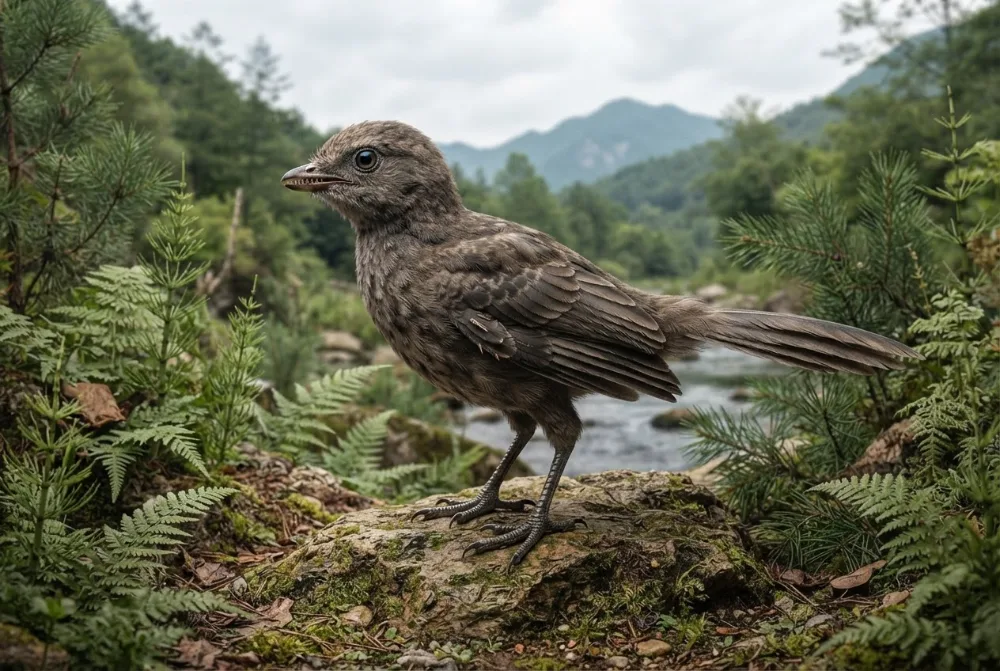
Gaaffiiwwan waa'ee Zhongjianornis baay'ee gaafataman
?How big was Zhongjianornis?
About the size of a pigeon. It was a small bird.1
?Did Zhongjianornis have teeth?
No, it had a toothless beak. It is one of the most primitive birds known to have completely lost its teeth.12
?What did Zhongjianornis eat?
Scientists are not sure, but its toothless beak suggests it may have eaten seeds or small insects.1
Seenaa sobaa diigaa
Seenaa sobaa: Zhongjianornis was the most primitive toothless bird.
Dhugaa: While initially thought to be very primitive, later analysis in 2012 showed that Zhongjianornis is more closely related to advanced euornithean birds, not the most primitive.1
Ogeeyyii daayinootiif
- Maqaa saayinsii
- Zhongjianornis
- Kan maqaa baase
- Zhou et al. 20104
- Garee
- Simbirroota jalqabaa
- Maatii / kilaadii
- Ornithuromorpha4
- Ramaddii
- Theropoda > Avialae4
- Umurii dhagaawwanii
- waggaa miliyoona 121 hanga 113 (Aptian)4
- Caasaawwan dhagaa
- Jiufotang4
- Biyyoota
- Chaayinaa4
- Galmee fosilii
- 1 The Paleobiology Database keessa4
- Argannoo
- Zhongjianornis was named and described by Zhou, Zhang, and Li in a paper published in January 2010 (though it appeared online in 2009). The only fossil, a nearly complete skeleton, was found at Jianchang in Liaoning Province, China.12
- Ammallee falmisiisaa
- Scientists still debate whether Zhongjianornis was a very primitive bird or a more advanced euornithean, due to conflicting interpretations of its fossil's anatomy.1
Odeeffannoon eessaa dhufa
- Zhongjianornis (en.wikipedia.org)
- A new Lower Cretaceous bird from China and tooth reduction in early avian evolution (royalsocietypublishing.org)
- PBDB Taxon (paleobiodb.org)
- Zhongjianornis in The Paleobiology Database (CC BY 4.0): umurii, bakkeewwan, caasaawwan dhagaa, ramaddii.
Odeeffannoon fuula kana irra jiru hundi lakkoofsa madda isaa agarsiisu qaba. Yoo waa dogoggorre, dhiifama, nuti jaallattoota daayinoo malee joornaalii saayinsii miti. [email protected] irratti nutti himi, nus ni sirreessina.
 Rex beela'eera! Dino Wiki pirojektii abbaa tokkoo kan ilma isaa daayinoo jaallatuuf hojjetame, bilisa, beeksisa malee fi hordoftuu malee. Ga'eessonni akka inni interneetii irra turuuf Rexiif nyaata xiqqoo kennuu danda'u.Rex soori
 Archaeopteryx
 Hesperornis
 Ichthyornis
 Baptornis
 Jurapteryx
 Gobipteryx
 Stegosaurus
 Iguanodon
 Giganotosaurus
 Microraptor
 Deinonychus
 Baryonyx