 Uri dinozore iyihe? Umukino w'ibibazo
 Intambara ya dinozore
 Isiganwa rya dinozore
 Imikino mito ya dinozore
 Alubumu ya sitikeri
 Intonde za TOP za dinozore
 Ntungura!
Aegirosaurus
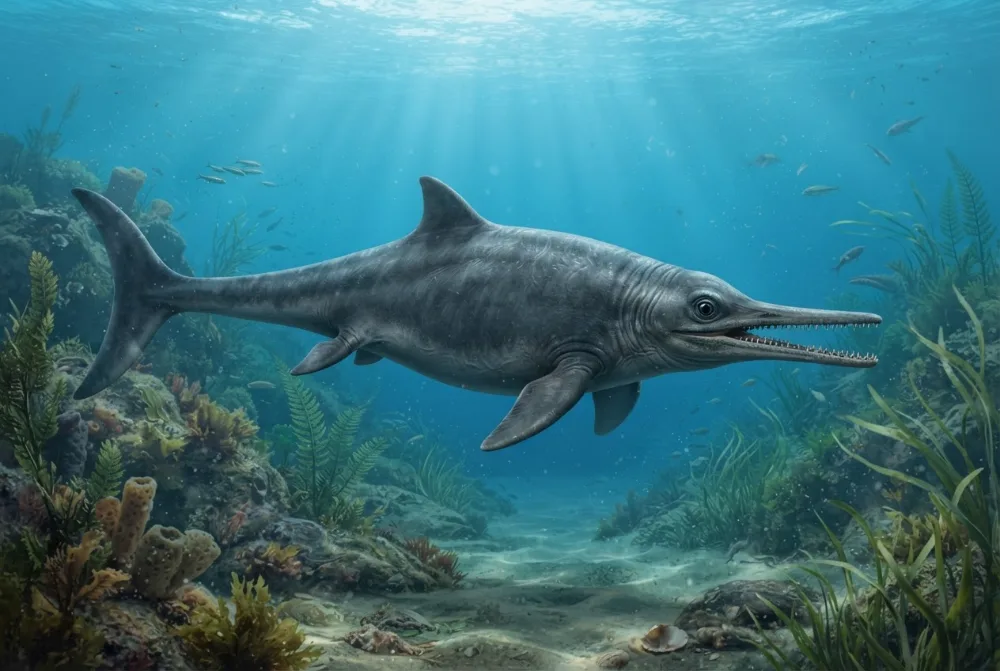
Aegirosaurus was a sleek, dolphin-like marine reptile that swam in the warm seas of Europe during the time of the dinosaurs. It had a long, slender snout packed with tiny, sharp teeth for catching fish and squid.1
Yabayeho ryari?
Yanganaga ite?
Yari ndende ite?
 ndende nk'injangwe 4 zo mu rugo zikurikiranye🍌ndende nk'imineke 11 ikurikiranye🏊yashoboraga koga uburebure bwa pisine nini (50 m) mu masegonda 4,4
Aegirosaurus yanganaga ite ugereranyije NAWE?
Ni imibare gusa ibarirwa muri mushakisha yawe. Nta kintu kibikwa cyangwa cyoherezwa ahandi.
Yihutaga ite?


Utuntu dushimishije
Aegirosaurus had a very long snout that made up 62 to 73 percent of its lower jaw length.1
Its front flippers were narrow and elongated, but its hind flippers were wide because of extra soft tissue.1
Aegirosaurus had a crescent-shaped tail fin, like a fish, to help it swim fast.1
Fossils of Aegirosaurus show skin impressions, including what might be tiny scales on the upper part of its tail fin.1
This ichthyosaur lived from the Late Jurassic to the Early Cretaceous, about 149 to 133 million years ago.3
Aegirosaurus is one of the few ichthyosaurs known from the Valanginian stage of the Early Cretaceous.1
Ibibazo bibazwa cyane kuri Aegirosaurus
?How big was Aegirosaurus?
Aegirosaurus was a medium sized ichthyosaur. The largest known specimen was about 2 metres (6.6 ft) long, and a complete skeleton is 1.77 metres (5.8 ft) long.1
?What did Aegirosaurus eat?
Aegirosaurus ate small fish and squid. Its long, slender snout was packed with tiny, sharp teeth, and its tooth wear suggests it was a generalist feeder.1
?When did Aegirosaurus live?
Aegirosaurus lived from the Late Jurassic to the Early Cretaceous, about 149 to 133 million years ago.1
?Where was Aegirosaurus found?
Fossils of Aegirosaurus have been found in Germany and France. Its remains were discovered in the Solnhofen limestone of Bavaria, Germany, and in southeastern France.1
Gusenya ibinyoma
Ibivugwa: Aegirosaurus was a dinosaur.
Ukuri: Aegirosaurus was an ichthyosaur, a marine reptile that lived in the sea, not a dinosaur. Dinosaurs lived on land.1
Ku bazobereye muri dinozore
- Izina rya siyansi
- Aegirosaurus
- Yiswe na
- Bardet and Fernandez 20003
- Itsinda
- Iktiyozore
- Umuryango / ishami
- Ophthalmosauridae3
- Ishyirwa mu byiciro
- Ichthyosauria > Ichthyosauromorpha3
- Imyaka y'amabuye
- imyaka miliyoni 149 kugeza 133 (Tithonian / Valanginian)3
- Inzego z'amabuye
- Solnhofen3
- Ibihugu
- Ubudage, Ubufaransa3
- Ibisigazwa byanditswe
- 3 muri The Paleobiology Database3
- Ivumburwa
- The first fossil was named Ichthyosaurus leptospondylus by Wagner in 1853. In 2000, scientists Bardet and Fernández gave it the new genus name Aegirosaurus after studying a nearly complete skeleton with soft tissue impressions.12
- Biracyagibwaho impaka
- Scientists are not sure whether Aegirosaurus had scales on its tail fin, because only one fossil shows possible scale impressions.1
Aho amakuru yakuwe
- Aegirosaurus (en.wikipedia.org)
- A new ichthyosaur from the Upper Jurassic lithographic limestones of Bavaria | Journal of Paleontology | Cambridge Core (cambridge.org)
- Aegirosaurus in The Paleobiology Database (CC BY 4.0): imyaka, ahantu, inzego z'amabuye, ishyirwa mu byiciro.
Buri kintu kiri kuri uru rupapuro gifite nimero yerekana aho cyakuwe. Niba hari icyo twibeshye, tubabarire, turi abakunzi ba dinozore, ntituri ikinyamakuru cya siyansi. Tubwire kuri [email protected] tuzagikosora.
 Rex arashonje! Dino Wiki ni umushinga wa papa umwe yakoreye umuhungu we ukunda dinozore, ni ubuntu, nta matangazo kandi nta bigukurikirana. Abantu bakuru bashobora guha Rex akantu ko kurya kugira ngo Dino Wiki ikomeze kuboneka kuri interineti.Gaburira Rex
 Ichthyosaurus
 Platypterygius
 Stenopterygius
 Khudiakovia
 Ophthalmosaurus
 Chonespondylus
 Stegosaurus
 Iguanodon
 Archaeopteryx
 Giganotosaurus
 Microraptor
 Deinonychus