 Uri dinozore iyihe? Umukino w'ibibazo
 Intambara ya dinozore
 Isiganwa rya dinozore
 Imikino mito ya dinozore
 Alubumu ya sitikeri
 Intonde za TOP za dinozore
 Ntungura!
Yabayeho ryari?

Yanganaga ite?
Yari ndende ite?
Ubutumburuke bwayo bwanganaga iki?
Yari iremereye ite?
 ndende nk'imodoka 2 ziparitse ku murongo🍌ndende nk'imineke 56 ikurikiranye
 iremereye nk'inzovu🍉iremereye nk'imbuto 1100 za watermelon🎒iremereye nk'ibyumba 7 by'amashuri byuzuye abana🐻❄️iremereye nk'idubu 12 zo mu rubura🏃yashoboraga kwiruka metero 100 mu masegonda 20 (umuntu wihuta kurusha abandi akenera 9,6)
Antetonitrus yanganaga ite ugereranyije NAWE?
Ni imibare gusa ibarirwa muri mushakisha yawe. Nta kintu kibikwa cyangwa cyoherezwa ahandi.
Yihutaga ite?


Utuntu dushimishije
Antetonitrus lived about 201 to 193 million years ago, during the Early Jurassic.2
Its name means 'before thunder' because it lived before the famous sauropod Brontosaurus, whose name means 'thunder lizard'.1
Unlike later sauropods, Antetonitrus had a flexible thumb that could grasp, not just support weight.1
Its fossils were first found in 1981 and were originally thought to belong to another dinosaur called Euskelosaurus.1
Antetonitrus was about 8 to 10 metres long and weighed as much as a large elephant.1
Its thigh bone was slightly S-shaped when viewed from the side, unlike the straight thigh bones of later sauropods.1
Antetonitrus is one of the oldest known sauropods, tied with other early sauropods from the same formation in South Africa.1
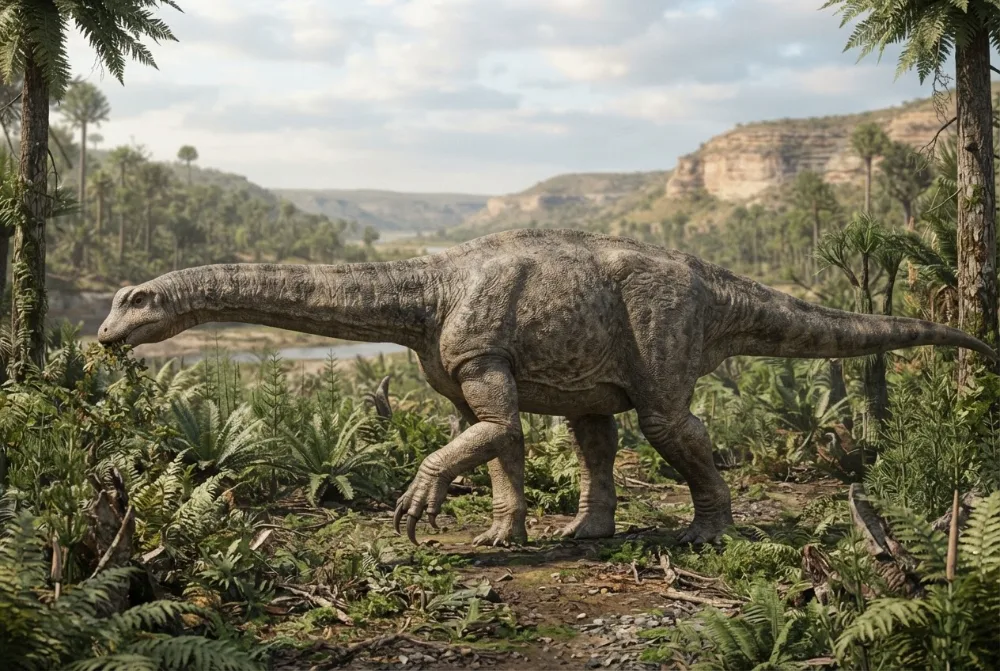
Ibibazo bibazwa cyane kuri Antetonitrus
?How big was Antetonitrus?
Antetonitrus was about 8 to 10 metres (26 to 33 feet) long, stood 1.5 to 2 metres (5 to 6.5 feet) tall at the hip, and weighed around 5.6 metric tons (6.2 short tons). It may not have been fully grown yet.34
?Could Antetonitrus grab things with its hands?
Yes. Unlike later sauropods, Antetonitrus had a flexible thumb that could grasp, not just support weight. Its wrist bones were not locked into a permanent weight-supporting position.35
Ku bazobereye muri dinozore
- Izina rya siyansi
- Antetonitrus
- Yiswe na
- Yates and Kitching 20036
- Itsinda
- Izifite amajosi maremare
- Umuryango / ishami
- Lessemsauridae6
- Ishyirwa mu byiciro
- Sauropodomorpha > Sauropoda6
- Imyaka y'amabuye
- imyaka miliyoni 201 kugeza 193 (Hettangian / Sinemurian)6
- Inzego z'amabuye
- Elliot6
- Ibihugu
- Afurika y'Epfo6
- Ibisigazwa byanditswe
- 2 muri The Paleobiology Database6
- Ivumburwa
- Antetonitrus was named in 2003 by Adam Yates and James Kitching. The fossils were discovered by Kitching in 1981 in the Free State of South Africa and were stored as Euskelosaurus until Yates recognized them as a new dinosaur.1
- Biracyagibwaho impaka
- Scientists are not sure if Antetonitrus was a true sauropod or a very close relative, because it had both primitive and advanced features.1
Aho amakuru yakuwe
- Antetonitrus (en.wikipedia.org)
- PBDB Taxon (paleobiodb.org)
- Antetonitrus (en.wikipedia.org)
- A Giant Dinosaur from the Earliest Jurassic of South Africa and the Transition to Quadrupedality in Early Sauropodomorphs: Current Biology (cell.com)
- The earliest known sauropod dinosaur and the first steps towards sauropod locomotion (royalsocietypublishing.org)
- Antetonitrus in The Paleobiology Database (CC BY 4.0): imyaka, ahantu, inzego z'amabuye, ishyirwa mu byiciro.
Buri kintu kiri kuri uru rupapuro gifite nimero yerekana aho cyakuwe. Niba hari icyo twibeshye, tubabarire, turi abakunzi ba dinozore, ntituri ikinyamakuru cya siyansi. Tubwire kuri [email protected] tuzagikosora.
 Rex arashonje! Dino Wiki ni umushinga wa papa umwe yakoreye umuhungu we ukunda dinozore, ni ubuntu, nta matangazo kandi nta bigukurikirana. Abantu bakuru bashobora guha Rex akantu ko kurya kugira ngo Dino Wiki ikomeze kuboneka kuri interineti.Gaburira Rex
 Brachiosaurus
 Diplodocus
 Brontosaurus
 Argentinosaurus
 Camarasaurus
 Morosaurus
 Dilophosaurus
 Stenopterygius
 Dorygnathus
 Scutellosaurus
 Sinosaurus
 Temnodontosaurus