 Uri dinozore iyihe? Umukino w'ibibazo
 Intambara ya dinozore
 Isiganwa rya dinozore
 Imikino mito ya dinozore
 Alubumu ya sitikeri
 Intonde za TOP za dinozore
 Ntungura!
Caupedactylus
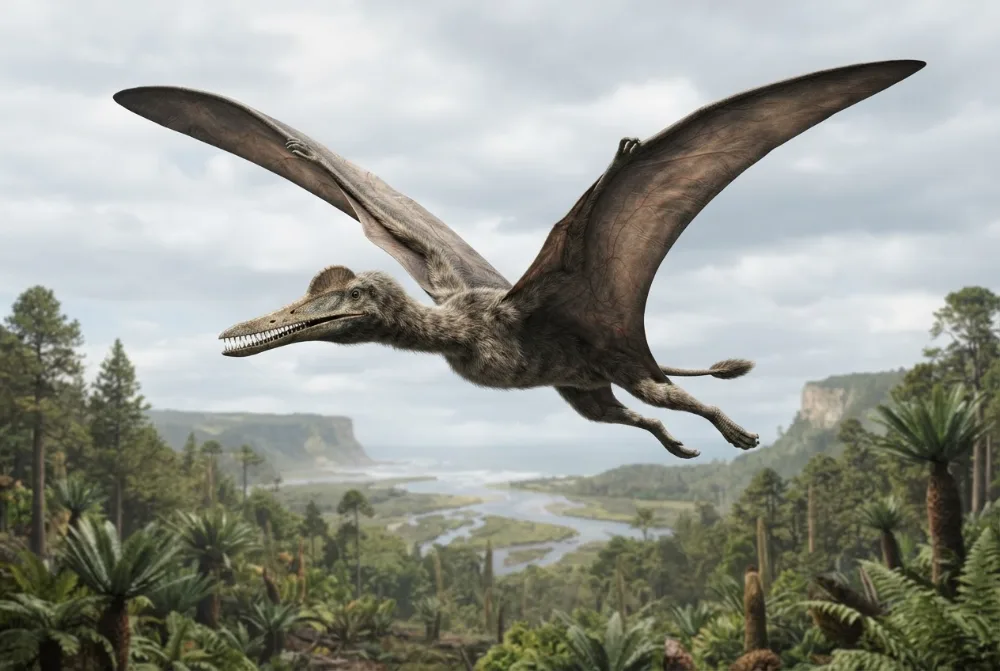
Caupedactylus was a flying reptile with a big, thin crest on its head. It had no teeth and used its beak to eat fruit. It lived about 110 million years ago in what is now Brazil.13
Yabayeho ryari?
Yanganaga ite?
Amababa yayo yari arambuye angana iki?
 amababa agari nk'amagare 2 akurikiranye⚽yashoboraga kuguruka ikambuka ikibuga cyose cy'umupira w'amaguru mu masegonda 6,5
Caupedactylus yanganaga ite ugereranyije NAWE?
Ni imibare gusa ibarirwa muri mushakisha yawe. Nta kintu kibikwa cyangwa cyoherezwa ahandi.
Yihutaga ite?


Utuntu dushimishije
Caupedactylus had a wingspan of about 3.3 metres (11 feet), making it the largest known tapejarine pterosaur.1
Its skull was about 46 centimetres long and had a large, rounded crest that was only half a millimetre thick at the top.1
The tip of its snout curved downward, and its upper jaw had a slightly concave lower edge.1
The crest on its snout had grooves that may have held blood vessels, possibly helping with temperature control.2
Its lower jaw had a thick, slightly convex surface at the rear, and when closed it fit tightly against the upper jaw with no gap.1
The holotype specimen (MN 4726-V) is an adult, which is rare for pterosaurs from this formation.1
Ibibazo bibazwa cyane kuri Caupedactylus
?What did Caupedactylus eat?
It ate fruit. Its beak had no teeth, and the Paleobiology Database lists it as a volant frugivore, meaning a flying fruit-eater.3
?How big was Caupedactylus?
Its wingspan was about 3.3 metres, making it the largest known tapejarine pterosaur. Its skull was about 46 centimetres long.1
?When did Caupedactylus live?
It lived about 110 million years ago, during the Early Cretaceous period (Albian stage).1
?Where was Caupedactylus found?
Its fossils were found in the Romualdo Formation of the Araripe Basin in northeastern Brazil.1
Ku bazobereye muri dinozore
- Izina rya siyansi
- Caupedactylus
- Yiswe na
- Kellner 20133
- Itsinda
- Ibikururanda biguruka
- Umuryango / ishami
- Tapejaridae3
- Ishyirwa mu byiciro
- Pterosauria > Pterodactyloidea3
- Imyaka y'amabuye
- imyaka miliyoni 120 kugeza 113 (Aptian)3
- Inzego z'amabuye
- Crato3
- Ibihugu
- Burezili3
- Ibisigazwa byanditswe
- 1 muri The Paleobiology Database3
- Ivumburwa
- Caupedactylus was named and described by Alexander Kellner in 2013 based on a partial skeleton found in the Romualdo Formation of Brazil.13
- Biracyagibwaho impaka
- Scientists are still debating whether the bones in the front of the palate are part of the palatine bones or the maxillae.1
Aho amakuru yakuwe
- Caupedactylus (en.wikipedia.org)
- A new unusual tapejarid (Pterosauria, Pterodactyloidea) from the Early Cretaceous Romualdo Formation, Araripe Basin, Brazil (cambridge.org)
- Caupedactylus in The Paleobiology Database (CC BY 4.0): imyaka, ahantu, inzego z'amabuye, ishyirwa mu byiciro.
Buri kintu kiri kuri uru rupapuro gifite nimero yerekana aho cyakuwe. Niba hari icyo twibeshye, tubabarire, turi abakunzi ba dinozore, ntituri ikinyamakuru cya siyansi. Tubwire kuri [email protected] tuzagikosora.
 Rex arashonje! Dino Wiki ni umushinga wa papa umwe yakoreye umuhungu we ukunda dinozore, ni ubuntu, nta matangazo kandi nta bigukurikirana. Abantu bakuru bashobora guha Rex akantu ko kurya kugira ngo Dino Wiki ikomeze kuboneka kuri interineti.Gaburira Rex
 Pteranodon
 Quetzalcoatlus
 Dorygnathus
 Rhamphorhynchus
 Anhanguera
 Pterodactylus
 Stegosaurus
 Iguanodon
 Archaeopteryx
 Giganotosaurus
 Microraptor
 Deinonychus