 Uri dinozore iyihe? Umukino w'ibibazo
 Intambara ya dinozore
 Isiganwa rya dinozore
 Imikino mito ya dinozore
 Alubumu ya sitikeri
 Intonde za TOP za dinozore
 Ntungura!
Guidraco
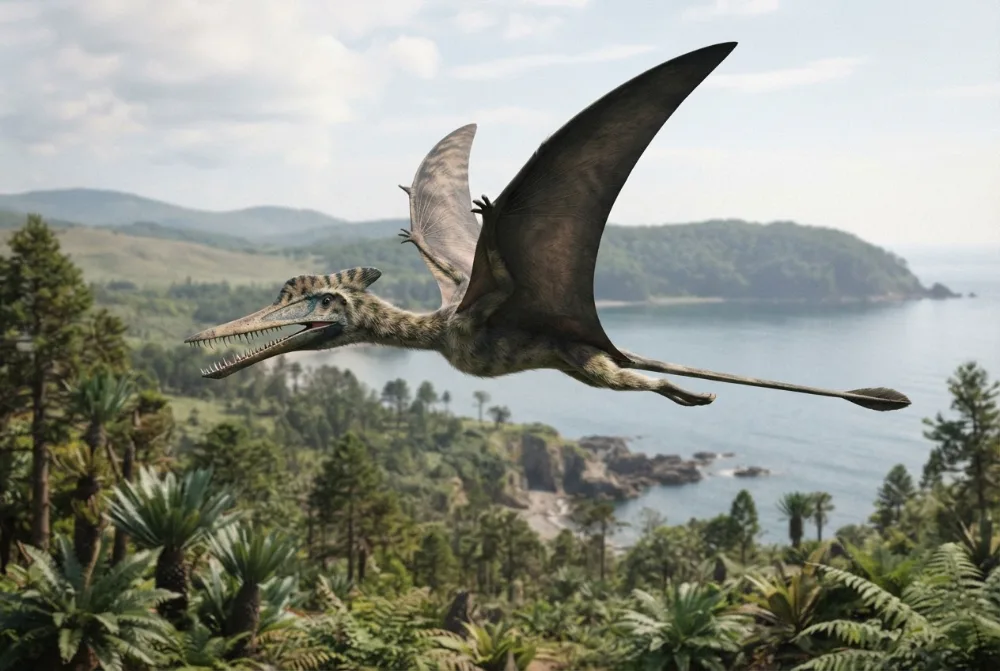
Guidraco was a flying reptile with a scary name meaning 'malicious ghost dragon'. It had a long beak full of sharp teeth that stuck out in all directions, perfect for snatching fish from the water.1
Yabayeho ryari?
Yihutaga ite?


Utuntu dushimishije
Guidraco had 82 teeth in its head, with the front ones being very long and sticking out far beyond the beak.1
The first tooth in the upper jaw pointed almost straight forward, like a spear.1
Guidraco lived about 120 million years ago during the Early Cretaceous period.1
Its neck vertebrae had large holes that let air sacs enter the bones, making them lighter for flight.1
Guidraco is closely related to Ludodactylus, a pterosaur from Brazil, showing that pterosaurs moved between continents.1
The only fossil found so far is a partial skeleton including a nearly complete skull and neck bones.1
Ibibazo bibazwa cyane kuri Guidraco
?How big was Guidraco?
Its skull was about 38 centimetres (15 inches) long. The rest of its body is not fully known, so its total size is an estimate.1
?What did Guidraco eat?
It ate fish. Its long, interlocking front teeth worked like a trap to grab slippery fish.1
?Where was Guidraco found?
It was found in Liaoning Province, northeast China, in the Jiufotang Formation.1
?Is Guidraco a dinosaur?
No, Guidraco is a pterosaur, a flying reptile that lived alongside dinosaurs but is not a dinosaur.1
?Why is it called Guidraco?
Its name means 'malicious ghost dragon' in Chinese and Latin. 'Gui' means ghost in Chinese, and 'draco' means dragon in Latin.1
?Did Guidraco have a crest?
Yes, it had a large, rounded crest on top of its skull, above the eye sockets. It pointed slightly forward.1
Ku bazobereye muri dinozore
- Izina rya siyansi
- Guidraco
- Yiswe na
- Wang et al. 20122
- Itsinda
- Ibikururanda biguruka
- Umuryango / ishami
- Ornithocheiroidea2
- Ishyirwa mu byiciro
- Pterosauria > Pterodactyloidea2
- Imyaka y'amabuye
- imyaka miliyoni 121 kugeza 113 (Aptian)2
- Inzego z'amabuye
- Jiufotang2
- Ibihugu
- Ubushinwa2
- Ibisigazwa byanditswe
- 1 muri The Paleobiology Database2
- Ivumburwa
- Guidraco was named in 2012 by Wang Xiaolin, Alexander W.A. Kellner, Jiang Shunxing, and Xin Cheng. The fossil was found in the Jiufotang Formation in Liaoning, China.12
- Biracyagibwaho impaka
- Scientists are not sure whether Guidraco belongs to the Anhangueridae family or the Boreopteridae family.1
Aho amakuru yakuwe
- Guidraco (en.wikipedia.org)
- Guidraco in The Paleobiology Database (CC BY 4.0): imyaka, ahantu, inzego z'amabuye, ishyirwa mu byiciro.
Buri kintu kiri kuri uru rupapuro gifite nimero yerekana aho cyakuwe. Niba hari icyo twibeshye, tubabarire, turi abakunzi ba dinozore, ntituri ikinyamakuru cya siyansi. Tubwire kuri [email protected] tuzagikosora.
 Rex arashonje! Dino Wiki ni umushinga wa papa umwe yakoreye umuhungu we ukunda dinozore, ni ubuntu, nta matangazo kandi nta bigukurikirana. Abantu bakuru bashobora guha Rex akantu ko kurya kugira ngo Dino Wiki ikomeze kuboneka kuri interineti.Gaburira Rex
 Pteranodon
 Quetzalcoatlus
 Dorygnathus
 Rhamphorhynchus
 Anhanguera
 Pterodactylus
 Stegosaurus
 Iguanodon
 Archaeopteryx
 Giganotosaurus
 Microraptor
 Deinonychus