 Uri dinozore iyihe? Umukino w'ibibazo
 Intambara ya dinozore
 Isiganwa rya dinozore
 Imikino mito ya dinozore
 Alubumu ya sitikeri
 Intonde za TOP za dinozore
 Ntungura!
Yabayeho ryari?

Yanganaga ite?
Ubutumburuke bwayo bwanganaga iki?
Yari iremereye ite?

 iremereye nk'imodoka 8🍉iremereye nk'imbuto 2400 za watermelon🎒iremereye nk'ibyumba 15 by'amashuri byuzuye abana🐻❄️iremereye nk'idubu 27 zo mu rubura🏃yashoboraga kwiruka metero 100 mu masegonda 26 (umuntu wihuta kurusha abandi akenera 9,6)
Ledumahadi yanganaga ite ugereranyije NAWE?
Ni imibare gusa ibarirwa muri mushakisha yawe. Nta kintu kibikwa cyangwa cyoherezwa ahandi.
Yihutaga ite?


Utuntu dushimishije
Ledumahadi walked on four legs, but its arms were not straight like later giant sauropods. Its elbows were slightly bent.2
This dinosaur was about 14 years old when it died, and scientists know this from looking at the growth rings in its bones.2
Ledumahadi lived right after the big extinction at the end of the Triassic Period, about 200 million years ago.2
Its name means 'giant thunderclap' in the Sesotho language of southern Africa.1
Ledumahadi is not a true sauropod, but a close relative called a sauropodomorph. It shows that giant size evolved in this group before the true sauropods appeared.2
The only known fossil of Ledumahadi includes parts of its backbone, arm bones, and a toe claw.2
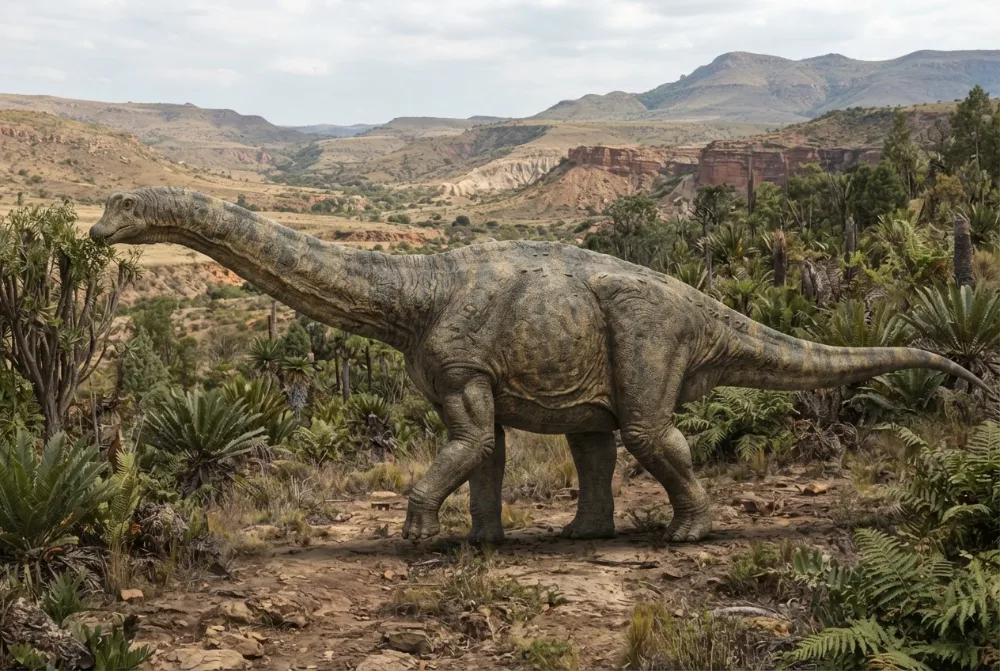
Ibibazo bibazwa cyane kuri Ledumahadi
?How big was Ledumahadi?
About 12 metric tons (13 short tons), as heavy as two adult African elephants. It was the largest land animal of its time.15
?What did Ledumahadi eat?
It was a plant-eater, a herbivore that ate leaves and other plants.1
?Is Ledumahadi a dinosaur?
Yes, it is a dinosaur. It is a sauropodomorph, a close relative of the long-necked sauropods like Brontosaurus.1
Ku bazobereye muri dinozore
- Izina rya siyansi
- Ledumahadi
- Yiswe na
- McPhee et al. 20186
- Itsinda
- Izifite amajosi maremare
- Umuryango / ishami
- Sauropodiformes6
- Ishyirwa mu byiciro
- Sauropodomorpha6
- Imyaka y'amabuye
- imyaka miliyoni 201 kugeza 193 (Hettangian / Sinemurian)6
- Inzego z'amabuye
- Elliot6
- Ibihugu
- Afurika y'Epfo6
- Ibisigazwa byanditswe
- 1 muri The Paleobiology Database6
- Ivumburwa
- Ledumahadi was named in 2018 by Blair McPhee and colleagues. The fossils were found on a farm in South Africa.2
- Biracyagibwaho impaka
- Scientists are still debating exactly how Ledumahadi walked. Its bent elbows suggest it was not as stiff-legged as later giant sauropods.2
Aho amakuru yakuwe
- Ledumahadi (en.wikipedia.org)
- A Giant Dinosaur from the Earliest Jurassic of South Africa and the Transition to Quadrupedality in Early Sauropodomorphs: Current Biology (cell.com)
- 2018-09 - Ledumahadi mafube – South Africa’s new Jurassic Giant - Wits University (wits.ac.za)
- Ledumahadi Mafube - new giant dinosaur species found in SA | Faculty of Science (science.uct.ac.za)
- New 12-Ton Jurassic Dinosaur Unearthed in South Africa | National Geographic (nationalgeographic.com)
- Ledumahadi in The Paleobiology Database (CC BY 4.0): imyaka, ahantu, inzego z'amabuye, ishyirwa mu byiciro.
Buri kintu kiri kuri uru rupapuro gifite nimero yerekana aho cyakuwe. Niba hari icyo twibeshye, tubabarire, turi abakunzi ba dinozore, ntituri ikinyamakuru cya siyansi. Tubwire kuri [email protected] tuzagikosora.
 Rex arashonje! Dino Wiki ni umushinga wa papa umwe yakoreye umuhungu we ukunda dinozore, ni ubuntu, nta matangazo kandi nta bigukurikirana. Abantu bakuru bashobora guha Rex akantu ko kurya kugira ngo Dino Wiki ikomeze kuboneka kuri interineti.Gaburira Rex
 Brachiosaurus
 Diplodocus
 Brontosaurus
 Argentinosaurus
 Camarasaurus
 Morosaurus
 Dilophosaurus
 Stenopterygius
 Dorygnathus
 Scutellosaurus
 Sinosaurus
 Temnodontosaurus