 Uri dinozore iyihe? Umukino w'ibibazo
 Intambara ya dinozore
 Isiganwa rya dinozore
 Imikino mito ya dinozore
 Alubumu ya sitikeri
 Intonde za TOP za dinozore
 Ntungura!
Yabayeho ryari?

Yanganaga ite?
Yari ndende ite?
Ubutumburuke bwayo bwanganaga iki?
igereranya
Yari iremereye ite?
 ndende nk'imodoka 2 ziparitse ku murongo🍌ndende nk'imineke 50 ikurikiranye
 iremereye nk'imbwa 120🍉iremereye nk'imbuto 460 za watermelon🎒iremereye nk'ibyumba 3 by'amashuri byuzuye abana🐻❄️iremereye nk'idubu 5 zo mu rubura🏃yashoboraga kwiruka metero 100 mu masegonda 15 (umuntu wihuta kurusha abandi akenera 9,6)
Lufengosaurus yanganaga ite ugereranyije NAWE?
Ni imibare gusa ibarirwa muri mushakisha yawe. Nta kintu kibikwa cyangwa cyoherezwa ahandi.
Yihutaga ite?


Utuntu dushimishije
Lufengosaurus was the first complete dinosaur skeleton ever mounted in China, and a postage stamp was made to celebrate it in 1958.1
In 2015, scientists found preserved collagen protein in a Lufengosaurus fossil, which was over 100 million years older than any previously known fossil protein.1
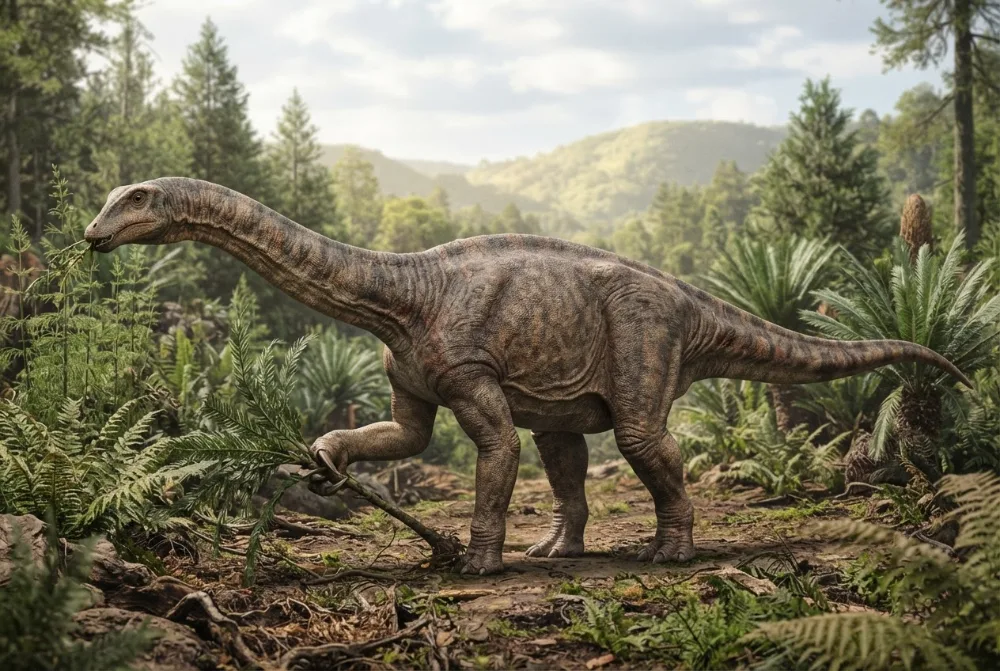
Lufengosaurus had a long neck and short arms, and it probably walked on two legs.1
Its skull was about 25 centimetres (10 inches) long, and it had bony bumps behind its nostrils and on its cheeks.1
Lufengosaurus lived during the Early Jurassic period, about 195 to 190 million years ago.1
Some scientists think Lufengosaurus may have taken care of its babies, because the leg bones of its embryos look like those of birds that need feeding.1
Ibibazo bibazwa cyane kuri Lufengosaurus
?How big was Lufengosaurus?
About 6 metres (20 ft) long, but larger specimens may have reached 9 metres (30 ft) and weighed up to 2.3 tonnes (2.5 short tons).1
?What did Lufengosaurus eat?
It was mostly a plant-eater, with serrated teeth good for eating leaves. Some scientists think it might have eaten meat sometimes too.1
?When did Lufengosaurus live?
It lived during the Early Jurassic period, about 195 to 190 million years ago.1
?Did Lufengosaurus have feathers?
The sources do not mention feathers, so we do not know for sure. It probably had scales like other early sauropodomorphs.1
Ku bazobereye muri dinozore
- Izina rya siyansi
- Lufengosaurus
- Yiswe na
- Young 19402
- Itsinda
- Izifite amajosi maremare
- Umuryango / ishami
- Massospondylidae2
- Ishyirwa mu byiciro
- Sauropodomorpha2
- Imyaka y'amabuye
- imyaka miliyoni 201 kugeza 168 (Hettangian / Bajocian)2
- Inzego z'amabuye
- Lufeng, Ziliujing2
- Ibihugu
- Ubushinwa2
- Ibisigazwa byanditswe
- 28 muri The Paleobiology Database2
- Ivumburwa
- Lufengosaurus was named by Chinese paleontologist C. C. Young in 1940, based on fossils found near Lufeng in Yunnan, China.1
- Biracyagibwaho impaka
- Scientists are not sure if Lufengosaurus was sometimes omnivorous, because it had sharp teeth and claws like meat-eaters, but also ate plants.1
Aho amakuru yakuwe
- Lufengosaurus (en.wikipedia.org)
- Lufengosaurus in The Paleobiology Database (CC BY 4.0): imyaka, ahantu, inzego z'amabuye, ishyirwa mu byiciro.
Buri kintu kiri kuri uru rupapuro gifite nimero yerekana aho cyakuwe. Niba hari icyo twibeshye, tubabarire, turi abakunzi ba dinozore, ntituri ikinyamakuru cya siyansi. Tubwire kuri [email protected] tuzagikosora.
 Rex arashonje! Dino Wiki ni umushinga wa papa umwe yakoreye umuhungu we ukunda dinozore, ni ubuntu, nta matangazo kandi nta bigukurikirana. Abantu bakuru bashobora guha Rex akantu ko kurya kugira ngo Dino Wiki ikomeze kuboneka kuri interineti.Gaburira Rex
 Brachiosaurus
 Diplodocus
 Brontosaurus
 Argentinosaurus
 Camarasaurus
 Morosaurus
 Dilophosaurus
 Stenopterygius
 Dorygnathus
 Scutellosaurus
 Sinosaurus
 Temnodontosaurus