 Uri dinozore iyihe? Umukino w'ibibazo
 Intambara ya dinozore
 Isiganwa rya dinozore
 Imikino mito ya dinozore
 Alubumu ya sitikeri
 Intonde za TOP za dinozore
 Ntungura!
Maiaspondylus
Maiaspondylus was a marine reptile that lived in the sea, not a dinosaur. It was an ichthyosaur, a fast-swimming predator with a long snout and sharp teeth. Fossils show that it gave birth to live babies, just like whales and dolphins do today.1
Yabayeho ryari?
Yanganaga ite?
Yari ndende ite?
 ndende nk'imbwa 4 zikurikiranye🍌ndende nk'imineke 22 ikurikiranye🏊yashoboraga koga uburebure bwa pisine nini (50 m) mu masegonda 3,8
Maiaspondylus yanganaga ite ugereranyije NAWE?
Ni imibare gusa ibarirwa muri mushakisha yawe. Nta kintu kibikwa cyangwa cyoherezwa ahandi.
Yihutaga ite?


Utuntu dushimishije
Maiaspondylus means 'caring mother vertebra' because a fossil was found with two embryos inside an adult, showing it gave live birth.1
The embryos found inside the adult are the smallest and youngest ichthyosaur embryos ever discovered.1
Maiaspondylus lived about 110 million years ago during the Early Cretaceous period.1
Its fossils were first found in the Loon River Formation in Canada's Northwest Territories.1
Maiaspondylus had a special skull bone arrangement: the jugal and maxilla overlapped a lot, which helped scientists tell it apart from other ichthyosaurs.2
Its teeth had smooth crowns and fluted cementum (the root covering), and they curved inward toward the tongue.2
The arm bone (humerus) of Maiaspondylus had three knobs at the end for muscles, with the middle knob smaller than the outer ones.2
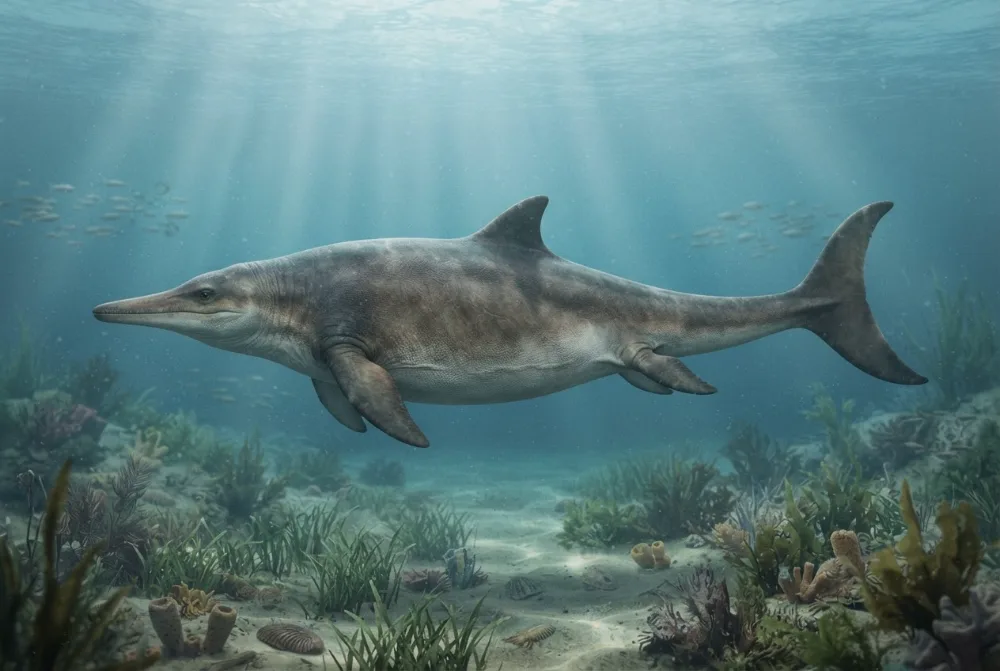
Ibibazo bibazwa cyane kuri Maiaspondylus
?How big was Maiaspondylus?
No one knows for sure because no complete skeleton has been found. The known fossils include a nearly complete skeleton and vertebrae from adults, but scientists have not estimated its total length.1
?Did Maiaspondylus give live birth?
Yes. A fossil of an adult Maiaspondylus was found with two embryos inside, proving it gave birth to live babies, just like whales and dolphins.13
?Where was Maiaspondylus found?
Its fossils were first found in the Loon River Formation in Canada's Northwest Territories. Later, fossils were also found in England and Russia.1
Ku bazobereye muri dinozore
- Izina rya siyansi
- Maiaspondylus
- Yiswe na
- Maxwell and Caldwell 20064
- Itsinda
- Iktiyozore
- Umuryango / ishami
- Ophthalmosauridae4
- Ishyirwa mu byiciro
- Ichthyosauria > Ichthyosauromorpha4
- Imyaka y'amabuye
- imyaka miliyoni 110 kugeza 106 (Albian)4
- Inzego z'amabuye
- Loon River4
- Ibihugu
- Kanada4
- Ibisigazwa byanditswe
- 1 muri The Paleobiology Database4
- Ivumburwa
- Maiaspondylus was named by scientists Erin Maxwell and Michael Caldwell in 2006. The fossils were found by technician Allan Lindoe, who collected and prepared them.1
- Biracyagibwaho impaka
- Scientists are still debating exactly how Maiaspondylus is related to other ichthyosaurs, especially the genus Platypterygius.1
Aho amakuru yakuwe
- Maiaspondylus (en.wikipedia.org)
- A NEW GENUS OF ICHTHYOSAUR FROM THE LOWER CRETACEOUS OF WESTERN CANADA (onlinelibrary.wiley.com)
- Pregnant prehistoric fossil offers clues to past | EurekAlert! (eurekalert.org)
- Maiaspondylus in The Paleobiology Database (CC BY 4.0): imyaka, ahantu, inzego z'amabuye, ishyirwa mu byiciro.
Buri kintu kiri kuri uru rupapuro gifite nimero yerekana aho cyakuwe. Niba hari icyo twibeshye, tubabarire, turi abakunzi ba dinozore, ntituri ikinyamakuru cya siyansi. Tubwire kuri [email protected] tuzagikosora.
 Rex arashonje! Dino Wiki ni umushinga wa papa umwe yakoreye umuhungu we ukunda dinozore, ni ubuntu, nta matangazo kandi nta bigukurikirana. Abantu bakuru bashobora guha Rex akantu ko kurya kugira ngo Dino Wiki ikomeze kuboneka kuri interineti.Gaburira Rex
 Ichthyosaurus
 Platypterygius
 Stenopterygius
 Khudiakovia
 Ophthalmosaurus
 Chonespondylus
 Stegosaurus
 Iguanodon
 Archaeopteryx
 Giganotosaurus
 Microraptor
 Deinonychus