 Uri dinozore iyihe? Umukino w'ibibazo
 Intambara ya dinozore
 Isiganwa rya dinozore
 Imikino mito ya dinozore
 Alubumu ya sitikeri
 Intonde za TOP za dinozore
 Ntungura!
Malawania
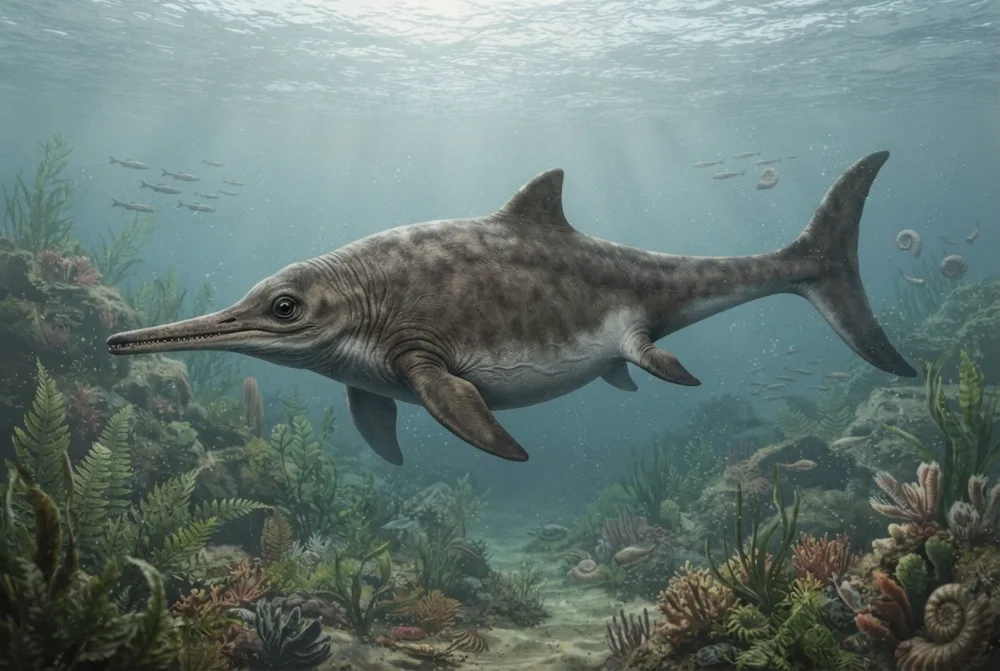
Malawania was a small ichthyosaur that lived in the Early Cretaceous seas. It looked a bit like a dolphin, with flippers instead of legs and a long snout. It is special because it was one of the last ichthyosaurs that did not belong to the ophthalmosaurid group.12
Yabayeho ryari?
Yanganaga ite?
Yari ndende ite?
 ndende nk'imbwa 3 zikurikiranye🍌ndende nk'imineke 17 ikurikiranye🏊yashoboraga koga uburebure bwa pisine nini (50 m) mu masegonda 3,8
Malawania yanganaga ite ugereranyije NAWE?
Ni imibare gusa ibarirwa muri mushakisha yawe. Nta kintu kibikwa cyangwa cyoherezwa ahandi.
Yihutaga ite?


Utuntu dushimishije
Malawania is the first non-ophthalmosaurid ichthyosaur known from after the Jurassic,Cretaceous boundary, meaning it survived a time when most of its relatives had died out.1
Its scientific name means 'out-of-time swimmer' because it seemed to belong to an earlier time period.1
The only fossil of Malawania was found in 1952, but scientists did not know its age until 2013 when they studied tiny fossils called palynomorphs in the rock.2
Malawania had a short, trapezoid-shaped humerus (upper arm bone) and an intermedium bone in its flipper that was almost as big as the radius.2
Its forefin had four main fingers and no extra digits, unlike many later ichthyosaurs.2
The fossil was found in Iraq, which is the first post-Triassic ichthyosaur ever reported from the Middle East.2
Ibibazo bibazwa cyane kuri Malawania
?How big was Malawania?
About 3 metres (9.8 feet) long. That is roughly as long as a small car.1
?What did Malawania eat?
Scientists are not sure exactly, but like other ichthyosaurs it probably ate fish and squid. Its long snout and sharp teeth were good for catching slippery prey.1
?When did Malawania live?
It lived during the Early Cretaceous period, about 130 to 125 million years ago. That is after most of its relatives had already died out.12
?Where was Malawania found?
The only fossil was discovered in 1952 in Iraqi Kurdistan, near the town of Amadia. It is the first post-Triassic ichthyosaur ever found in the Middle East.1
Ku bazobereye muri dinozore
- Izina rya siyansi
- Malawania
- Yiswe na
- Fischer et al. 20133
- Itsinda
- Iktiyozore
- Umuryango / ishami
- Thunnosauria3
- Ishyirwa mu byiciro
- Ichthyosauria > Ichthyosauromorpha3
- Imyaka y'amabuye
- imyaka miliyoni 133 kugeza 121 (Hauterivian / Barremian)3
- Ibihugu
- Iraki3
- Ibisigazwa byanditswe
- 1 muri The Paleobiology Database3
- Ivumburwa
- The only known fossil of Malawania was discovered in 1952 near Amadia in Iraq. It was named Malawania anachronus by Fischer and colleagues in 2013.12
- Biracyagibwaho impaka
- Scientists are still debating exactly how Malawania is related to other ichthyosaurs, because it has a mix of ancient and modern features.2
Aho amakuru yakuwe
- Malawania (en.wikipedia.org)
- biblio.naturalsciences.be (biblio.naturalsciences.be)
- Malawania in The Paleobiology Database (CC BY 4.0): imyaka, ahantu, inzego z'amabuye, ishyirwa mu byiciro.
Buri kintu kiri kuri uru rupapuro gifite nimero yerekana aho cyakuwe. Niba hari icyo twibeshye, tubabarire, turi abakunzi ba dinozore, ntituri ikinyamakuru cya siyansi. Tubwire kuri [email protected] tuzagikosora.
 Rex arashonje! Dino Wiki ni umushinga wa papa umwe yakoreye umuhungu we ukunda dinozore, ni ubuntu, nta matangazo kandi nta bigukurikirana. Abantu bakuru bashobora guha Rex akantu ko kurya kugira ngo Dino Wiki ikomeze kuboneka kuri interineti.Gaburira Rex
 Ichthyosaurus
 Platypterygius
 Stenopterygius
 Khudiakovia
 Ophthalmosaurus
 Chonespondylus
 Stegosaurus
 Iguanodon
 Archaeopteryx
 Giganotosaurus
 Microraptor
 Deinonychus