 Uri dinozore iyihe? Umukino w'ibibazo
 Intambara ya dinozore
 Isiganwa rya dinozore
 Imikino mito ya dinozore
 Alubumu ya sitikeri
 Intonde za TOP za dinozore
 Ntungura!
Xingxiulong
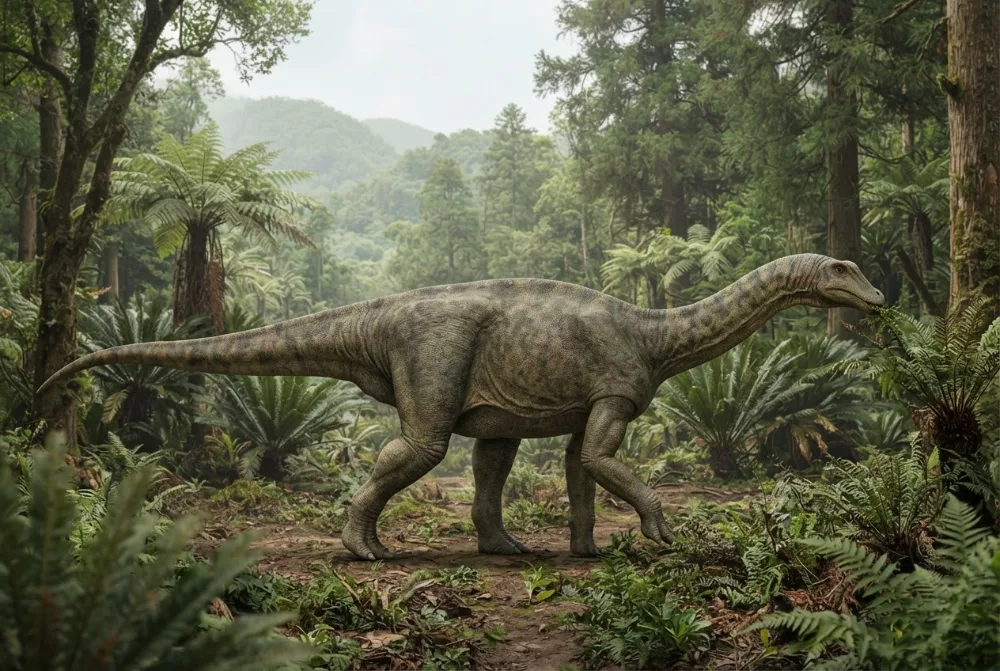
Xingxiulong was a long-necked plant-eater that lived in China during the Early Jurassic. It walked on two legs and had a strong, heavy body like a small sauropod. Three skeletons were found buried together, including two adults and a teenager.21
Yabayeho ryari?
Yanganaga ite?
Yari ndende ite?
Ubutumburuke bwayo bwanganaga iki?
 ndende nk'imbwa 5 zikurikiranye🍌ndende nk'imineke 28 ikurikiranye🏃yashoboraga kwiruka metero 100 mu masegonda 10 (umuntu wihuta kurusha abandi akenera 9,6)
Xingxiulong yanganaga ite ugereranyije NAWE?
Ni imibare gusa ibarirwa muri mushakisha yawe. Nta kintu kibikwa cyangwa cyoherezwa ahandi.
Yihutaga ite?


Utuntu dushimishije
Xingxiulong had four vertebrae in its sacrum (hip region), which is a feature usually seen in true sauropods.21
Its pubis (hip bone) had a very long top plate, about 40% of the total length of the bone.2
Xingxiulong was bipedal, meaning it walked on two legs, unlike later sauropods that used all four legs.1
The three skeletons were found together in purple silty mudstone from the Shawan Member of the Lufeng Formation.21
One skeleton was about 14% smaller than the others and had unfused vertebrae, showing it was a subadult.21
Xingxiulong is one of the oldest and most primitive members of the group Sauropodiformes, which includes all sauropods.2
Ibibazo bibazwa cyane kuri Xingxiulong
?How big was Xingxiulong?
About 4 to 5 metres (13 to 16 ft) long and 1 to 1.5 metres (3.3 to 4.9 ft) tall at the hip for the first species. A second species was larger, at 8 to 10 metres (26 to 33 ft) long.12
?Did Xingxiulong walk on two legs?
Yes, it was bipedal. Unlike later sauropods that used all four legs, Xingxiulong walked on two legs.12
?What did Xingxiulong eat?
It was a plant-eater. Its strong, heavy body and large gut helped it digest tough plants.1
Ku bazobereye muri dinozore
- Izina rya siyansi
- Xingxiulong
- Yiswe na
- Wang et al. 20173
- Itsinda
- Izifite amajosi maremare
- Umuryango / ishami
- Sauropodiformes3
- Ishyirwa mu byiciro
- Sauropodomorpha3
- Imyaka y'amabuye
- imyaka miliyoni 201 kugeza 175 (Hettangian / Toarcian)3
- Inzego z'amabuye
- Lufeng3
- Ibihugu
- Ubushinwa3
- Ibisigazwa byanditswe
- 2 muri The Paleobiology Database3
- Ivumburwa
- Xingxiulong was named in 2017 by Wang, You, and Wang. The fossils were dug up in 2013 near Sankeshu Village in Lufeng County, China.21
- Biracyagibwaho impaka
- Scientists are not sure whether Xingxiulong was more closely related to Jingshanosaurus or to other sauropodiformes.1
Aho amakuru yakuwe
- Xingxiulong (en.wikipedia.org)
- A new basal sauropodiform dinosaur from the Lower Jurassic of Yunnan Province, China | Scientific Reports (nature.com)
- Xingxiulong in The Paleobiology Database (CC BY 4.0): imyaka, ahantu, inzego z'amabuye, ishyirwa mu byiciro.
Buri kintu kiri kuri uru rupapuro gifite nimero yerekana aho cyakuwe. Niba hari icyo twibeshye, tubabarire, turi abakunzi ba dinozore, ntituri ikinyamakuru cya siyansi. Tubwire kuri [email protected] tuzagikosora.
 Rex arashonje! Dino Wiki ni umushinga wa papa umwe yakoreye umuhungu we ukunda dinozore, ni ubuntu, nta matangazo kandi nta bigukurikirana. Abantu bakuru bashobora guha Rex akantu ko kurya kugira ngo Dino Wiki ikomeze kuboneka kuri interineti.Gaburira Rex
 Brachiosaurus
 Diplodocus
 Brontosaurus
 Argentinosaurus
 Camarasaurus
 Morosaurus
 Dilophosaurus
 Stenopterygius
 Dorygnathus
 Scutellosaurus
 Sinosaurus
 Temnodontosaurus