 Uri dinozore iyihe? Umukino w'ibibazo
 Intambara ya dinozore
 Isiganwa rya dinozore
 Imikino mito ya dinozore
 Alubumu ya sitikeri
 Intonde za TOP za dinozore
 Ntungura!
Yabayeho ryari?

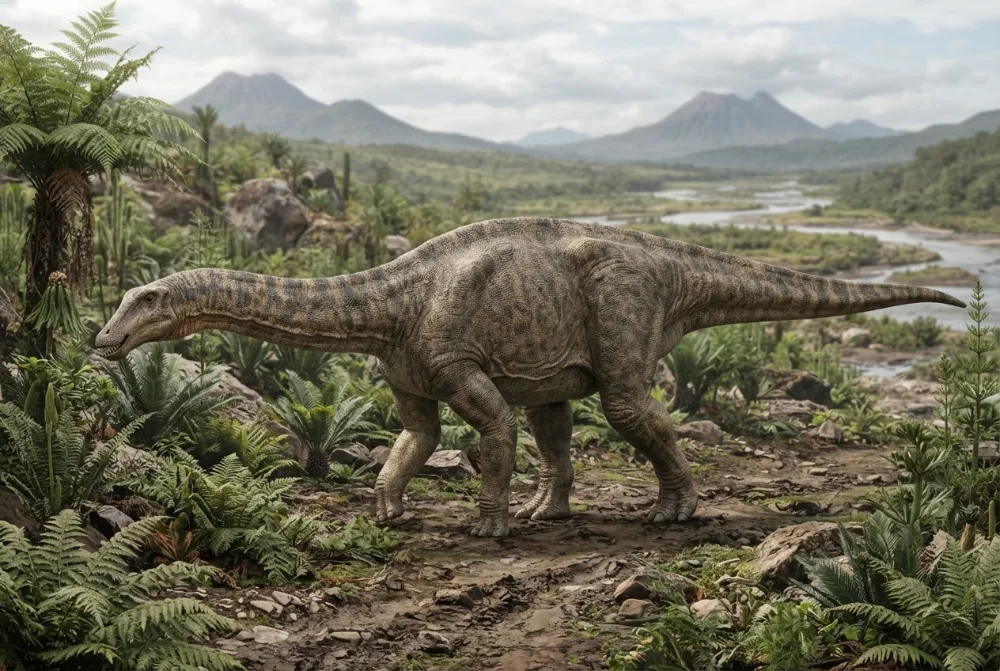
Yanganaga ite?
Yari ndende ite?
Ubutumburuke bwayo bwanganaga iki?
 ndende nk'imodoka 3 ziparitse ku murongo🍌ndende nk'imineke 72 ikurikiranye🏃yashoboraga kwiruka metero 100 mu masegonda 20 (umuntu wihuta kurusha abandi akenera 9,6)
Yunnanosaurus yanganaga ite ugereranyije NAWE?
Ni imibare gusa ibarirwa muri mushakisha yawe. Nta kintu kibikwa cyangwa cyoherezwa ahandi.
Yihutaga ite?


Utuntu dushimishije
Yunnanosaurus had more than sixty spoon-shaped teeth that were self-sharpening because they wore against each other as the animal fed.1
Its teeth were advanced for an early sauropodomorph and looked like those of later giant sauropods, but scientists think this similarity evolved separately.1
The largest species, Yunnanosaurus youngi, reached about 13 metres (42 feet) long, as big as a school bus.1
The first fossils were discovered by Chinese paleontologist Yang Zhongjian (also known as C. C. Young) in the early 1940s.1
Yunnanosaurus lived between about 201 and 183 million years ago, during the Early Jurassic Period.12
It could walk on two legs or on all fours, making it a versatile mover through its ancient environment.1
Ibibazo bibazwa cyane kuri Yunnanosaurus
?How big was Yunnanosaurus?
The smallest species, Y. huangi, was about 7 metres (23 feet) long, while the largest, Y. youngi, reached about 13 metres (43 feet) long, roughly the size of a school bus.13
?What did Yunnanosaurus eat?
It was a herbivore that ate plants. Its spoon-shaped teeth were self-sharpening, and it fed on softer, less fibrous plants than later giant sauropods.13
?When did Yunnanosaurus live?
Yunnanosaurus lived during the Early Jurassic Period, about 201 to 183 million years ago.13
?Where was Yunnanosaurus found?
Its fossils were found in Yunnan Province, China. The first skeletons were discovered in the Lufeng Formation.1
?Did Yunnanosaurus have feathers?
No known fossils show feathers on Yunnanosaurus. It is not related to feathered dinosaurs like birds.1
?Could Yunnanosaurus walk on two legs?
Yes, it could walk on two legs or on all fours. It was a versatile mover that could switch between bipedal and quadrupedal walking.1
Gusenya ibinyoma
Ibivugwa: Yunnanosaurus is often called a prosauropod, meaning it was a direct ancestor of sauropods.
Ukuri: Scientists now place Yunnanosaurus in a group called Sauropodiformes, which is closer to true sauropods but not a direct ancestor.1
Ku bazobereye muri dinozore
- Izina rya siyansi
- Yunnanosaurus
- Yiswe na
- Young 19404
- Itsinda
- Izifite amajosi maremare
- Umuryango / ishami
- Sauropodiformes4
- Ishyirwa mu byiciro
- Sauropodomorpha4
- Imyaka y'amabuye
- imyaka miliyoni 201 kugeza 184 (Hettangian / Pliensbachian)4
- Inzego z'amabuye
- Lufeng, Fengjiahe4
- Ibihugu
- Ubushinwa4
- Ibisigazwa byanditswe
- 17 muri The Paleobiology Database4
- Ivumburwa
- Chinese paleontologist C. C. Young (Yang Zhongjian) named Yunnanosaurus in 1942 after finding many skeletons in Yunnan, China. The type species is Yunnanosaurus huangi.1
- Biracyagibwaho impaka
- Scientists are not sure whether Yunnanosaurus robustus is a separate species or just a larger individual of Yunnanosaurus huangi.1
Aho amakuru yakuwe
- Yunnanosaurus (en.wikipedia.org)
- PBDB Taxon (paleobiodb.org)
- Yunnanosaurus | Natural History Museum (nhm.ac.uk)
- Yunnanosaurus in The Paleobiology Database (CC BY 4.0): imyaka, ahantu, inzego z'amabuye, ishyirwa mu byiciro.
Buri kintu kiri kuri uru rupapuro gifite nimero yerekana aho cyakuwe. Niba hari icyo twibeshye, tubabarire, turi abakunzi ba dinozore, ntituri ikinyamakuru cya siyansi. Tubwire kuri [email protected] tuzagikosora.
 Rex arashonje! Dino Wiki ni umushinga wa papa umwe yakoreye umuhungu we ukunda dinozore, ni ubuntu, nta matangazo kandi nta bigukurikirana. Abantu bakuru bashobora guha Rex akantu ko kurya kugira ngo Dino Wiki ikomeze kuboneka kuri interineti.Gaburira Rex
 Brachiosaurus
 Diplodocus
 Brontosaurus
 Argentinosaurus
 Camarasaurus
 Morosaurus
 Dilophosaurus
 Stenopterygius
 Dorygnathus
 Scutellosaurus
 Sinosaurus
 Temnodontosaurus