 Uri dhino ripi? Kwizi
 Hondo yemadhino
 Mujaho wemadhino
 Mitambo midiki yemadhino
 Arubhamu yemasitika
 Rondedzero dzeTOP dzemadhino
 Ndishamise!
Aegirosaurus
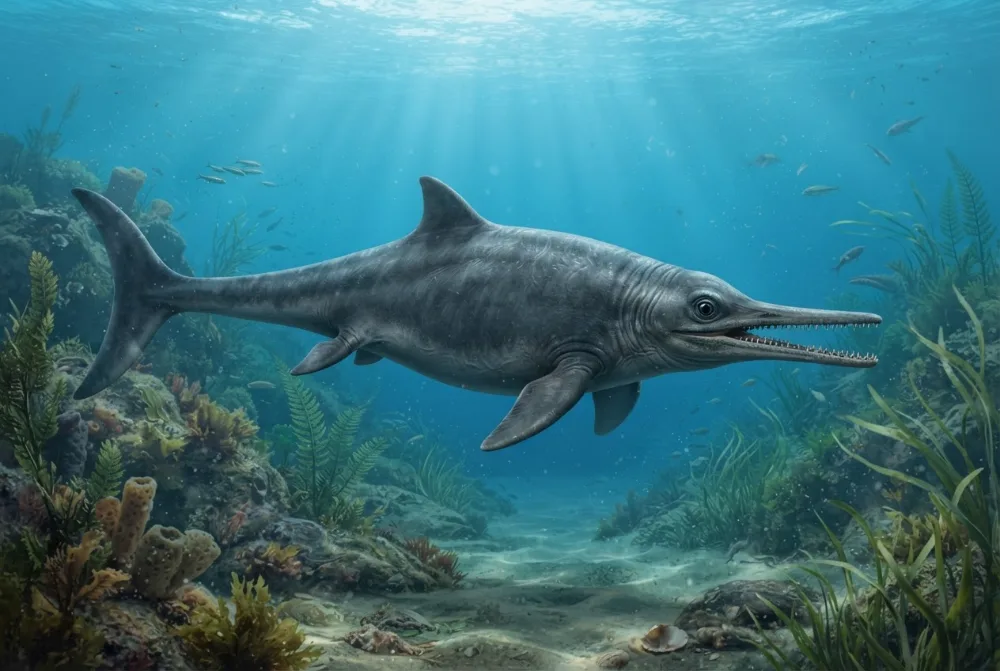
Aegirosaurus was a sleek, dolphin-like marine reptile that swam in the warm seas of Europe during the time of the dinosaurs. It had a long, slender snout packed with tiny, sharp teeth for catching fish and squid.1
Rairarama rini?
Raiva hombe sei?
Raiva refu zvakadii?
 kureba sekatsi dzemumba 4 kubva pamhino kusvika kumuswe🍌kureba semabhanana 11 akatevedzana🏊raigona kushambira kureba kwedziva guru rekushambira (50 m) mumasekonzi 4.4
Aegirosaurus raiva hombe sei kana richienzaniswa NEWE?
Masvomhu chete mubrowser yako. Hapana chinochengetwa kana kutumirwa kupi zvako.
Raimhanya zvakadii?


Zvinonakidza
Aegirosaurus had a very long snout that made up 62 to 73 percent of its lower jaw length.1
Its front flippers were narrow and elongated, but its hind flippers were wide because of extra soft tissue.1
Aegirosaurus had a crescent-shaped tail fin, like a fish, to help it swim fast.1
Fossils of Aegirosaurus show skin impressions, including what might be tiny scales on the upper part of its tail fin.1
This ichthyosaur lived from the Late Jurassic to the Early Cretaceous, about 149 to 133 million years ago.3
Aegirosaurus is one of the few ichthyosaurs known from the Valanginian stage of the Early Cretaceous.1
Mibvunzo inonyanya kubvunzwa nezve Aegirosaurus
?How big was Aegirosaurus?
Aegirosaurus was a medium sized ichthyosaur. The largest known specimen was about 2 metres (6.6 ft) long, and a complete skeleton is 1.77 metres (5.8 ft) long.1
?What did Aegirosaurus eat?
Aegirosaurus ate small fish and squid. Its long, slender snout was packed with tiny, sharp teeth, and its tooth wear suggests it was a generalist feeder.1
?When did Aegirosaurus live?
Aegirosaurus lived from the Late Jurassic to the Early Cretaceous, about 149 to 133 million years ago.1
?Where was Aegirosaurus found?
Fossils of Aegirosaurus have been found in Germany and France. Its remains were discovered in the Solnhofen limestone of Bavaria, Germany, and in southeastern France.1
Mubvisi wengano
Ngano: Aegirosaurus was a dinosaur.
Chokwadi: Aegirosaurus was an ichthyosaur, a marine reptile that lived in the sea, not a dinosaur. Dinosaurs lived on land.1
Zvevanyanzvi vemadhino
- Zita resainzi
- Aegirosaurus
- Akaripa zita:
- Bardet and Fernandez 20003
- Boka
- Maikitiyosauro
- Mhuri / boka
- Ophthalmosauridae3
- Kurongwa kwemhuka
- Ichthyosauria > Ichthyosauromorpha3
- Zera rematombo
- makore mamiriyoni 149 kusvika 133 (Tithonian / Valanginian)3
- Mapoka ematombo
- Solnhofen3
- Nyika
- Germany, France3
- Zvinyorwa zvemafosiri
- 3 mu The Paleobiology Database3
- Kuwanikwa
- The first fossil was named Ichthyosaurus leptospondylus by Wagner in 1853. In 2000, scientists Bardet and Fernández gave it the new genus name Aegirosaurus after studying a nearly complete skeleton with soft tissue impressions.12
- Zvichiri kupokanwa
- Scientists are not sure whether Aegirosaurus had scales on its tail fin, because only one fossil shows possible scale impressions.1
Kunobva chokwadi
- Aegirosaurus (en.wikipedia.org)
- A new ichthyosaur from the Upper Jurassic lithographic limestones of Bavaria | Journal of Paleontology | Cambridge Core (cambridge.org)
- Aegirosaurus in The Paleobiology Database (CC BY 4.0): zera, nzvimbo, mapoka ematombo, kurongwa kwemhuka.
Chokwadi chega chega papeji ino chine nhamba inoratidza kwachakabva. Kana takakanganisa chimwe chinhu, ruregerero, tiri vanoda madhino, kwete magazini yesainzi. Tiudze pa [email protected] tichazvigadzirisa.
 Rex ane nzara! Dino Wiki ipurojekiti yababa yemwanakomana wavo anoda madhino, mahara, pasina kushambadza uye pasina zvinokutevera. Vakuru vanogona kupa Rex chekudyadya kuti vabatsire kuchengeta saiti iri pamhepo.Fudza Rex
 Ichthyosaurus
 Platypterygius
 Stenopterygius
 Khudiakovia
 Ophthalmosaurus
 Chonespondylus
 Stegosaurus
 Iguanodon
 Archaeopteryx
 Giganotosaurus
 Microraptor
 Deinonychus