 Uri dhino ripi? Kwizi
 Hondo yemadhino
 Mujaho wemadhino
 Mitambo midiki yemadhino
 Arubhamu yemasitika
 Rondedzero dzeTOP dzemadhino
 Ndishamise!
Archaeornithomimus
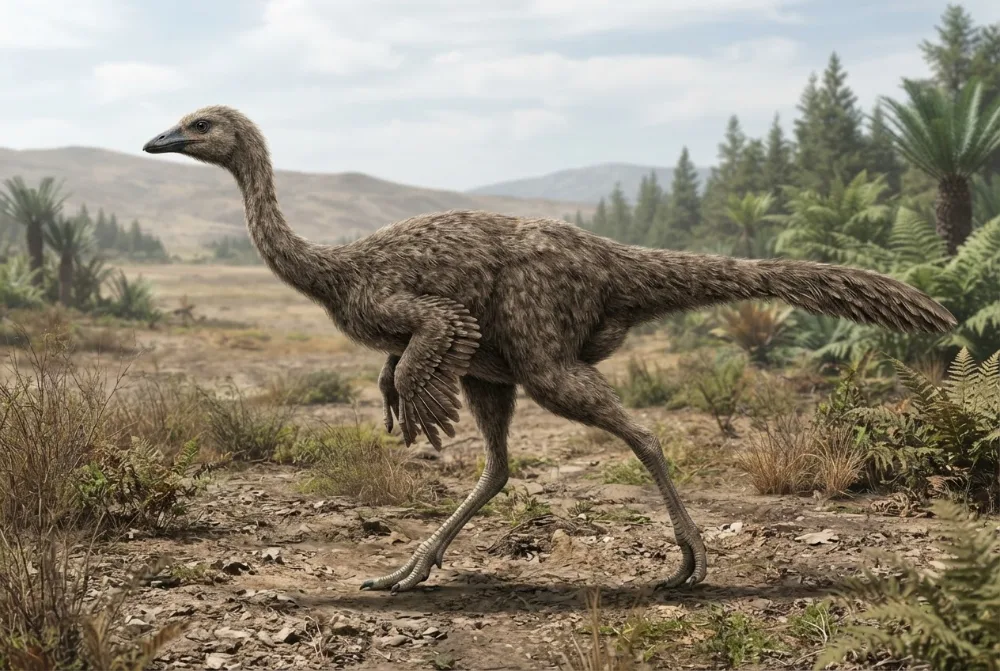
Archaeornithomimus was a fast, ostrich-like dinosaur that lived in Asia during the Late Cretaceous. It had a beak, long legs, and probably feathers. It could run quickly to escape predators or chase small prey.1
Rairarama rini?
Raiva hombe sei?
Raiva refu zvakadii?
Raiva rakakwirira zvakadii?
fungidziro
Rairema zvakadii?
 kureba seimbwa 3 kubva pamhino kusvika kumuswe🍌kureba semabhanana 19 akatevedzana🍉kurema semanwiwa 14🧸kurema sevana vekireshi 4🎒kurema sevana vechikoro 2🏃raigona kumhanya mamita 100 mumasekonzi 5.5 (munhu anomhanya kupfuura vose anoda 9.6)
Archaeornithomimus raiva hombe sei kana richienzaniswa NEWE?
Masvomhu chete mubrowser yako. Hapana chinochengetwa kana kutumirwa kupi zvako.
Raimhanya zvakadii?


Zvinonakidza
Its neck bones had air spaces inside, like modern birds, which made its neck lighter.1
Scientists think it had feathers that looked like those of an ostrich.1
It lived alongside the giant dinosaur Gigantoraptor and the predator Alectrosaurus.1
No stress fractures were found in its foot bones, meaning it probably didn't run too hard or too often.1
Its third toe bone was not pinched at the top, so its foot was not built for extreme speed like some other ornithomimids.1
The first fossils were found by an expedition led by Roy Chapman Andrews in 1923.1
Mibvunzo inonyanya kubvunzwa nezve Archaeornithomimus
?How big was Archaeornithomimus?
About 3.4 metres (11 feet) long and weighed over 71.5 kilograms (158 pounds).1
?What did Archaeornithomimus eat?
It was an omnivore with a horny beak, eating small mammals, plants, fruit, eggs, and even hatchlings of other dinosaurs.1
?Did Archaeornithomimus have feathers?
Yes, scientists think it had feathers that looked like those of an ostrich.1
?When did Archaeornithomimus live?
It lived during the Late Cretaceous period, about 96 million years ago.1
?Where was Archaeornithomimus found?
Its fossils were found in the Iren Dabasu Formation of Inner Mongolia, China.1
?Was Archaeornithomimus a dinosaur?
Yes, it was a theropod dinosaur, specifically an ornithomimosaurian.1
Zvevanyanzvi vemadhino
- Zita resainzi
- Archaeornithomimus
- Akaripa zita:
- Russell 19724
- Boka
- Madhino eostrich
- Mhuri / boka
- Ornithomimidae4
- Kurongwa kwemhuka
- Theropoda > Ornithomimosauria4
- Zera rematombo
- makore mamiriyoni 90 kusvika 72 (Coniacian / Campanian)4
- Mapoka ematombo
- Iren Dabasu, Dabrazhin4
- Nyika
- China, Kazakhstan4
- Zvinyorwa zvemafosiri
- 3 mu The Paleobiology Database4
- Kuwanikwa
- The first fossils were found in 1923 in Inner Mongolia by an American Museum of Natural History expedition. In 1933, Charles Gilmore named them Ornithomimus asiaticus. In 1972, Dale Russell gave them their own genus, Archaeornithomimus.1
- Zvichiri kupokanwa
- Scientists are not sure whether Archaeornithomimus was a true ornithomimid or a more primitive ornithomimosaur. Some studies place it inside the family, others outside.1
Kunobva chokwadi
- Archaeornithomimus (en.wikipedia.org)
- Archaeornithomimus | Natural History Museum (nhm.ac.uk)
- PBDB Taxon (paleobiodb.org)
- Archaeornithomimus in The Paleobiology Database (CC BY 4.0): zera, nzvimbo, mapoka ematombo, kurongwa kwemhuka.
Chokwadi chega chega papeji ino chine nhamba inoratidza kwachakabva. Kana takakanganisa chimwe chinhu, ruregerero, tiri vanoda madhino, kwete magazini yesainzi. Tiudze pa [email protected] tichazvigadzirisa.
 Rex ane nzara! Dino Wiki ipurojekiti yababa yemwanakomana wavo anoda madhino, mahara, pasina kushambadza uye pasina zvinokutevera. Vakuru vanogona kupa Rex chekudyadya kuti vabatsire kuchengeta saiti iri pamhepo.Fudza Rex
 Gallimimus
 Ornithomimus
 Struthiomimus
 Deinocheirus
 Dromiceiomimus
 Anserimimus
 Tyrannosaurus
 Triceratops
 Velociraptor
 Spinosaurus
 Ankylosaurus
 Parasaurolophus