 Uri dhino ripi? Kwizi
 Hondo yemadhino
 Mujaho wemadhino
 Mitambo midiki yemadhino
 Arubhamu yemasitika
 Rondedzero dzeTOP dzemadhino
 Ndishamise!
Rairarama rini?

Raiva hombe sei?
Raiva refu zvakadii?
Raiva rakakwirira zvakadii?
Rairema zvakadii?
 kureba semotokari 2 dzakamiswa dzakatevedzana🍌kureba semabhanana 56 akatevedzana
 kurema senzou 1.5🍉kurema semanwiwa 2000🎒kurema semakirasi 12 akazara evana vechikoro🐻❄️kurema semabere echando 22🏃raigona kumhanya mamita 100 mumasekonzi 15 (munhu anomhanya kupfuura vose anoda 9.6)
Deinocheirus raiva hombe sei kana richienzaniswa NEWE?
Masvomhu chete mubrowser yako. Hapana chinochengetwa kana kutumirwa kupi zvako.
Raimhanya zvakadii?


Zvinonakidza
For a long time, scientists only had a pair of arm bones with huge claws to study Deinocheirus. They did not know what the rest of the dinosaur looked like until 2014.1
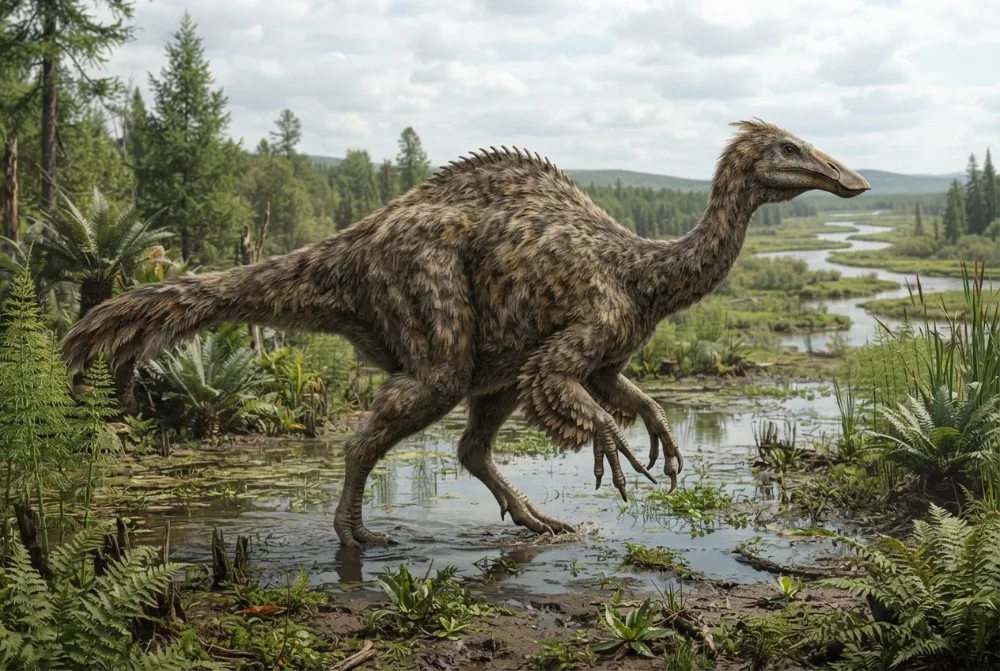
Deinocheirus had a large hump on its back, supported by its backbone. This made it look a bit like a camel.1
Its hands were huge and had long, sharp claws. The name Deinocheirus means 'terrible hand'.1
Deinocheirus lived during the Late Cretaceous period, about 70 to 66 million years ago.1
It was an omnivore, meaning it ate both plants and meat. Scientists think it used its beak to eat plants and small animals.15
Deinocheirus belonged to a group of dinosaurs called ornithomimosaurs, which are often called 'ostrich dinosaurs' because they looked a bit like ostriches.5
Mibvunzo inonyanya kubvunzwa nezve Deinocheirus
?How big was Deinocheirus?
It was about 11 metres (36 feet) long and weighed around 6.5 tonnes (7.2 short tons). That is as long as a big bus.4
?What did Deinocheirus eat?
It was an omnivore, meaning it ate both plants and meat. It had a duck-like beak for cropping soft plants, and fish scales found with one specimen show it also ate fish.4
?Did Deinocheirus have feathers?
Yes, it probably had a fan of feathers on its tail. The tail ended in pygostyle-like vertebrae, which is a sign of feathers.4
?Why did Deinocheirus have such big claws?
Its huge, blunt claws were probably used for digging and gathering plants. The name Deinocheirus means 'terrible hand' because of those big claws.4
?Was Deinocheirus a dinosaur?
Yes, it was a dinosaur. It belonged to a group called ornithomimosaurs, which are often called 'ostrich dinosaurs'.41
?When did Deinocheirus live?
It lived during the Late Cretaceous period, about 70 to 66 million years ago.1
?Could Deinocheirus run fast?
No, it was not built for speed. It had short legs and a bulky body, so it moved slowly.4
?What hunted Deinocheirus?
Bite marks on its bones show that the tyrannosaurid Tarbosaurus probably attacked or scavenged it.4
Zvevanyanzvi vemadhino
- Zita resainzi
- Deinocheirus
- Akaripa zita:
- Kielan-Jaworowska 19695
- Boka
- Madhino eostrich
- Mhuri / boka
- Deinocheiridae5
- Kurongwa kwemhuka
- Theropoda > Ornithomimosauria5
- Zera rematombo
- makore mamiriyoni 100 kusvika 66 (Cenomanian / Maastrichtian)5
- Mapoka ematombo
- Nemegt, Baynshire5
- Nyika
- Mongolia5
- Zvinyorwa zvemafosiri
- 5 mu The Paleobiology Database5
- Kuwanikwa
- Deinocheirus was named by Polish paleontologist Zofia Kielan-Jaworowska in 1969. The first fossils were found in the Gobi Desert in Mongolia.51
Kunobva chokwadi
- Deinocheirus | Natural History Museum (nhm.ac.uk)
- PBDB Taxon (paleobiodb.org)
- Deinocheirus — size, diet & habitat | DinoLifePedia (dinolifepedia.com)
- Deinocheirus (en.wikipedia.org)
- Deinocheirus in The Paleobiology Database (CC BY 4.0): zera, nzvimbo, mapoka ematombo, kurongwa kwemhuka.
Chokwadi chega chega papeji ino chine nhamba inoratidza kwachakabva. Kana takakanganisa chimwe chinhu, ruregerero, tiri vanoda madhino, kwete magazini yesainzi. Tiudze pa [email protected] tichazvigadzirisa.
 Rex ane nzara! Dino Wiki ipurojekiti yababa yemwanakomana wavo anoda madhino, mahara, pasina kushambadza uye pasina zvinokutevera. Vakuru vanogona kupa Rex chekudyadya kuti vabatsire kuchengeta saiti iri pamhepo.Fudza Rex
 Gallimimus
 Ornithomimus
 Struthiomimus
 Dromiceiomimus
 Archaeornithomimus
 Anserimimus
 Tyrannosaurus
 Triceratops
 Velociraptor
 Spinosaurus
 Ankylosaurus
 Parasaurolophus