 Uri dhino ripi? Kwizi
 Hondo yemadhino
 Mujaho wemadhino
 Mitambo midiki yemadhino
 Arubhamu yemasitika
 Rondedzero dzeTOP dzemadhino
 Ndishamise!
Rairarama rini?

Raiva hombe sei?
Raiva refu zvakadii?
Raiva rakakwirira zvakadii?
fungidziro
Rairema zvakadii?
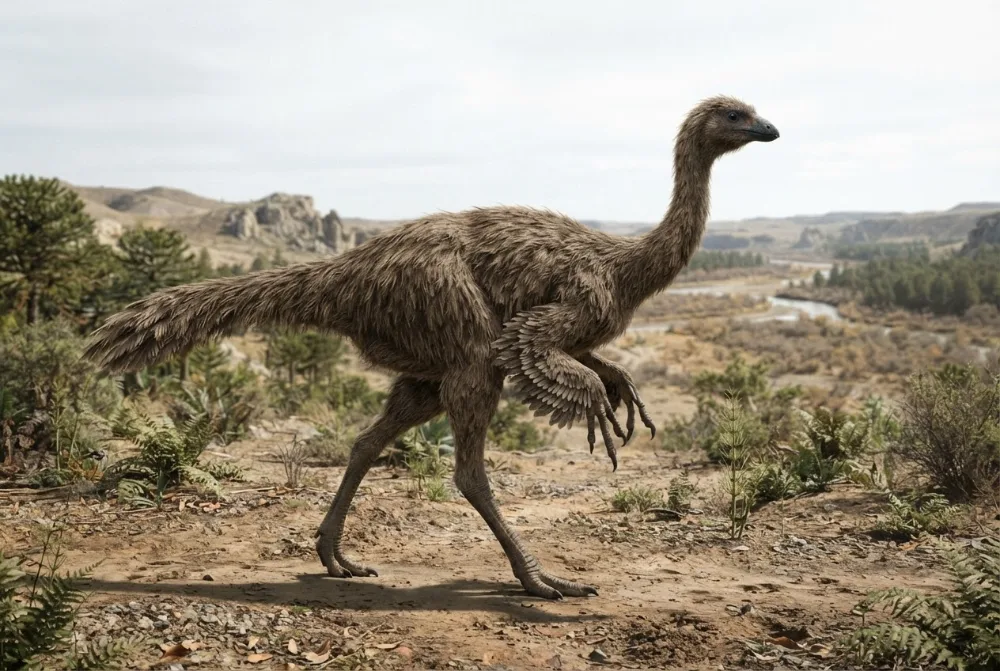
 kureba seimbwa 7 kubva pamhino kusvika kumuswe🍌kureba semabhanana 39 akatevedzana🍉kurema semanwiwa 130🧸kurema sevana vekireshi 33🎒kurema sevana vechikoro 20🏃raigona kumhanya mamita 100 mumasekonzi 6.5 (munhu anomhanya kupfuura vose anoda 9.6)
Beishanlong raiva hombe sei kana richienzaniswa NEWE?
Masvomhu chete mubrowser yako. Hapana chinochengetwa kana kutumirwa kupi zvako.
Raimhanya zvakadii?


Zvinonakidza
Beishanlong is one of the largest ornithomimosaurs ever found, but the only known skeleton was still growing when it died.1
Its fossils were found in the Xinminpu Group of rocks, which are about 121 to 113 million years old.2
Beishanlong lived alongside other giant dinosaurs like the therizinosaur Suzhousaurus and the oviraptorosaur Gigantoraptor.1
A bone study showed that the Beishanlong holotype had 13 or 14 growth lines, meaning it was a teenager when it died.3
Beishanlong had strong arms and curved claws on its hands, which it may have used to gather food.1
Scientists think Beishanlong was stockier and heavier than later ornithomimosaurs like Gallimimus.1
Mibvunzo inonyanya kubvunzwa nezve Beishanlong
?How big was Beishanlong?
Beishanlong was about 5.9 to 7 metres (19 to 23 feet) long and weighed roughly 375 to 626 kilograms (827 to 1,380 pounds), but it was still growing when it died.31
?Was Beishanlong bigger than Gallimimus?
Beishanlong was smaller than the largest Gallimimus, which reached about 8 metres long. Beishanlong was one of the largest ornithomimosaurs, but not the biggest.31
?What did Beishanlong eat?
Beishanlong had a toothless beak and probably ate plants and maybe small animals, like other ornithomimosaurs. Its strong arms and curved claws may have helped it gather food.3
?Could Beishanlong run fast?
Yes, Beishanlong had long legs and was probably a fast runner, like other ostrich-like dinosaurs. Its build was robust, but it could still run quickly.3
?When did Beishanlong live?
Beishanlong lived during the Early Cretaceous, about 121 to 113 million years ago, in what is now China.3
?Was Beishanlong a dinosaur?
Yes, Beishanlong was a theropod dinosaur, specifically an ornithomimosaur, which is a type of ostrich-like dinosaur.3
Zvevanyanzvi vemadhino
- Zita resainzi
- Beishanlong
- Akaripa zita:
- Makovicky et al. 20104
- Boka
- Madhino eostrich
- Mhuri / boka
- Ornithomimosauria4
- Kurongwa kwemhuka
- Theropoda > Ornithomimosauria4
- Zera rematombo
- makore mamiriyoni 121 kusvika 113 (Aptian)4
- Mapoka ematombo
- Xiagou4
- Nyika
- China4
- Zvinyorwa zvemafosiri
- 1 mu The Paleobiology Database4
- Kuwanikwa
- Beishanlong was named in 2010 by Peter Makovicky and colleagues. The main skeleton was found in 2006 in the Yujingzi Basin of Gansu, China.13
- Zvichiri kupokanwa
- Scientists are not sure exactly what Beishanlong ate. It had a toothless beak, so it may have been a plant-eater or an omnivore.2
Kunobva chokwadi
- A giant ornithomimosaur from the Early Cretaceous of China (pmc.ncbi.nlm.nih.gov)
- PBDB Taxon (paleobiodb.org)
- Beishanlong (en.wikipedia.org)
- Beishanlong in The Paleobiology Database (CC BY 4.0): zera, nzvimbo, mapoka ematombo, kurongwa kwemhuka.
Chokwadi chega chega papeji ino chine nhamba inoratidza kwachakabva. Kana takakanganisa chimwe chinhu, ruregerero, tiri vanoda madhino, kwete magazini yesainzi. Tiudze pa [email protected] tichazvigadzirisa.
 Rex ane nzara! Dino Wiki ipurojekiti yababa yemwanakomana wavo anoda madhino, mahara, pasina kushambadza uye pasina zvinokutevera. Vakuru vanogona kupa Rex chekudyadya kuti vabatsire kuchengeta saiti iri pamhepo.Fudza Rex
 Gallimimus
 Ornithomimus
 Struthiomimus
 Deinocheirus
 Dromiceiomimus
 Archaeornithomimus
 Stegosaurus
 Iguanodon
 Archaeopteryx
 Giganotosaurus
 Microraptor
 Deinonychus