 Uri dhino ripi? Kwizi
 Hondo yemadhino
 Mujaho wemadhino
 Mitambo midiki yemadhino
 Arubhamu yemasitika
 Rondedzero dzeTOP dzemadhino
 Ndishamise!
Carinodens
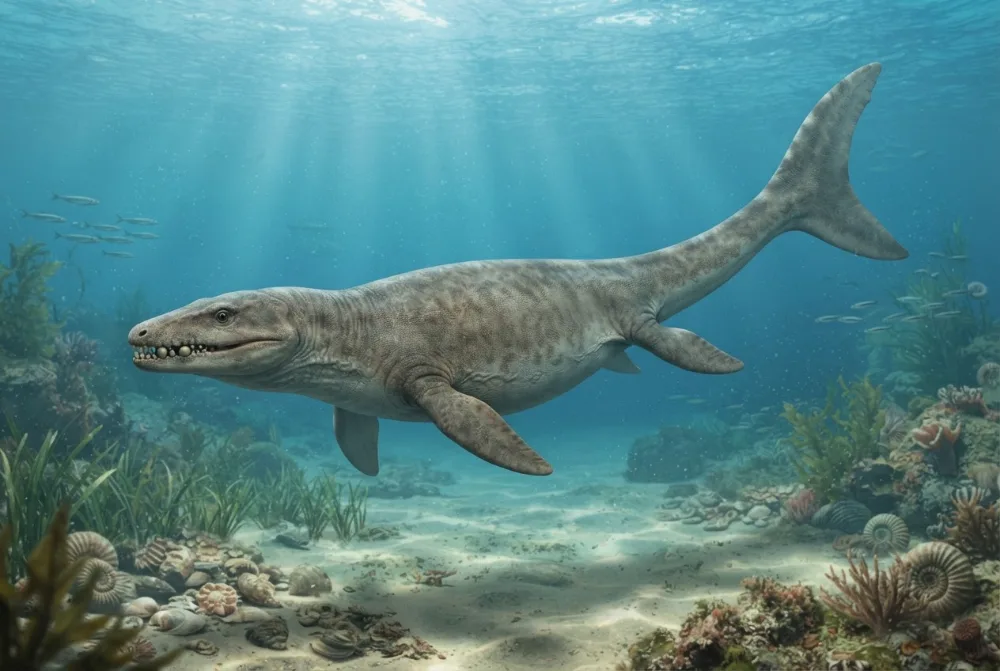
Carinodens was a small mosasaur, a marine lizard that lived in the late Cretaceous seas. It had round, blunt teeth like a set of nutcrackers for crushing hard-shelled animals. At only about 2 to 2.6 metres long, it was one of the tiniest mosasaurs ever.1
Rairarama rini?
Raiva hombe sei?
Raiva refu zvakadii?
 kureba seimbwa 2.5 kubva pamhino kusvika kumuswe🍌kureba semabhanana 14 akatevedzana🏊raigona kushambira kureba kwedziva guru rekushambira (50 m) mumasekonzi 6
Carinodens raiva hombe sei kana richienzaniswa NEWE?
Masvomhu chete mubrowser yako. Hapana chinochengetwa kana kutumirwa kupi zvako.
Raimhanya zvakadii?


Zvinonakidza
Carinodens was first thought to be a crocodile! A fossil jaw was originally named Bottosaurus belgicus and considered a crocodilian before being recognized as a mosasaur.1
Its teeth were very different from each other. The front teeth were round and curved, while the back teeth were flat and blade-like with a keel on each side.1
Scientists can tell what Carinodens ate by looking at tiny scratches on its teeth. The wear patterns show it munched on hard-shelled animals that lived on the seafloor.1
Carinodens is closely related to Globidens, another mosasaur with crushing teeth. Together they belong to a group called Globidensini.1
The name Carinodens means 'keel teeth' because its teeth have a ridge like the keel of a boat. It replaced the older name Compressidens, which was already used for a different animal.1
Mibvunzo inonyanya kubvunzwa nezve Carinodens
?What did Carinodens eat?
Carinodens ate hard-shelled animals like clams, oysters, and sea urchins. Its blunt teeth were perfect for crushing them, and scratches on the teeth show it munched on creatures that lived on the seafloor.12
?How big was Carinodens?
Carinodens was about 2 to 2.6 metres (6.6 to 8.5 feet) long. That makes it one of the smallest mosasaurs ever.1
?Where did Carinodens live?
Carinodens lived in the late Cretaceous seas, and its fossils have been found in Europe, North America, South America, and North Africa. Most skull fossils come from the Netherlands and Belgium.1
?Is Carinodens a dinosaur?
No, Carinodens is not a dinosaur. It is a marine lizard called a mosasaur that lived in the sea during the time of the dinosaurs.1
Zvevanyanzvi vemadhino
- Zita resainzi
- Carinodens
- Akaripa zita:
- Thurmond 19693
- Boka
- Mamosasauro
- Mhuri / boka
- Mosasauridae3
- Kurongwa kwemhuka
- Mosasauroidea3
- Zera rematombo
- makore mamiriyoni 72 kusvika 66 (Maastrichtian)3
- Mapoka ematombo
- Maastricht, Gramame, Bereza Beds3
- Nyika
- Netherlands, Morocco, Brazil, Ukraine, Russia, Belgium3
- Zvinyorwa zvemafosiri
- 16 mu The Paleobiology Database3
- Kuwanikwa
- The first fossils were found in Belgium and described by Louis Dollo in 1913 as Globidens fraasi. In 1969, J.T. Thurmond gave it the new name Carinodens because the old name was already taken.1
- Zvichiri kupokanwa
- Scientists are not sure how many species of Carinodens existed. Some think C. belgicus and C. fraasi might be the same species, while others believe they are different based on tooth shape.1
Kunobva chokwadi
- Carinodens (en.wikipedia.org)
- Feeding the Mechanical Mosasaur: what did Carinodens eat? | Netherlands Journal of Geosciences | Cambridge Core (cambridge.org)
- Carinodens in The Paleobiology Database (CC BY 4.0): zera, nzvimbo, mapoka ematombo, kurongwa kwemhuka.
Chokwadi chega chega papeji ino chine nhamba inoratidza kwachakabva. Kana takakanganisa chimwe chinhu, ruregerero, tiri vanoda madhino, kwete magazini yesainzi. Tiudze pa [email protected] tichazvigadzirisa.
 Rex ane nzara! Dino Wiki ipurojekiti yababa yemwanakomana wavo anoda madhino, mahara, pasina kushambadza uye pasina zvinokutevera. Vakuru vanogona kupa Rex chekudyadya kuti vabatsire kuchengeta saiti iri pamhepo.Fudza Rex
 Mosasaurus
 Prognathodon
 Tylosaurus
 Platecarpus
 Clidastes
 Globidens
 Tyrannosaurus
 Triceratops
 Velociraptor
 Spinosaurus
 Ankylosaurus
 Parasaurolophus