 Uri dhino ripi? Kwizi
 Hondo yemadhino
 Mujaho wemadhino
 Mitambo midiki yemadhino
 Arubhamu yemasitika
 Rondedzero dzeTOP dzemadhino
 Ndishamise!
Comptonatus
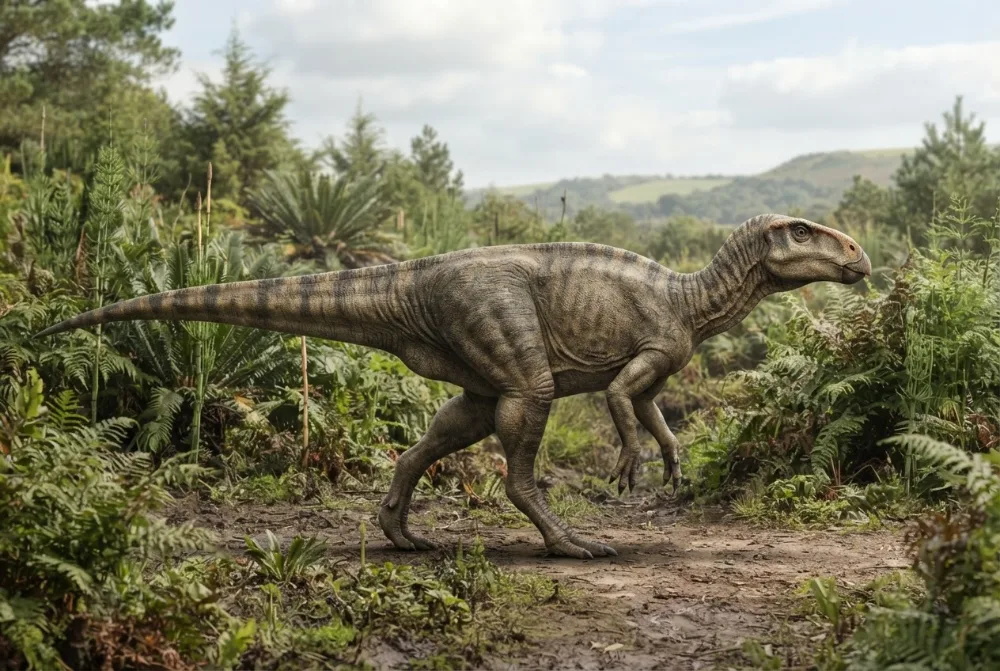
Comptonatus was a big, plant-eating dinosaur that lived on the Isle of Wight in England about 125 million years ago. It had a beak and walked on two legs, munching on ferns and cycads. Its skeleton is the most complete iguanodontian dinosaur found in the Wealden Group in a hundred years!61
Rairarama rini?
Raiva hombe sei?
Raiva refu zvakadii?
Raiva rakakwirira zvakadii?
fungidziro
Rairema zvakadii?
 kureba seimbwa 6 kubva pamhino kusvika kumuswe🍌kureba semabhanana 34 akatevedzana🍉kurema semanwiwa 210🧸kurema sevana vekireshi 55🎒kurema sevana vechikoro 33🐻❄️kurema semabere echando 2.5🏃raigona kumhanya mamita 100 mumasekonzi 11 (munhu anomhanya kupfuura vose anoda 9.6)
Comptonatus raiva hombe sei kana richienzaniswa NEWE?
Masvomhu chete mubrowser yako. Hapana chinochengetwa kana kutumirwa kupi zvako.
Raimhanya zvakadii?


Zvinonakidza
Comptonatus was named in 2024, making it one of the newest dinosaur species.6
Its name means 'the Compton thunderer' because it was found at Compton Bay and was a large animal.1
The skeleton was discovered in 2013 by fossil collector Nick Chase, and it took over a decade to study and name.1
Comptonatus had a straight lower jaw bone (dentary) and a very wide prepubic blade, which are unique features.1
It lived alongside other dinosaurs like Mantellisaurus, Brighstoneus, and Iguanodon in the same area.1
The fossils were found in a plant debris bed that also contained fish scales, crocodile teeth, and conifer trunks.1
Mibvunzo inonyanya kubvunzwa nezve Comptonatus
?How big was Comptonatus?
About 4 metres (13 feet) long. That is roughly the length of a small car.4
?What did Comptonatus eat?
It was a herbivore, eating plants like conifers, cycads and tree-ferns that grew in its environment.4
?Did Comptonatus have any special features?
Yes, it had a straight lower jaw bone and a very wide prepubic blade. It also had large thumb spikes that may have been used for defense or fighting.41
?When did Comptonatus live?
It lived during the early Cretaceous period, about 125 million years ago.5
Zvevanyanzvi vemadhino
- Zita resainzi
- Comptonatus
- Akaripa zita:
- Lockwood et al. 20246
- Boka
- Vanodya miriwo vane miromo
- Mhuri / boka
- Hadrosauriformes6
- Kurongwa kwemhuka
- Ornithischia > Ornithopoda > Iguanodontia6
- Zera rematombo
- makore mamiriyoni 126 kusvika 121 (Barremian)6
- Mapoka ematombo
- Wessex6
- Nyika
- United Kingdom6
- Zvinyorwa zvemafosiri
- 1 mu The Paleobiology Database6
- Kuwanikwa
- Comptonatus chasei was discovered in 2013 by Nick Chase on National Trust land at Compton Bay, Isle of Wight. It was named by Jeremy Lockwood, David Martill, and Susannah Maidment in 2024.1
- Zvichiri kupokanwa
- Scientists are still debating exactly how Comptonatus is related to other iguanodontian dinosaurs, because it has a mix of features seen in different groups.1
Kunobva chokwadi
- Full article: Comptonatus chasei, a new iguanodontian dinosaur from the Lower Cretaceous Wessex Formation of the Isle of Wight, southern England (tandfonline.com)
- Comptonatus chasei | Dinosaur Database by DinoAnimals.com (dinoanimals.com)
- The most complete UK dinosaur in a century found on the Isle of Wight | Natural History Museum (nhm.ac.uk)
- Comptonatus, an iguanodontian dinosaur from the Isle of Wight - DinoWight (dinowight.org.uk)
- Comptonatus (en.wikipedia.org)
- Comptonatus in The Paleobiology Database (CC BY 4.0): zera, nzvimbo, mapoka ematombo, kurongwa kwemhuka.
Chokwadi chega chega papeji ino chine nhamba inoratidza kwachakabva. Kana takakanganisa chimwe chinhu, ruregerero, tiri vanoda madhino, kwete magazini yesainzi. Tiudze pa [email protected] tichazvigadzirisa.
 Rex ane nzara! Dino Wiki ipurojekiti yababa yemwanakomana wavo anoda madhino, mahara, pasina kushambadza uye pasina zvinokutevera. Vakuru vanogona kupa Rex chekudyadya kuti vabatsire kuchengeta saiti iri pamhepo.Fudza Rex
 Iguanodon
 Tenontosaurus
 Thescelosaurus
 Zalmoxes
 Camptosaurus
 Rhabdodon
 Stegosaurus
 Archaeopteryx
 Giganotosaurus
 Microraptor
 Deinonychus
 Baryonyx