 Uri dhino ripi? Kwizi
 Hondo yemadhino
 Mujaho wemadhino
 Mitambo midiki yemadhino
 Arubhamu yemasitika
 Rondedzero dzeTOP dzemadhino
 Ndishamise!
Edmontonia
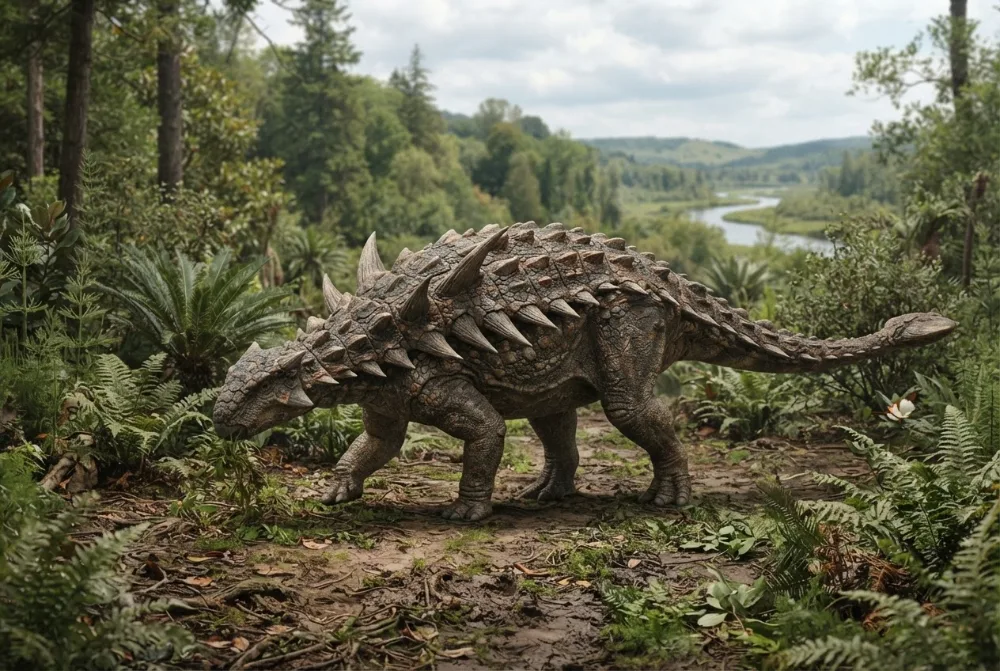
Edmontonia was a tank-like dinosaur covered in bony plates and sharp spikes. It walked on four legs and munched on low-growing plants. This nodosaurid dinosaur lived in western North America near the end of the Age of Dinosaurs.1
Rairarama rini?
Raiva hombe sei?
Raiva refu zvakadii?
Raiva rakakwirira zvakadii?
Rairema zvakadii?

 kureba seimbwa 7 kubva pamhino kusvika kumuswe🍌kureba semabhanana 37 akatevedzanakurema seimbwa 150🍉kurema semanwiwa 600🎒kurema semakirasi 4 akazara evana vechikoro🐻❄️kurema semabere echando 7🏃raigona kumhanya mamita 100 mumasekonzi 28 (munhu anomhanya kupfuura vose anoda 9.6)
Edmontonia raiva hombe sei kana richienzaniswa NEWE?
Masvomhu chete mubrowser yako. Hapana chinochengetwa kana kutumirwa kupi zvako.
Raimhanya zvakadii?


Zvinonakidza
Edmontonia had four huge spikes sticking out from each shoulder, the largest of any nodosaurid. These spikes could have been used to fight other Edmontonia or to stab attacking predators.1
Its back and head were covered with small, oval bony plates that had a ridge down the middle. Its neck and shoulders were protected by three half-rings made of large keeled plates.1
Edmontonia lived alongside many other giant plant-eaters like the duck-billed dinosaurs Gryposaurus and Corythosaurus, and the horned dinosaurs Centrosaurus and Chasmosaurus.1
The only large predators that lived with Edmontonia were the tyrannosaurids Gorgosaurus and Daspletosaurus.1
Scientists think Edmontonia might have crouched down to protect its soft belly from predators, making it hard for a predator to flip it over.1
One species of Edmontonia, E. rugosidens, lived about 76.5 to 75 million years ago. The other species, E. longiceps, lived about 72 million years ago.1
Mibvunzo inonyanya kubvunzwa nezve Edmontonia
?How big was Edmontonia?
Edmontonia was about 6 to 6.6 metres (20 to 22 ft) long and weighed around 3 tonnes (about 6,600 lb).15
?What did Edmontonia eat?
Edmontonia was an herbivore that ate low-growing plants like ferns and cycads. Its small teeth and weak jaws suggest it processed food differently than modern mammals.156
?Did Edmontonia have armor?
Yes, Edmontonia was covered in small oval bony plates on its back and head, and had three half-rings of large keeled plates protecting its neck and shoulders. It also had four huge spikes on each shoulder.15
?How fast could Edmontonia run?
No source gives a speed for Edmontonia, but its heavy armor and short, thick legs suggest it was slow-moving, like a tank.15
?Was Edmontonia bigger than T. rex?
No, Edmontonia was much smaller. T. rex could be over 12 metres (40 ft) long, while Edmontonia was only about 6 to 6.6 metres (20 to 22 ft) long.1
?When did Edmontonia live?
Edmontonia lived during the Late Cretaceous Period, about 76.5 to 68 million years ago.16
?Where was Edmontonia found?
Edmontonia fossils have been found in western North America, especially in Alberta, Canada, and also in the Talkeetna Mountains near Denali National Park in Alaska.15
?Could Edmontonia swim?
No source says Edmontonia could swim. Its heavy armor and short legs probably kept it on land.1
Mubvisi wengano
Ngano: Edmontonia could swing its tail like a club to defend itself.
Chokwadi: Edmontonia was a nodosaurid, not an ankylosaurid. Nodosaurids did not have a tail club. Instead, Edmontonia relied on its shoulder spikes and body armor for protection.1
Zvevanyanzvi vemadhino
- Zita resainzi
- Edmontonia
- Akaripa zita:
- Sternberg 19287
- Boka
- Madhino ane nhovo
- Mhuri / boka
- Nodosauridae7
- Kurongwa kwemhuka
- Ornithischia > Ankylosauria > Nodosauridae > Thyreophora7
- Zera rematombo
- makore mamiriyoni 84 kusvika 66 (Campanian / Maastrichtian)7
- Mapoka ematombo
- Judith River, Aguja, Hell Creek7
- Nyika
- Amerika, Kanada7
- Zvinyorwa zvemafosiri
- 16 mu The Paleobiology Database7
- Rinonziwo
- Chassternbergia, Denversaurus (mazita ekare zvino oonekwa semhuka imwe chete)7
- Kuwanikwa
- Edmontonia was named by Charles M. Sternberg in 1928. The first fossils, including a skull and much of the skeleton, were found near Morrin, Alberta, Canada in 1924 by George Paterson.1
- Zvichiri kupokanwa
- Scientists still debate whether the fossils called Denversaurus and Chassternbergia are really separate dinosaurs or just different species of Edmontonia.2
Kunobva chokwadi
- Edmontonia (en.wikipedia.org)
- PBDB Taxon (paleobiodb.org)
- EDMONTONIA - DinoChecker dinosaur archive (dinochecker.com)
- Edmontonia | Dino Tail - Dinosaur Encyclopedia (dino-tail.com)
- Edmontonia - Denali National Park & Preserve (U.S. National Park Service) (nps.gov)
- enchantedlearning.com (enchantedlearning.com)
- Edmontonia in The Paleobiology Database (CC BY 4.0): zera, nzvimbo, mapoka ematombo, kurongwa kwemhuka.
Chokwadi chega chega papeji ino chine nhamba inoratidza kwachakabva. Kana takakanganisa chimwe chinhu, ruregerero, tiri vanoda madhino, kwete magazini yesainzi. Tiudze pa [email protected] tichazvigadzirisa.
 Rex ane nzara! Dino Wiki ipurojekiti yababa yemwanakomana wavo anoda madhino, mahara, pasina kushambadza uye pasina zvinokutevera. Vakuru vanogona kupa Rex chekudyadya kuti vabatsire kuchengeta saiti iri pamhepo.Fudza Rex
 Ankylosaurus
 Sauropelta
 Pinacosaurus
 Scutellosaurus
 Struthiosaurus
 Euoplocephalus
 Tyrannosaurus
 Triceratops
 Velociraptor
 Spinosaurus
 Parasaurolophus
 Pteranodon