 Uri dhino ripi? Kwizi
 Hondo yemadhino
 Mujaho wemadhino
 Mitambo midiki yemadhino
 Arubhamu yemasitika
 Rondedzero dzeTOP dzemadhino
 Ndishamise!
Euoplocephalus
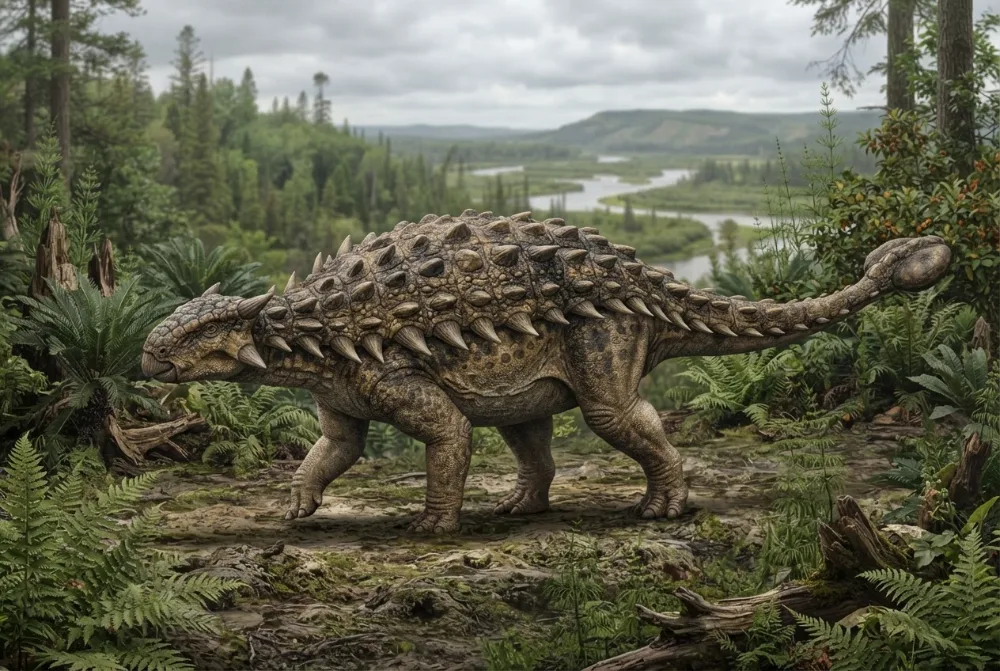
Euoplocephalus was a tank-like dinosaur covered in bony armour and a heavy club on its tail. It lived in what is now Canada and the USA during the Late Cretaceous period. This slow-moving plant-eater could defend itself from big predators like Albertosaurus.1
Rairarama rini?
Raiva hombe sei?
Raiva refu zvakadii?
Raiva rakakwirira zvakadii?
Rairema zvakadii?

 kureba seimbwa 5 kubva pamhino kusvika kumuswe🍌kureba semabhanana 29 akatevedzanakurema seimbwa 100🍉kurema semanwiwa 400🎒kurema semakirasi 2.5 akazara evana vechikoro🐻❄️kurema semabere echando 4🏃raigona kumhanya mamita 100 mumasekonzi 24 (munhu anomhanya kupfuura vose anoda 9.6)
Euoplocephalus raiva hombe sei kana richienzaniswa NEWE?
Masvomhu chete mubrowser yako. Hapana chinochengetwa kana kutumirwa kupi zvako.
Raimhanya zvakadii?


Zvinonakidza
Euoplocephalus had a heavy club at the end of its tail made of bone. It could swing this club to fight off predators.1
Its body was covered in rows of bony plates called scutes. It also had two bone rings around its neck for extra protection.1
Euoplocephalus was about 5.3 metres (17 feet) long and weighed around 2 metric tons (2.2 short tons). That is as heavy as a small car.1
The first fossil was found in 1897 in Alberta, Canada. It was originally named Stereocephalus, but that name was already used for an insect, so it was changed to Euoplocephalus in 1910.1
Euoplocephalus lived between about 76 and 75 million years ago, during the late Campanian stage of the Late Cretaceous.1
Scientists once thought many different ankylosaur fossils all belonged to Euoplocephalus, but now they know most are separate species like Scolosaurus and Platypelta.1
Euoplocephalus had a short, drooping snout and a horny beak to bite off plants. Its teeth show it could chew tough plant material.1
Mibvunzo inonyanya kubvunzwa nezve Euoplocephalus
?How big was Euoplocephalus?
About 5.3 metres (17 feet) long and 2 tonnes (2.2 short tons) in weight, as heavy as a small car.13
?What did Euoplocephalus eat?
It was a plant-eater. It used a horny beak to bite off plants and had small teeth to chew tough plant material.13
?Did Euoplocephalus have a tail club?
Yes, it had a heavy bony club at the end of its tail. It could swing this club to defend itself from predators like Albertosaurus.13
?Was Euoplocephalus bigger than Ankylosaurus?
No, Ankylosaurus was bigger. Among ankylosaurids, Euoplocephalus was exceeded in size only by Ankylosaurus and perhaps Tarchia and Cedarpelta.1
?When did Euoplocephalus live?
It lived during the Late Cretaceous period, about 76 to 70 million years ago.3
?Where was Euoplocephalus found?
Fossils have been found in Canada (Alberta) and the United States (Montana).13
?How fast could Euoplocephalus run?
Nobody knows for sure, but it was a slow-moving dinosaur with short, sturdy legs built for walking, not running.1
?What does the name Euoplocephalus mean?
It means 'well-armed head', from Greek words for 'well', 'armed', and 'head'.1
Mubvisi wengano
Ngano: Euoplocephalus could roll into a ball like an armadillo to protect itself.
Chokwadi: Euoplocephalus could not roll into a ball. It relied on its armour and tail club for defence.1
Zvevanyanzvi vemadhino
- Zita resainzi
- Euoplocephalus
- Akaripa zita:
- Lambe 19104
- Boka
- Madhino ane nhovo
- Mhuri / boka
- Ankylosauridae4
- Kurongwa kwemhuka
- Ornithischia > Ankylosauria > Ankylosauridae > Thyreophora4
- Zera rematombo
- makore mamiriyoni 84 kusvika 66 (Campanian / Maastrichtian)4
- Mapoka ematombo
- Dinosaur Park, Judith River, Two Medicine4
- Nyika
- Kanada, Amerika, China4
- Zvinyorwa zvemafosiri
- 18 mu The Paleobiology Database4
- Rinonziwo
- Stereocephalus (mazita ekare zvino oonekwa semhuka imwe chete)4
- Kuwanikwa
- Canadian paleontologist Lawrence Morris Lambe discovered the first Euoplocephalus fossil on 18 August 1897 in what is now Dinosaur Provincial Park, Alberta. He named it Stereocephalus in 1902, but changed the name to Euoplocephalus in 1910 because the old name was already taken.1
- Zvichiri kupokanwa
- Scientists still debate exactly which fossils belong to Euoplocephalus and which belong to other closely related ankylosaurs like Anodontosaurus and Scolosaurus.1
Kunobva chokwadi
- Euoplocephalus (en.wikipedia.org)
- PBDB Taxon (paleobiodb.org)
- Euoplocephalus | Natural History Museum (nhm.ac.uk)
- Euoplocephalus in The Paleobiology Database (CC BY 4.0): zera, nzvimbo, mapoka ematombo, kurongwa kwemhuka.
Chokwadi chega chega papeji ino chine nhamba inoratidza kwachakabva. Kana takakanganisa chimwe chinhu, ruregerero, tiri vanoda madhino, kwete magazini yesainzi. Tiudze pa [email protected] tichazvigadzirisa.
 Rex ane nzara! Dino Wiki ipurojekiti yababa yemwanakomana wavo anoda madhino, mahara, pasina kushambadza uye pasina zvinokutevera. Vakuru vanogona kupa Rex chekudyadya kuti vabatsire kuchengeta saiti iri pamhepo.Fudza Rex
 Ankylosaurus
 Sauropelta
 Pinacosaurus
 Scutellosaurus
 Struthiosaurus
 Edmontonia
 Tyrannosaurus
 Triceratops
 Velociraptor
 Spinosaurus
 Parasaurolophus
 Pteranodon