 Uri dhino ripi? Kwizi
 Hondo yemadhino
 Mujaho wemadhino
 Mitambo midiki yemadhino
 Arubhamu yemasitika
 Rondedzero dzeTOP dzemadhino
 Ndishamise!
Eonatator
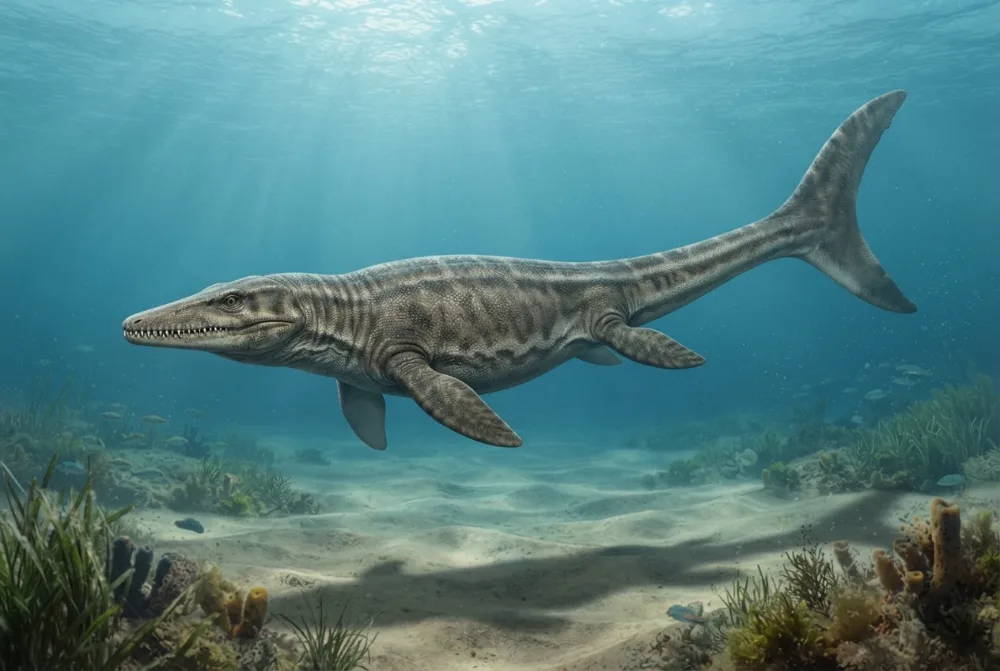
Eonatator was a small, speedy marine lizard that swam in warm Cretaceous seas. It was an early relative of the giant mosasaurs, but much smaller and more agile.1
Rairarama rini?
Raiva hombe sei?
Raiva refu zvakadii?
 kureba seimbwa 2.5 kubva pamhino kusvika kumuswe🍌kureba semabhanana 14 akatevedzana🏊raigona kushambira kureba kwedziva guru rekushambira (50 m) mumasekonzi 6
Eonatator raiva hombe sei kana richienzaniswa NEWE?
Masvomhu chete mubrowser yako. Hapana chinochengetwa kana kutumirwa kupi zvako.
Raimhanya zvakadii?


Zvinonakidza
Eonatator's tail made up about 40% of its head and body length, helping it swim fast.1
The first Eonatator fossil was found in the Niobrara Chalk of Kansas in 1918 by Charles Hazelius Sternberg and his son Levi.1
Eonatator was originally thought to be a species of Clidastes or Halisaurus, but scientists gave it its own genus in 2005.1
A second species, Eonatator coellensis, was discovered in Colombia and named after the town of Coello.1
Eonatator had a smooth, triangular bone on top of its skull with a round hole called the parietal foramen.1
Like many mosasaurs, Eonatator gave birth to live young instead of laying eggs.2
Mibvunzo inonyanya kubvunzwa nezve Eonatator
?How big was Eonatator?
Eonatator was a small mosasaur. The type specimen of Eonatator sternbergii was about 2.6 metres (8.5 ft) long, and a specimen of Eonatator coellensis measured 2.8 metres (9.2 ft) long as preserved, missing part of its tail.1
?What did Eonatator eat?
The sources do not say exactly what Eonatator ate. As a small marine lizard and a mosasaur, it likely ate fish and other small sea creatures, but no specific diet is given.1
?Where was Eonatator found?
Eonatator fossils have been found in North America (Kansas and Alabama), Colombia, and Sweden. The first fossil was discovered in the Niobrara Chalk of Kansas in 1918.1
?Is Eonatator a dinosaur?
No, Eonatator is not a dinosaur. It is a marine lizard belonging to the mosasaur family.1
Zvevanyanzvi vemadhino
- Zita resainzi
- Eonatator
- Akaripa zita:
- Bardet et al. 20053
- Boka
- Mamosasauro
- Mhuri / boka
- Mosasauridae3
- Kurongwa kwemhuka
- Mosasauroidea3
- Zera rematombo
- makore mamiriyoni 86 kusvika 72 (Santonian / Campanian)3
- Mapoka ematombo
- Niobrara, Nivel de Lutitas y Arenas3
- Nyika
- Sweden, Amerika, Kolombiya3
- Zvinyorwa zvemafosiri
- 9 mu The Paleobiology Database3
- Kuwanikwa
- The first Eonatator fossil, a nearly complete skeleton, was found in Kansas in 1918 by Charles Hazelius Sternberg and his son Levi. It was named Eonatator sternbergii by Nathalie Bardet and colleagues in 2005.1
- Zvichiri kupokanwa
- Some scientists think Eonatator might actually belong to the genus Halisaurus, but most now accept it as a separate genus.1
Kunobva chokwadi
- Eonatator (en.wikipedia.org)
- PBDB Taxon (paleobiodb.org)
- Eonatator in The Paleobiology Database (CC BY 4.0): zera, nzvimbo, mapoka ematombo, kurongwa kwemhuka.
Chokwadi chega chega papeji ino chine nhamba inoratidza kwachakabva. Kana takakanganisa chimwe chinhu, ruregerero, tiri vanoda madhino, kwete magazini yesainzi. Tiudze pa [email protected] tichazvigadzirisa.
 Rex ane nzara! Dino Wiki ipurojekiti yababa yemwanakomana wavo anoda madhino, mahara, pasina kushambadza uye pasina zvinokutevera. Vakuru vanogona kupa Rex chekudyadya kuti vabatsire kuchengeta saiti iri pamhepo.Fudza Rex
 Mosasaurus
 Prognathodon
 Tylosaurus
 Platecarpus
 Clidastes
 Globidens
 Tyrannosaurus
 Triceratops
 Velociraptor
 Spinosaurus
 Ankylosaurus
 Parasaurolophus