 Uri dhino ripi? Kwizi
 Hondo yemadhino
 Mujaho wemadhino
 Mitambo midiki yemadhino
 Arubhamu yemasitika
 Rondedzero dzeTOP dzemadhino
 Ndishamise!
Eremiasaurus
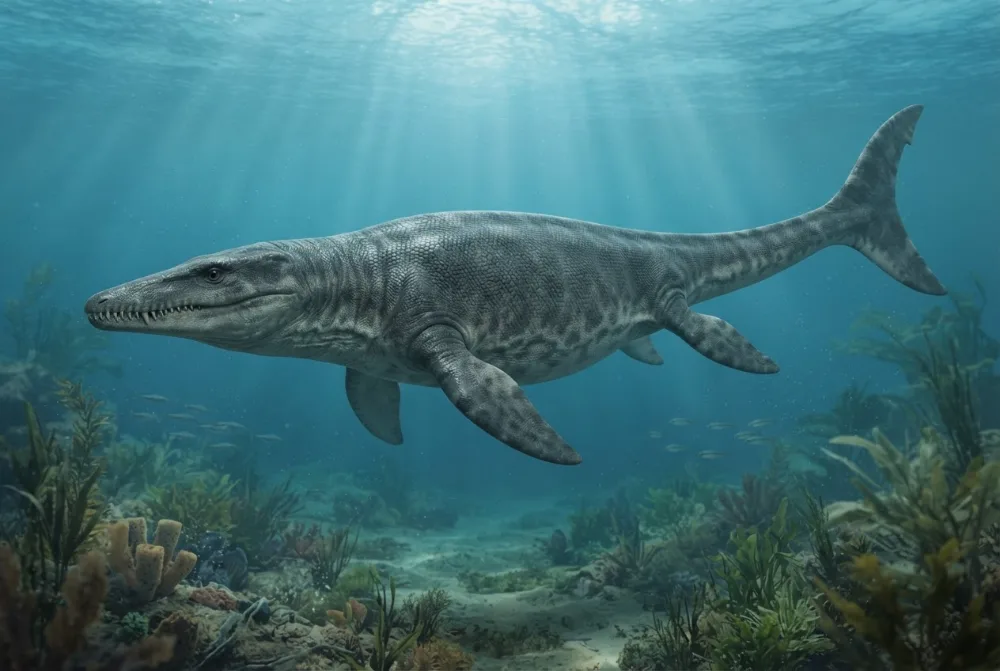
Eremiasaurus was a marine reptile that swam in warm seas during the time of the dinosaurs. It was a mosasaur, not a dinosaur, and it lived about 70 to 66 million years ago. This predator had a streamlined body and a long tail to help it zoom through the water.1
Rairarama rini?
Raiva hombe sei?
Raiva refu zvakadii?
 kureba seimbwa 5 kubva pamhino kusvika kumuswe🍌kureba semabhanana 28 akatevedzana🏊raigona kushambira kureba kwedziva guru rekushambira (50 m) mumasekonzi 4.7
Eremiasaurus raiva hombe sei kana richienzaniswa NEWE?
Masvomhu chete mubrowser yako. Hapana chinochengetwa kana kutumirwa kupi zvako.
Raimhanya zvakadii?


Zvinonakidza
Eremiasaurus had very different-shaped teeth in its jaws, a rare trait for mosasaurs. Its species name heterodontus means 'different teeth'.1
The first fossils of Eremiasaurus were teeth found in Morocco in 1952. Scientists at first thought they belonged to another mosasaur called Mosasaurus.1
Eremiasaurus was named in 2012 from two nearly complete skeletons. One skeleton was found by a scientist, and the other came from a commercial fossil collector.1
This mosasaur had a tail that bent downward and a fan of bones in its tail, which helped it swim fast. Its tail was similar to the fast-swimming mosasaur Plotosaurus.1
Eremiasaurus lived in a warm, shallow sea called the Mediterranean Tethys. Many other mosasaurs and fish lived there too.1
Scientists think Eremiasaurus ate different food than its larger mosasaur neighbors, like Thalassotitan and Prognathodon. This helped them avoid competing for the same prey.1
Mibvunzo inonyanya kubvunzwa nezve Eremiasaurus
?How big was Eremiasaurus?
About 5 metres (16 feet) long, which is a bit shorter than a minibus.1
?What did Eremiasaurus eat?
Nobody knows for sure. Its different-shaped teeth make it unclear what prey it ate.1
?Could Eremiasaurus swim fast?
Yes. Its tail bones suggest it was a high-speed pursuit predator, built for fast swimming.1
?Where did Eremiasaurus live?
It lived in a warm, shallow sea called the Mediterranean Tethys, near what is now Morocco.1
Zvevanyanzvi vemadhino
- Zita resainzi
- Eremiasaurus
- Akaripa zita:
- LeBlanc et al. 20122
- Boka
- Mamosasauro
- Mhuri / boka
- Mosasauridae2
- Kurongwa kwemhuka
- Mosasauroidea2
- Zera rematombo
- makore mamiriyoni 72 kusvika 66 (Maastrichtian)2
- Mapoka ematombo
- Phosphates, Couche III2
- Nyika
- Morocco2
- Zvinyorwa zvemafosiri
- 7 mu The Paleobiology Database2
- Kuwanikwa
- Eremiasaurus was named in 2012 by paleontologists Aaron LeBlanc, Michael Caldwell, and Nathalie Bardet. They described it from two skeletons found in the phosphate mines of the Ouled Abdoun Basin in Morocco.1
- Zvichiri kupokanwa
- Scientists are not sure exactly what Eremiasaurus ate. Its unusual teeth make it hard to guess its favorite prey.1
Kunobva chokwadi
- Eremiasaurus (en.wikipedia.org)
- Eremiasaurus in The Paleobiology Database (CC BY 4.0): zera, nzvimbo, mapoka ematombo, kurongwa kwemhuka.
Chokwadi chega chega papeji ino chine nhamba inoratidza kwachakabva. Kana takakanganisa chimwe chinhu, ruregerero, tiri vanoda madhino, kwete magazini yesainzi. Tiudze pa [email protected] tichazvigadzirisa.
 Rex ane nzara! Dino Wiki ipurojekiti yababa yemwanakomana wavo anoda madhino, mahara, pasina kushambadza uye pasina zvinokutevera. Vakuru vanogona kupa Rex chekudyadya kuti vabatsire kuchengeta saiti iri pamhepo.Fudza Rex
 Mosasaurus
 Prognathodon
 Tylosaurus
 Platecarpus
 Clidastes
 Globidens
 Tyrannosaurus
 Triceratops
 Velociraptor
 Spinosaurus
 Ankylosaurus
 Parasaurolophus