 Uri dhino ripi? Kwizi
 Hondo yemadhino
 Mujaho wemadhino
 Mitambo midiki yemadhino
 Arubhamu yemasitika
 Rondedzero dzeTOP dzemadhino
 Ndishamise!
Rairarama rini?

Raiva hombe sei?
Raiva refu zvakadii?
Rairema zvakadii?
 kureba sekatsi dzemumba 4 kubva pamhino kusvika kumuswe🍌kureba semabhanana 11 akatevedzana🍌kurema semabhanana 76🏃raigona kumhanya mamita 100 mumasekonzi 16 (munhu anomhanya kupfuura vose anoda 9.6)
Graciliceratops raiva hombe sei kana richienzaniswa NEWE?
Masvomhu chete mubrowser yako. Hapana chinochengetwa kana kutumirwa kupi zvako.
Raimhanya zvakadii?


Zvinonakidza
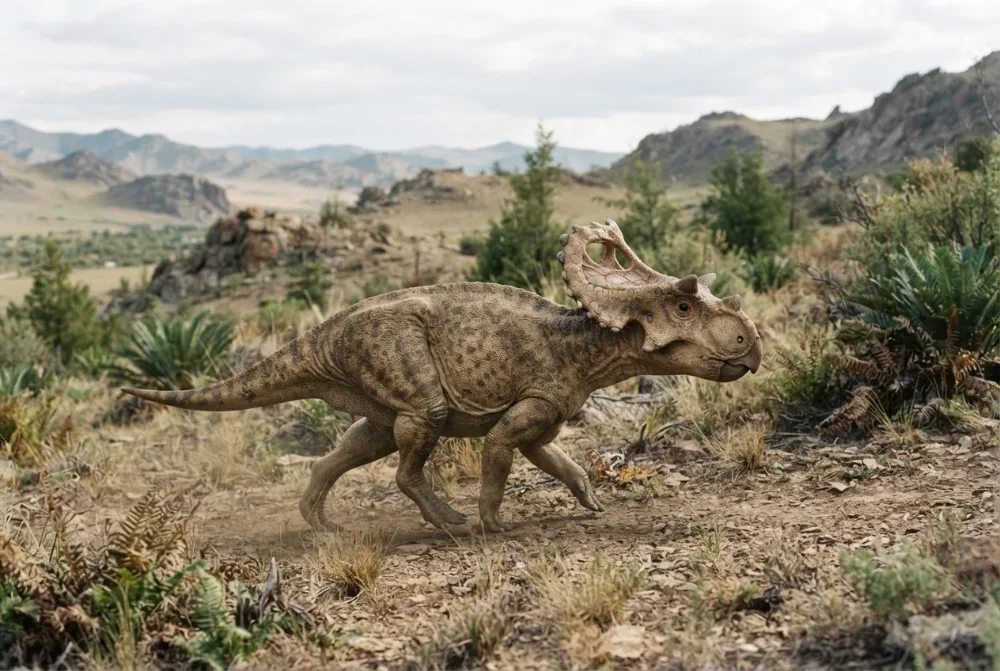
Graciliceratops had a very slender, fragile frill with large holes in it, held up by thin struts of bone.2
The only fossil found is a young animal, because its sacral vertebrae were not yet fused together.2
Its shin bone (tibia) was longer than its thigh bone (femur), which helped it run fast.2
Graciliceratops lived alongside the large dromaeosaurid Achillobator and the tyrannosauroid Khankhuuluu.2
It was a basal neoceratopsian, an early relative of later horned dinosaurs like Protoceratops.2
Mibvunzo inonyanya kubvunzwa nezve Graciliceratops
?How big was Graciliceratops?
The only known fossil is a young animal about 60 cm long and weighing 2.27 to 9.1 kg. Scientists think a full-grown adult would have been around 2 m long, about the size of a small pony.21
?What did Graciliceratops eat?
It was an herbivore, eating plants. Fossil fruits found in the same area show that flowering plants grew there, so it probably ate those.21
Zvevanyanzvi vemadhino
- Zita resainzi
- Graciliceratops
- Akaripa zita:
- Sereno 20003
- Boka
- Madhino ane nyanga
- Mhuri / boka
- Neoceratopsia3
- Kurongwa kwemhuka
- Ornithischia > Ceratopsia3
- Zera rematombo
- makore mamiriyoni 100 kusvika 84 (Cenomanian / Santonian)3
- Mapoka ematombo
- Baynshire3
- Nyika
- Mongolia3
- Zvinyorwa zvemafosiri
- 1 mu The Paleobiology Database3
- Kuwanikwa
- The first fossil was found in 1971 by a Polish-Mongolian expedition. It was originally called Microceratops, but Paul Sereno gave it the new name Graciliceratops in 2000.21
- Zvichiri kupokanwa
- Scientists are not sure exactly how big a fully grown Graciliceratops was, because the only known skeleton is from a juvenile.2
Kunobva chokwadi
- Graciliceratops | Natural History Museum (nhm.ac.uk)
- Graciliceratops (en.wikipedia.org)
- Graciliceratops in The Paleobiology Database (CC BY 4.0): zera, nzvimbo, mapoka ematombo, kurongwa kwemhuka.
Chokwadi chega chega papeji ino chine nhamba inoratidza kwachakabva. Kana takakanganisa chimwe chinhu, ruregerero, tiri vanoda madhino, kwete magazini yesainzi. Tiudze pa [email protected] tichazvigadzirisa.
 Rex ane nzara! Dino Wiki ipurojekiti yababa yemwanakomana wavo anoda madhino, mahara, pasina kushambadza uye pasina zvinokutevera. Vakuru vanogona kupa Rex chekudyadya kuti vabatsire kuchengeta saiti iri pamhepo.Fudza Rex
 Triceratops
 Protoceratops
 Ojoceratops
 Tatankaceratops
 Psittacosaurus
 Centrosaurus
 Tyrannosaurus
 Velociraptor
 Spinosaurus
 Ankylosaurus
 Parasaurolophus
 Pteranodon